


Total shoulder arthroplasty (TSA) is an increasingly common procedure for shoulder OA, rotator cuff arthropathy, and inflammatory arthritis of the shoulder. Unlike hip and knee replacement, where the operated limb is the weight-bearing one and the cane is used on the opposite side, shoulder replacement creates a different challenge: the operated shoulder is potentially the shoulder that must hold the cane.
The Post-TSA Cane Problem
After total shoulder replacement, the operated arm is typically placed in a sling and protected from loading for 4-6 weeks, depending on the surgical technique (anatomic TSA vs. reverse shoulder arthroplasty). During this protected phase:
- The operated arm cannot be used to hold and load a walking cane
- The contralateral (non-operated) arm must therefore be used for the cane if a cane is needed for lower limb walking support
- If the patient also has lower limb pathology (hip OA, knee OA, neurological walking impairment) requiring cane support on a specific side, there may be a conflict between the lower limb cane side recommendation and the shoulder restriction
When Both Lower Limb and Shoulder Conditions Require a Cane
Consider a patient with right shoulder arthroplasty (operated arm: right) and left knee OA (cane for knee OA: right hand). Conflict:
- The knee OA guideline says the cane should be in the right hand (contralateral to left knee)
- The shoulder arthroplasty says the right arm cannot load the cane for 4-6 weeks
- Solution: during the shoulder protected phase, use the left hand for the cane if needed, accepting that this is not biomechanically optimal for the knee but safer overall. After shoulder rehabilitation allows right arm loading, reassess and reintroduce optimal cane side
Reverse Shoulder Arthroplasty vs. Anatomic TSA
- Anatomic TSA: Preserves or replaces the rotator cuff-dependent anatomy. Protected period typically 4-6 weeks for the operated arm
- Reverse total shoulder arthroplasty (RTSA): Used when the rotator cuff is irreparably damaged. The mechanics rely on the deltoid muscle rather than the rotator cuff. Recovery may allow earlier loading of the arm through the cane but this varies -- surgical guidance is essential
Post-TSA Cane Load Progression
| Phase | Operated Arm Status | Cane Recommendation |
|---|---|---|
| Weeks 0-4 (protected) | Sling, no loading | Use contralateral arm only; accept non-optimal side |
| Weeks 4-8 (early active) | Light active motion permitted | Confirm with surgeon before loading cane through operated arm |
| Weeks 8-12 (progressive loading) | Increasing active use | Reintroduce optimal cane side if surgeon clearance obtained |
| Post-12 weeks (consolidation) | Near-normal function | Resume standard cane use on optimal side |
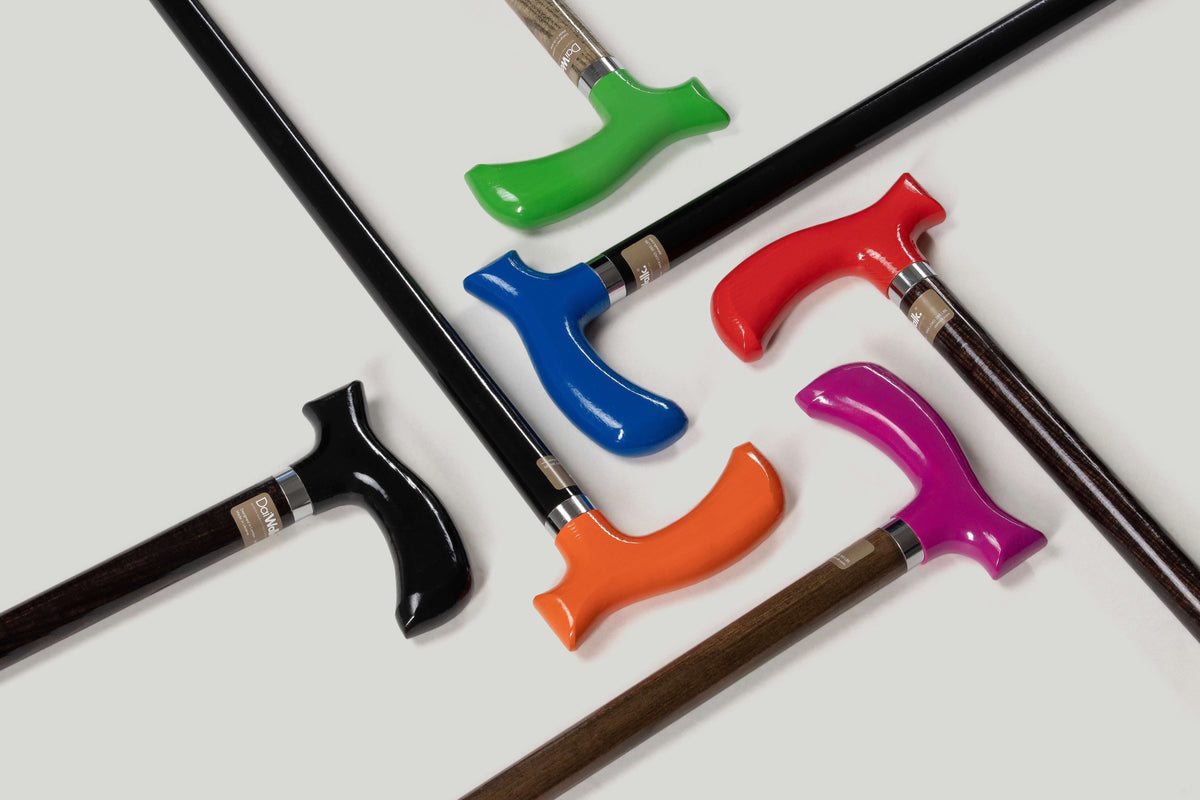
Explore the DaiWalk cane collection. Related: Walking Cane for Tennis Elbow | Walking Cane for Knee Replacement


