


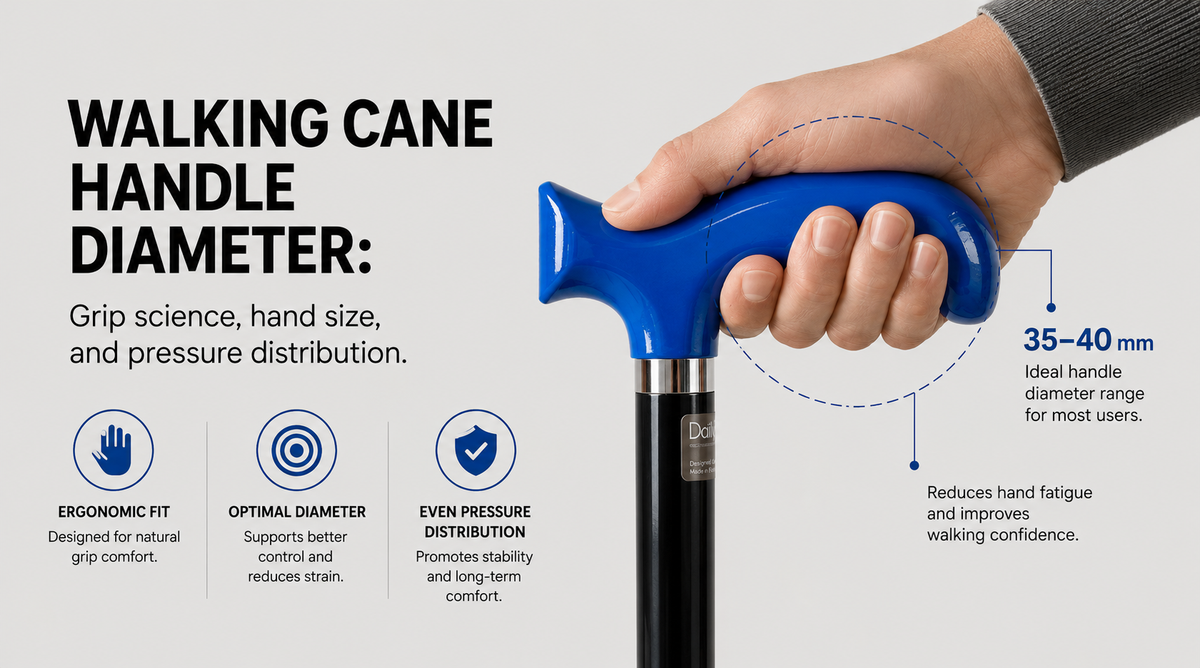
Handle diameter is one of the most consistently overlooked dimensions in walking cane selection. The focus on height, material, and tip tends to dominate cane discussions -- but the point where hand meets handle is where the entire load transfer happens, and the mechanics of that interface determine both comfort over time and the risk of secondary injury from sustained use.
The Physics of Grip and Handle Diameter
When a person grips a cane handle, they are applying a clamping force with the fingers and palm. The pressure exerted on the hand depends on two variables:
- Force applied: The load being transferred through the cane (varies with body weight, gait pattern, and degree of offloading)
- Contact area: The surface area over which that force is distributed
Pressure = Force / Area
A handle with greater contact area for the same gripping force produces lower pressure on any given point of the hand. This is directly analogous to why a wide chair armrest is more comfortable than a narrow one under the same elbow load.

DaiWalk Handle Pressure Data
DaiWalk internal testing comparing the Anatomic Grip to a standard T-bar handle produced the following peak pressure measurements during cane-assisted walking (typical offloading condition):
- Anatomic Grip: Peak pressure 1.9 N/cm2
- T-bar handle: Peak pressure 4.2 N/cm2
This 2.2x difference in peak pressure has cumulative significance over sustained use. A person using a cane for 4 hours of daily walking over multiple years is exposing the palm and fingers to that pressure differential on every step. In patients with hand conditions (arthritis, carpal tunnel, trigger finger, Dupuytren contracture, rheumatoid hand changes), this matters particularly.
Hand Size and Handle Diameter Matching
The optimal handle diameter for a given user depends on hand size. The principle is that the handle should allow the thumb and index finger to close around it with slight contact, not a white-knuckle clamp. A handle that is too narrow forces the user to grip tightly to maintain control, increasing intrinsic muscle fatigue. A handle that is too wide prevents the fingers from wrapping around to stabilise it properly.
General guidance:
- Small hands (women, adolescents, small-frame adults): Thinner diameter handles provide better contact and control. A handle designed for average male hands may be too wide for a small female hand
- Large hands: A thin handle creates high pressure on fewer contact points. A larger-diameter ergonomic handle provides better load distribution
- Arthritic hands: Grip strength is reduced; a handle that requires less active clamping (wider, with surface texture) is preferable
Surface Texture and Friction at the Handle
Handle material affects the required grip force independently of diameter:
- A smooth, hard handle (polished metal, smooth plastic) requires more active grip force to prevent slipping -- the user must clamp harder to maintain friction
- A handle with surface texture or a materials grip element reduces the clamping force needed because friction supplements it
- Wood handles have inherent surface texture and thermal properties (neutral to warm feel vs. the cold of metal in winter) that affect grip comfort during extended use
Handle Pressure Comparison
| Handle Type | Peak Pressure | Contact Area | Best For |
|---|---|---|---|
| DaiWalk Anatomic Grip | 1.9 N/cm2 | Large (anatomic shape) | Daily use, arthritic hands, extended walking |
| Standard T-bar | 4.2 N/cm2 | Small (narrow bar) | Short-term use, seated balance |
| Crook (hook) handle | Variable | Medium | Hanging, occasional use |
| Fritz/offset handle | Medium | Medium-large | Common rehab standard |
View the DaiWalk cane collection with the Anatomic Grip design or use the cane length calculator. Related: Walking Cane Handle Materials


