


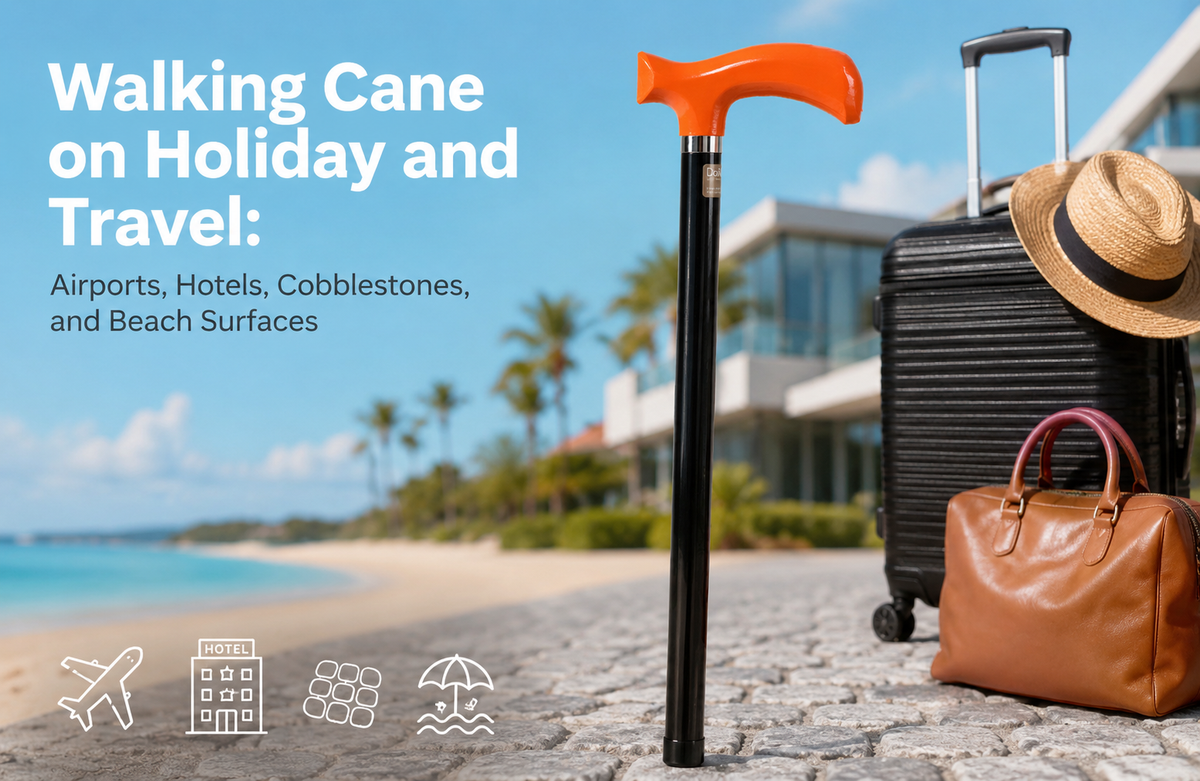
Travel with a walking cane introduces a set of surface and environment challenges that do not exist in the person's everyday home or work environment. The cane that performs reliably on office carpet and city pavement is tested by airport polished marble, cobblestone streets, beach boardwalks, poolside tiles, and uneven terrain in historic cities. Understanding these surface demands -- and preparing for them -- is the difference between a successful holiday and a near-miss fall in an unfamiliar environment.
Airport Surfaces: Polished Floors and Moving Walkways
Airport terminals present two specific challenges:
- Polished marble or composite flooring: High-gloss airport floors are among the highest-slip-risk surfaces for a cane tip. A worn or generic ferrule on polished marble behaves like ice -- the tip skids rather than grips. The DaiWalk Steady Tip on polished surface maintains 0.57 COF (oak cane) and 3mm lateral slip; a generic ferrule on wet polished marble may drop to 0.29 COF
- Moving walkways and escalators: Moving walkways require the cane to be repositioned with each moving-walkway step -- the walkway moves but the cane tip must be picked up and placed deliberately. On escalators, the cane should be held parallel to the body and not placed across the escalator step. Step onto escalators leading with the non-cane side, step off leading with the cane side
Cobblestones: The Most Challenging Surface
Historic city cobblestones (particularly sett cobblestones in European cities) are the most demanding surface for cane tip stability. The inter-stone gaps, rounded stone surfaces, and irregular heights create:
- Unpredictable tip placement (the tip may land in a gap or on a rounded stone face)
- Higher lateral slip risk (the tip can skid across the stone surface)
- Higher vibration transmission to the hand and arm
A cane tip designed for soft compliance (45 Shore A outer durometer on the DaiWalk Steady Tip) provides better cobblestone contact than a hard rubber ferrule, because the soft outer material deforms around irregular surfaces rather than pivoting on them.
Beach and Sand: A Different Challenge
Dry sand provides good tip grip (tip sinks in and locks) but creates a different problem: extracting the tip from deep sand on each step requires additional arm effort. Wet compacted sand is more manageable. Beach boardwalks and decking may have gaps that trap a narrow tip. A wider-base tip (6.2 cm² contact) is less likely to sink excessively in soft sand and less likely to catch in boardwalk gaps.
Travel Surface Conditions and Cane Tip Performance
| Surface | Key Risk | Tip Recommendation |
|---|---|---|
| Airport polished marble (dry) | High slip -- low COF | High-grip wide-contact tip; check tip wear before travel |
| Airport polished marble (wet/mopped) | Very high slip | Wide contact, maximum-grip tip essential |
| Cobblestones (dry) | Irregular placement, rounded stone surface | Soft-compound outer (45 Shore A) for surface conformance |
| Cobblestones (wet) | Very high slip on wet stone | Maximum-grip tip; slow pace; increased caution |
| Beach sand (dry) | Tip sinking, extraction effort | Wide-base tip (reduces sinking); pace accordingly |
| Poolside tile (wet) | Extremely slippery | Maximum-grip wide tip; do not use narrow ferrule |
Inspect cane tip wear before any trip -- a worn tip on home surfaces may be dangerously inadequate on holiday surfaces. The DaiWalk interchangeable tip system allows replacement before travel. Explore interchangeable tips and the tip size finder. Browse DaiWalk walking canes.


