


Walking canes are rarely discussed in a paediatric context -- mobility aids for children are more commonly associated with crutches, walkers, or wheelchairs. But a subset of children and adolescents do use single-point walking canes, and the considerations differ substantially from adult cane use in both technical and psychosocial dimensions.
When Children Use Walking Canes
The conditions that lead a child or adolescent to use a walking cane include:
- Juvenile idiopathic arthritis (JIA): Hip, knee, or ankle involvement causing pain and load-bearing difficulty -- may be intermittent, requiring cane only during flares
- Perthes disease (Legg-Calve-Perthes): Osteonecrosis of the femoral head in young children (typically ages 4-10) causing hip pain and limping; cane may supplement other treatments
- Slipped capital femoral epiphysis (SCFE): Hip condition in adolescents causing sudden or gradual hip pain and altered gait
- Post-surgical rehabilitation: After orthopaedic surgery (limb-length procedures, hip surgery, knee surgery) -- temporary cane use during recovery
- Cerebral palsy, mild forms: Some children with mild CP who ambulate independently may benefit from a cane for safety on uneven terrain or in community settings
- Hypermobility: Joint hypermobility causing repeated sprains, fall risk, and pain at the ankle and knee
- Post-fracture: Recovery phase after lower limb fracture
Technical Considerations for Paediatric Cane Use
Standard adult canes are not appropriate for children:
- Length: Adult cane minimum lengths are too long for smaller children. Cane length must be calculated from the wrist crease height of the individual child using the same formula as adults, but the resulting measurement may be 45-65cm for a child versus 75-95cm for an adult
- Handle diameter: Adult handles are designed for adult hand size. A child with small hands cannot grip a full-size ergonomic handle appropriately -- the grip geometry changes when the hand is too small for the handle
- Weight: A cane that is heavy relative to the child ability to control it will create fatigue and erratic placement. Lighter materials are preferable in paediatric use
Psychosocial Factors: School and Peers
The psychosocial dimension of cane use in children and adolescents is significant and often underweighted in clinical decision-making:
- Peer visibility: A walking cane is immediately visible to classmates and may attract attention, questions, or bullying. The child perception of how the cane looks matters enormously for adherence -- a cane the child finds embarrassing will be abandoned regardless of medical necessity
- Teacher and school staff awareness: Teachers need to understand when the child requires the cane and when it may be safely set aside during low-risk activities
- Physical education: Involvement of the physiotherapist and school PE staff in defining when cane use is needed vs. when the child can participate without it is important for both safety and social normalisation
- Teenager autonomy: Adolescents have strong views on their own bodies and appearance. Forcing cane use on a reluctant teenager is counterproductive -- the conversation should involve the teenager as the primary decision-maker alongside the clinical team

Appearance Adherence in Paediatric and Adolescent Users
The DaiWalk customer follow-up data (n=112, 18 months) found that 87% of users with high appearance satisfaction maintained daily cane use, versus 26% with low appearance satisfaction. While this data comes from an adult population, the principle is even more acute in adolescents where peer comparison is a dominant social force.
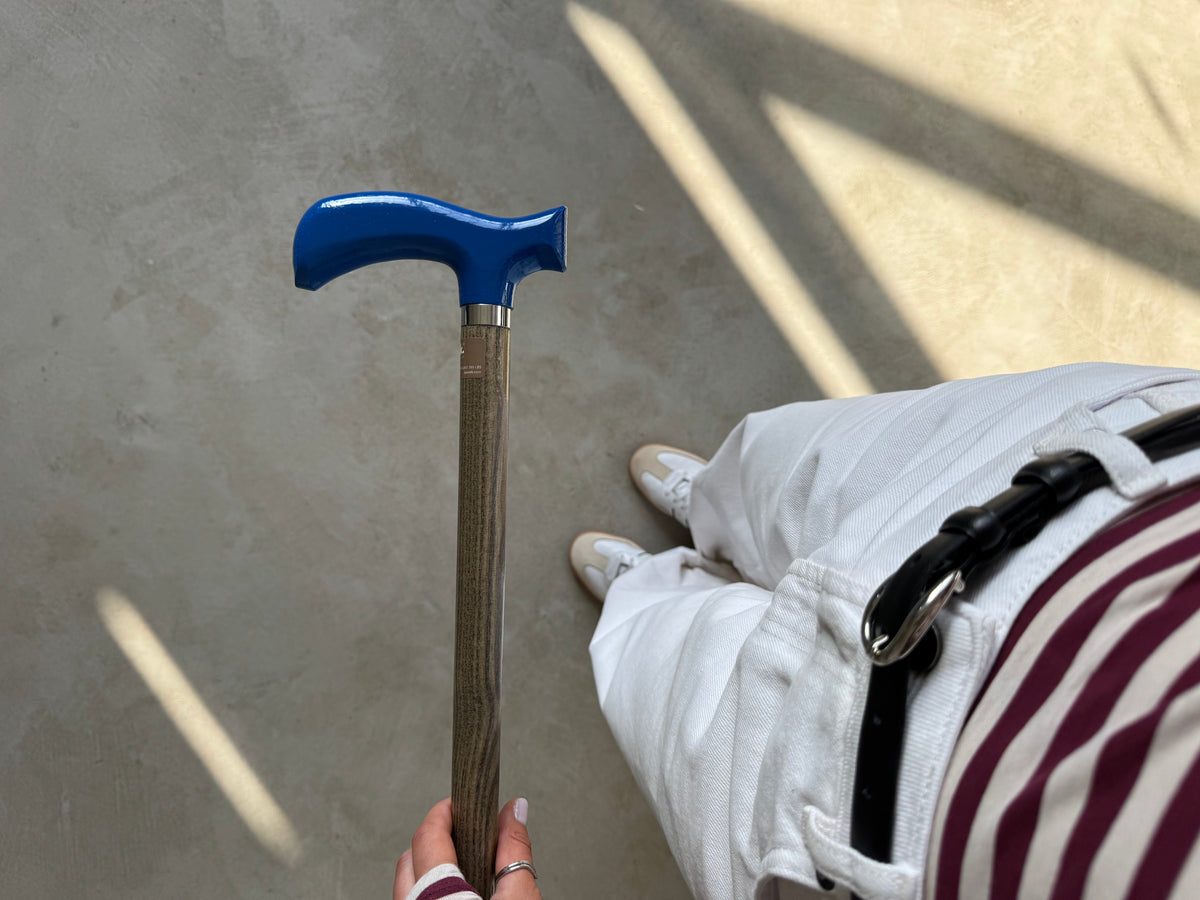
For adolescent users particularly, a cane that looks like a medical device will be abandoned faster than one that reads as a design object or lifestyle item. This is not vanity -- it is a realistic assessment of adherence psychology in this age group.
Paediatric Cane Use: Summary
| Age group | Key consideration | Priority |
|---|---|---|
| Young children (4-10) | Correct sizing (length, handle), parent-supervised technique | Technical fit + supervised use |
| Pre-teens (10-13) | Peer visibility, school integration | Social normalisation + correct fit |
| Teenagers (13-18) | Adolescent autonomy, appearance acceptance | Design acceptance + clinical buy-in |
Explore the DaiWalk cane collection or use the cane length calculator to find the correct length for any age. Related: Walking Cane and Self-Image: Appearance and Adherence


