


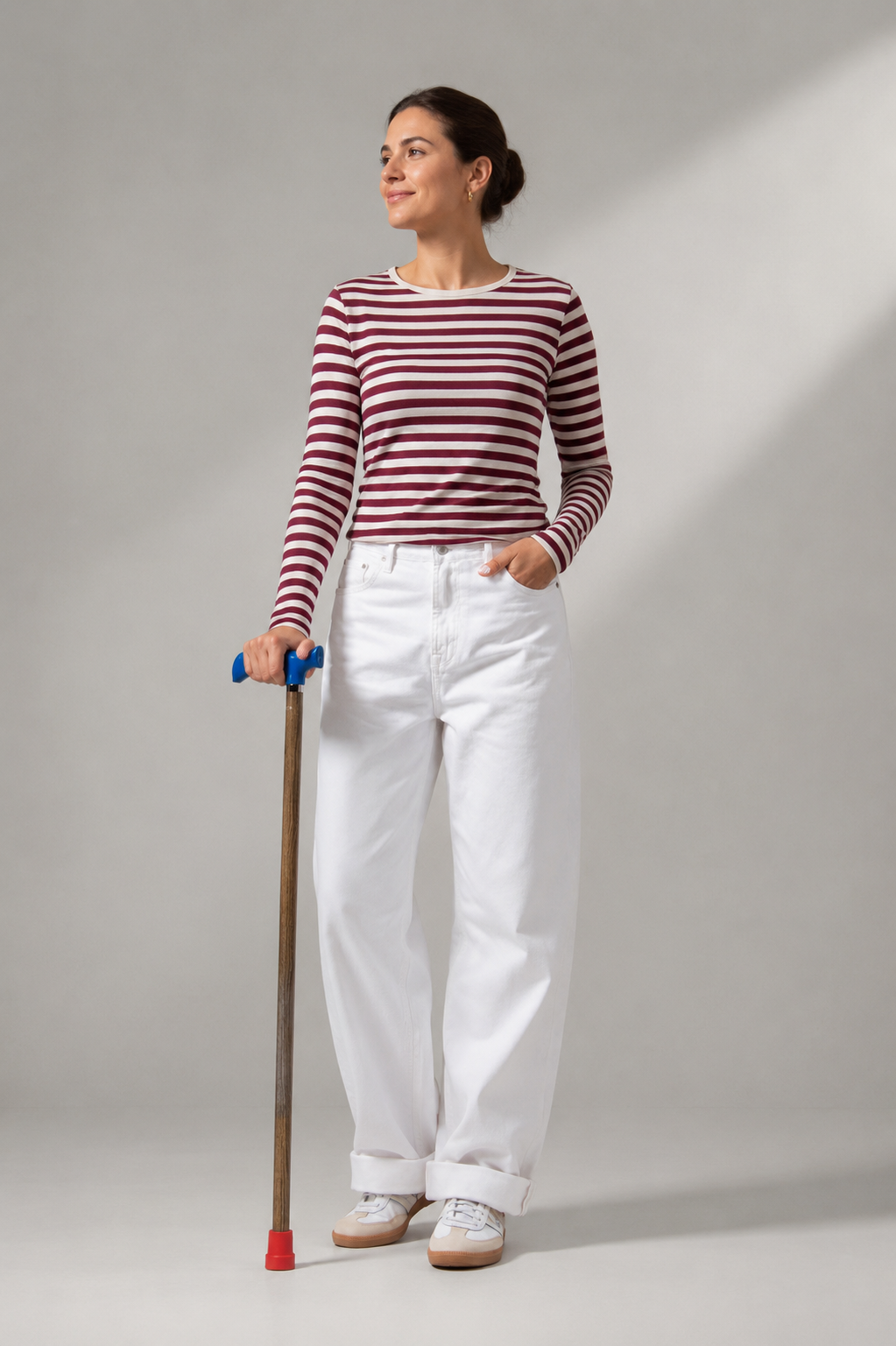
There is a particular moment that almost every woman who eventually buys a walking cane can describe in detail. She is standing in the aisle of a pharmacy or a medical supply store, looking at a row of aluminum canes in gray, black, and "cane blue," and thinking: I am not ready for this.
It isn't that she doesn't need the support. It's that nothing in front of her looks like something she would choose to be seen with. The canes are functional. They are also, unmistakably, hospital equipment — designed for a supply closet, not for a woman who still dresses with intention, still notices good design, and still wants to walk into a room rather than shuffle into it.
This guide exists for that moment. It's written for women 45 to 80 who are active, independent, and unwilling to trade their sense of style for a piece of medical equipment. It covers everything you need to know to choose a walking cane that supports your body and reflects who you are: the materials that matter, the handle shapes that actually reduce strain, the height and fit details that most guides skip, the mistakes that lead to buyer's remorse, and the questions real women ask before they buy.
You won't find invented statistics or vague claims here — just the kind of practical, experience-based guidance you'd want from a knowledgeable friend who happens to know a great deal about canes.
Table of Contents
- Why "Stylish" and "Supportive" Are Not Opposites
- What Actually Makes a Walking Cane Stylish
- The Complete Buying Guide
- Material Comparison: Wood vs. Aluminum vs. Carbon Fiber vs. Acrylic
- The Style Guide: Finding a Cane That Matches You
- How to Choose the Right Cane: A Step-by-Step Framework
- Common Mistakes Women Make When Buying a Cane
- Expert Tips for Comfort, Confidence, and Longevity
- Caring for a Wooden Cane So It Lasts for Years
- What to Expect When You Start Using a Cane
- Frequently Asked Questions
- Final Thoughts: Choosing a Cane, Not Settling for One
Why "Stylish" and "Supportive" Are Not Opposites
Medical device design and fashion design have historically answered to different masters. A hospital-issue cane is engineered around cost, liability, and manufacturing efficiency — hence the ubiquitous aluminum shaft, rubber tip, and molded plastic handle you'll find in nearly every drugstore. It works. It is also completely indifferent to how it looks in your hand, with your coat, or in a photograph at your granddaughter's wedding.
But a walking cane is not only a mobility aid. It's an accessory you'll have in your hand — visibly, publicly — for hours at a time, in restaurants, at church, on walks with friends, in every photo taken of you for as long as you use it. Treating it purely as equipment ignores that reality.
The good news is that supportive and beautiful are not in tension. A well-made wooden cane with a properly shaped handle can offer better ergonomics than a generic aluminum one, not worse. The idea that style requires a trade-off in function is largely a myth created by an industry that, until relatively recently, didn't design for style at all. Premium cane makers have simply applied the same rigor furniture makers and shoemakers apply to comfort and durability — the difference is that canes have historically been treated as an afterthought.

What Actually Makes a Walking Cane Stylish
"Stylish" gets used loosely, so it's worth being precise. Across the canes that actually look elegant in person — not just in a product photo — a handful of design elements do the real work.
1. Solid Wood, Not Painted Metal
Wood has grain, depth, and warmth that no painted or anodized metal finish can replicate. Even a high-quality metal cane, viewed up close, reads as a manufactured object. A hand-finished wooden shaft — walnut, cherry, oak, or maple — reads as a crafted one, closer to a fine pen or a piece of furniture than to a piece of equipment.
2. Proportion and Taper
Many mass-market canes are a straight, uniform tube from handle to tip. Well-designed wooden canes are often gently tapered, narrower near the base than at the grip, which changes how the cane sits visually in the hand and against the body. This is a subtle detail, but it's the difference between a cane that looks like plumbing and one that looks considered.
3. Handle Shape and Finish
The handle is the focal point of the entire object — it's the part closest to your hand and your eye. Derby handles (contoured, ergonomic, slightly angled), fritz handles (rounded, compact), and crook handles (the classic curved "umbrella" shape) all carry different visual associations, from modern-minimal to classic-heritage. A handle finished in polished wood, leather wrap, or horn reads entirely differently than one finished in ribbed rubber.
4. Hardware Details
Brass or nickel collars, engraved bands, and the transition point between handle and shaft are small details that most buyers don't consciously notice but that separate an elegant cane from a generic one. This is the same principle that applies to a well-made bag or a good pair of shoes — the hardware is where quality shows.
5. Color and Finish Consistency
A stylish cane doesn't look like it's trying too hard. Rich, natural wood tones — chestnut, espresso, honey, black walnut — tend to read as more sophisticated than bright colors or busy patterns, though patterned and colorful canes absolutely have their place for women who want to make a bolder statement. The key is intentionality: a cane that looks chosen, not settled for.
The Complete Buying Guide
Before comparing materials and styles, it helps to understand the practical criteria that should shape your decision. These are the factors that determine whether a cane genuinely helps you, regardless of how it looks.
Weight-Bearing Needs
Canes generally fall into two categories: those meant for light, occasional balance support, and those meant to bear real weight during recovery or for consistent daily stability. If you need to offload significant weight from a hip, knee, or ankle, that changes what you should prioritize — a sturdier shaft, a more substantial handle, and possibly a wider base (such as a quad tip) matter more than they would for a cane used mainly for confidence and balance on uneven ground.
If you're recovering from surgery or a specific injury, it's worth a conversation with your physical therapist or physician about how much weight-bearing support you actually need — that clinical guidance should inform your choice, even if the cane you ultimately buy is chosen for how it looks and feels.
Height and Fit
This is the single most consequential — and most commonly ignored — factor in cane comfort. A cane that's the wrong height doesn't just feel awkward; it can cause you to lean, which strains your back, shoulder, and wrist, and defeats the purpose of using a cane at all.
The standard measurement method: stand up straight in the shoes you wear most often, let your arms hang naturally at your sides, and measure from the crease of your wrist down to the floor. That measurement is a good starting point for cane height. When you hold the cane with your arm relaxed at your side, your elbow should bend at roughly a 15–20 degree angle — not locked straight, not sharply bent.
Many premium wooden canes are sold slightly long and designed to be cut to size, which is actually an advantage: it means the cane is fitted to you rather than you adjusting to a fixed length. If a cane is adjustable (telescoping), check that the locking mechanism is sturdy and doesn't rattle or slip under weight.
Handle Comfort for Extended Use
If you'll be holding the cane for long stretches — a full day of travel, a wedding, a museum visit — handle shape matters enormously. A round handle concentrates pressure into a small area of your palm, which can become uncomfortable or even painful over hours. A contoured or ergonomic handle (like a derby or palm-grip design) distributes pressure across a broader surface and tends to feel dramatically better by the end of a long day.
If you have arthritis in your hands, this consideration moves from "nice to have" to essential. Look specifically for handles described as ergonomic or contoured, and avoid narrow, perfectly cylindrical grips.
Tip Type and Traction
The rubber tip at the base of the cane is easy to overlook but does real work. A wider, concave rubber tip generally offers better traction and stability than a narrow, flat one. If you'll use your cane outdoors, on stairs, or in wet weather, prioritize a tip designed for grip — and plan to replace it periodically, since rubber wears down and loses traction over time, often before the rest of the cane shows any wear at all.
Weight of the Cane Itself
Counterintuitively, a slightly heavier cane can feel more stable and easier to control than an ultra-lightweight one, because it has more presence in the hand and less tendency to wobble. That said, if you have limited hand or wrist strength, an extremely heavy cane will tire you out faster. Solid hardwood canes typically fall in a comfortable middle range — heavier than aluminum, lighter than they look.
Where and How You'll Use It
A cane for daily neighborhood walks has different demands than one for air travel, formal events, or hiking on uneven trails. If you travel frequently, a high-quality folding cane may be worth considering, though folding mechanisms typically add some weight and reduce the sense of solidity that a one-piece shaft provides. If you mainly need a cane for occasional outings — dinners, events, travel — a beautiful fixed-shaft cane may serve you better than a folding one built primarily for portability.
Material Comparison: Wood vs. Aluminum vs. Carbon Fiber vs. Acrylic
| Material | Look & Feel | Weight | Durability | Comfort in Hand | Best For |
|---|---|---|---|---|---|
| Solid Hardwood (walnut, oak, cherry, maple) | Warm, rich, classic — reads as furniture, not equipment | Moderate | Excellent; can last decades with care | Warms to body temperature; substantial, grounded feel | Women who want elegance, daily use, longevity |
| Aluminum | Clinical, uniform; often painted or anodized | Very light | Good, but prone to dents and scuffs | Cold to the touch; can feel flimsy | Budget use, travel, temporary recovery |
| Carbon Fiber | Modern, technical, sometimes with visible weave pattern | Extremely light | Very durable but can be brittle under lateral stress | Neutral; not warm like wood | Active users prioritizing minimal weight |
| Acrylic / Lucite | Glossy, glamorous, jewel-toned or clear options available | Moderate to heavy | Can crack or chip if dropped on hard surfaces | Smooth but can feel slippery when hands perspire | Statement pieces for special occasions |

Why Wood Is the Foundation of Truly Elegant Canes
Wood earns its place at the top of this comparison for reasons beyond aesthetics, though the aesthetic case is strong on its own.
Thermal comfort. Wood is a poor conductor of heat, which means it quickly warms to your hand's temperature and stays comfortable to hold. Metal and acrylic stay cool or even cold, especially outdoors — a small but constant reminder, every time you pick it up, that you're holding equipment rather than an object you chose.
Natural shock absorption. Wood has a small amount of natural flex that metal and rigid carbon fiber lack. Over thousands of steps, that flex translates into slightly less jarring feedback through your wrist and forearm — a difference most people feel without being able to articulate why one cane feels "nicer" to walk with than another.
Character that improves with age. Hardwood develops a richer patina over years of handling and oiling, the same way a good leather bag or wooden furniture does. An aluminum cane looks the same, or worse, the day you retire it as the day you bought it. A well-cared-for wooden cane often looks better after years of use.
Repairability. A scratched or dented aluminum shaft is difficult to restore. A wooden shaft can be sanded, re-oiled, and refinished, extending its life well beyond its original condition.
The trade-off is weight and price — a solid hardwood cane will typically weigh and cost more than an aluminum one, and it's not the ideal choice if your top priority is the absolute lightest possible object or the lowest possible price point. For most women prioritizing daily comfort, appearance, and longevity, though, the trade-off favors wood clearly.
The Style Guide: Finding a Cane That Matches You
Just as no single dress or handbag style suits every woman, no single cane style is universally "the stylish one." Below are the major style categories and who each genuinely suits — not as marketing categories, but as a practical way to think about your own wardrobe and habits.
The Classic Derby
Look: A gently contoured, slightly angled wooden handle, usually in a rich walnut or espresso finish, often with a brass or nickel collar. Best for: Women who want a cane that looks at home with tailored coats, structured handbags, and a generally polished, timeless wardrobe. This is the style least likely to ever look dated.
The Curved Crook Handle
Look: The traditional umbrella-style curve, evoking classic English walking sticks. Best for: Women drawn to heritage style — think tweed, brogues, and a slightly literary aesthetic. This shape also allows the cane to hang from a forearm or the back of a chair, which some women find genuinely useful in restaurants and at events.
The Modern Minimalist
Look: Clean lines, a straight or barely-tapered shaft, minimal ornamentation, often in a darker matte finish. Best for: Women whose personal style leans contemporary — simple silhouettes, neutral palettes, architectural jewelry. This style photographs beautifully and tends to disappear into an outfit rather than dominate it.
The Statement Cane
Look: Bold inlays, colored acrylic accents, decorative bands, or an unusual handle material like polished horn or engraved metal. Best for: Women who see the cane as an accessory in the fullest sense — the walking-cane equivalent of a statement bracelet. If your personal style already includes bold color or striking accessories, a purely "safe" cane will actually look out of place next to the rest of your wardrobe.
The Convertible or Folding Elegant Cane
Look: Designed to fold or collapse into two or three sections while still using premium wood or wood-composite materials, often with a fabric or leather carrying pouch. Best for: Women who travel often and want a cane elegant enough to bring to dinner but practical enough to pack in a suitcase or tote.
How to Choose the Right Cane: A Step-by-Step Framework
If you take nothing else from this guide, use this sequence. It moves from the non-negotiables (fit and function) to the personal (style), because a beautiful cane that's the wrong height or too heavy for your hand will end up in a closet.
Step 1 — Get your correct height. Measure wrist-to-floor as described above, in the shoes you wear most. If you're between sizes or unsure, choose a cane that can be professionally cut to length rather than guessing.
Step 2 — Identify your real support need. Occasional balance support and consistent weight-bearing support call for different shaft sturdiness and, sometimes, different tip designs. If you're unsure, ask your doctor or physical therapist — this is the one step in the process worth outside professional input.
Step 3 — Choose your handle shape based on hand comfort, not appearance alone. If you have any arthritis, joint pain, or grip weakness, physically test or closely research the handle shape before finalizing your choice. A gorgeous handle you can't hold comfortably for ten minutes isn't the right cane, no matter how it looks.
Step 4 — Choose your material with your actual daily use in mind. If you're walking with the cane for hours most days, prioritize wood's comfort and durability. If you're flying several times a year and need to pack it, prioritize a well-made folding design.
Step 5 — Choose the wood tone and handle style that matches your existing wardrobe. Pull up a few outfits you wear most — coats, favorite bags, the shoes you reach for. Rich espresso and walnut tones pair with nearly everything; lighter woods like maple or ash suit softer, lighter palettes.
Step 6 — Check the tip and hardware quality before purchase. These are the parts that wear fastest and are most often overlooked. A cane with a premium shaft and a cheap, thin rubber tip will disappoint you within months.
Step 7 — Buy from a maker who stands behind fit. A cane is a fit-dependent object, much like shoes. Look for a brand that offers height adjustment, cutting-to-length, or an easy exchange if the fit isn't right the first time.
Common Mistakes Women Make When Buying a Cane
Mistake 1: Buying based on the height they "think" they need. Guessing height, or buying based on a family member's cane, is the most common source of discomfort. Always measure.
Mistake 2: Prioritizing looks over handle comfort. A beautiful handle that digs into the palm after twenty minutes will end up unused. Comfort and beauty are both achievable — don't settle for only one.
Mistake 3: Choosing the lightest possible cane by default. Ultra-light isn't always ultra-stable. For many women, a moderate-weight wooden cane provides more confidence and control than the lightest option on the shelf.
Mistake 4: Ignoring the tip until it's worn smooth. A worn tip is a real fall risk, especially on wet or tiled floors. It's an inexpensive part that's easy to check and replace, and easy to forget.
Mistake 5: Treating the cane purchase as purely medical. Buying the first "practical" option out of a sense that a cane shouldn't be a personal or stylistic decision often leads to a cane that sits unused in a closet — which defeats the entire purpose. If you'll actually use it, you have to actually like it.
Mistake 6: Not considering how the cane will be carried when not in use. Restaurants, cars, coat check — think through where the cane goes when you sit down. A curved handle that hooks over a chair or table edge solves a real, everyday annoyance that a straight-handled cane doesn't.
Mistake 7: Overlooking the collar and hardware. Cheaply made metal fittings can loosen, rattle, or corrode over time, undermining an otherwise beautiful cane. It's worth inspecting — or asking about — the quality of these small components before you buy.
Expert Tips for Comfort, Confidence, and Longevity
-
Use your cane on the correct side. Generally, hold the cane in the hand opposite your weaker or more painful side, and move the cane forward at the same time as your weaker leg. This is a small technique detail that dramatically improves how naturally you walk.
-
Oil a wooden cane occasionally. A light application of furniture-grade oil every few months keeps the wood from drying out and preserves both its appearance and its structural integrity, much like caring for a wooden cutting board or fine furniture.
-
Rotate the rubber tip periodically if it wears unevenly, and replace it well before it becomes smooth or thin. Most hardware and medical supply stores carry universal replacement tips.
-
Let the cane's weight do some of the work. Many first-time users grip too tightly, which causes hand fatigue. A well-fitted cane with a comfortable handle needs a relaxed grip, not a white-knuckled one.
-
Practice at home before using it in public the first time. A short amount of practice on stairs, thresholds, and uneven surfaces at home builds real confidence and muscle memory before you need it in a more public or high-stakes setting.
-
Think of it the way you think of eyeglasses. Reading glasses went, within a generation, from something people hid to something people wear as an intentional style choice — often collecting several pairs. A cane can occupy the same place in your wardrobe: a functional object you actually enjoy having.
Caring for a Wooden Cane So It Lasts for Years
One advantage of solid wood that rarely makes it into buying guides is how well it responds to basic care — far better than aluminum, which mostly just accumulates scuffs, or acrylic, which chips and never looks quite right again once it does.
Cleaning. Wipe the shaft down with a soft, slightly damp cloth after use in wet or dusty conditions, then dry it immediately. Avoid soaking the wood or leaving it standing in a wet umbrella stand — prolonged moisture is the main enemy of any wooden object, cane included.
Oiling. A light coat of furniture-grade oil (the same products used on cutting boards or wooden furniture) every few months keeps the wood from drying out, prevents small surface cracks, and restores the depth of the grain. This takes about five minutes and is genuinely one of the more satisfying small rituals of owning a well-made object.
Storage. Store the cane upright or flat rather than leaning it at an angle for long periods against a wall, which can gradually warp a shaft over months or years. Avoid storing it near a heat source like a radiator or in direct sun, both of which can dry and crack wood over time.
Handling minor scratches. Light surface scratches can usually be buffed out with fine steel wool and a fresh coat of oil. Deeper gouges may need light sanding and refinishing — a task a local woodworker or furniture restorer can typically handle for a modest fee, something that simply isn't an option with a dented aluminum tube.
Hardware upkeep. Brass and nickel collars can be polished periodically with a standard metal polish to keep them from dulling. If a collar loosens over time, most premium makers can re-seat or replace it rather than requiring you to replace the entire cane — worth asking about before you buy.
Treated this way, a solid hardwood cane isn't a disposable accessory. It's closer to a piece of furniture or a good leather bag: an object that can genuinely last for decades and look better, not worse, for having been used.
What to Expect When You Start Using a Cane
If this is your first cane, it's worth knowing what the adjustment period actually looks like, because it's rarely mentioned honestly.
The first week is the hardest. Your brain and body need time to recalibrate the rhythm of walking with an added point of contact. It's common to feel self-conscious, to forget to bring the cane along, or to find your hand or shoulder slightly sore as unfamiliar muscles adjust. This is normal and it passes.
Confidence tends to arrive before comfort does. Many women report feeling more stable and more willing to go out — to a museum, a longer walk, a family event — within days, even before the physical adjustment is complete. The psychological benefit of having reliable support often outpaces the physical adjustment period.
People notice the cane far less than you expect. This is one of the more consistent observations from women who've made the transition: the anticipated scrutiny rarely materializes. What people do sometimes comment on, warmly, is an unusually beautiful cane — which is a very different experience than being seen as someone who "needs" one.
It's fine to use it selectively at first. Some women start by using a cane only for longer outings, uneven terrain, or end-of-day fatigue, rather than constantly. There's no rule that a cane has to be all-or-nothing from day one. Let your comfort and confidence guide the pace.
Frequently Asked Questions
What is the most stylish material for a walking cane? Solid hardwood — walnut, cherry, oak, or maple — is generally considered the most elegant material because of its natural grain, warmth in the hand, and the way it develops character over time, unlike painted metal or plastic.
How do I know what height my walking cane should be? Stand in your usual shoes, let your arm hang naturally, and measure from your wrist crease to the floor. That measurement is your general target cane height, adjusted so your elbow bends slightly (about 15–20 degrees) when holding the cane at your side.
Are wooden canes as sturdy as aluminum ones? A well-made solid hardwood cane is fully capable of providing daily weight-bearing support and, in many cases, offers better shock absorption than aluminum due to wood's natural flex. The right choice depends more on the specific construction and your support needs than on the material category alone.
What handle shape is most comfortable for arthritic hands? Contoured, ergonomic handles — such as derby-style handles — distribute pressure across a broader area of the palm and are generally more comfortable than narrow, perfectly round handles for anyone with joint pain or reduced grip strength.
Can I use a stylish wooden cane for serious mobility support, or is it only decorative? A properly constructed solid wood cane with a sturdy shaft and quality rubber tip can absolutely serve as genuine mobility support. Style and function aren't mutually exclusive; the key is choosing a well-made cane, not assuming that "decorative" and "supportive" are separate categories.
How often should I replace the rubber tip on my cane? Check it regularly and replace it as soon as the tread is visibly worn smooth or the rubber feels hard or cracked — typically every six months to a year with daily use, though this varies with how much you walk and on what surfaces.
What's the difference between a derby handle and a fritz handle? A derby handle is longer and more contoured, angled to fit the curve of the hand; a fritz handle is shorter, rounder, and sits more compactly under the palm. Both are ergonomic; the choice mostly comes down to hand size and personal preference.
Is a folding cane less sturdy than a one-piece cane? Folding canes are generally slightly less rigid than one-piece canes because of the joints in the shaft, though high-quality folding canes are still fully functional for daily support. If maximum sturdiness and a completely solid feel are your top priority, a one-piece shaft is the more stable choice.
How do I choose a cane that matches my personal style, not just a generic "pretty" one? Look at what you already wear and carry most — coat colors, bag hardware, shoe styles — and choose a wood tone and handle finish that complements those choices, the same way you'd choose a watch or a bag.
Do stylish wooden canes cost more than medical aluminum canes? Generally, yes — solid hardwood construction, hand-finishing, and premium hardware cost more to produce than mass-manufactured aluminum tubing. Many women find the difference worthwhile given how much more they actually use a cane they feel confident carrying.
Final Thoughts: Choosing a Cane, Not Settling for One
A walking cane is one of the only mobility aids that stays visible all day, in every setting, in every photograph. That's exactly why it deserves more thought than grabbing whatever's in stock at a pharmacy.
More and more women are choosing beautifully crafted wooden canes over standard medical models for a fairly simple reason: a cane you're proud to carry is a cane you'll actually carry — confidently, consistently, and without a second thought about how it looks in your hand. The support is the same, or better. What changes is how it feels to use it, and how you feel using it.
That's the quiet distinction between a piece of equipment and an accessory you've chosen. It's also the whole idea behind DaiWalk's approach to handcrafted wooden canes — designed first for comfort and support, and finished with the same care you'd expect from a well-made piece of furniture, so that using a cane feels less like a concession and more like one more considered choice in how you show up in the world.


