


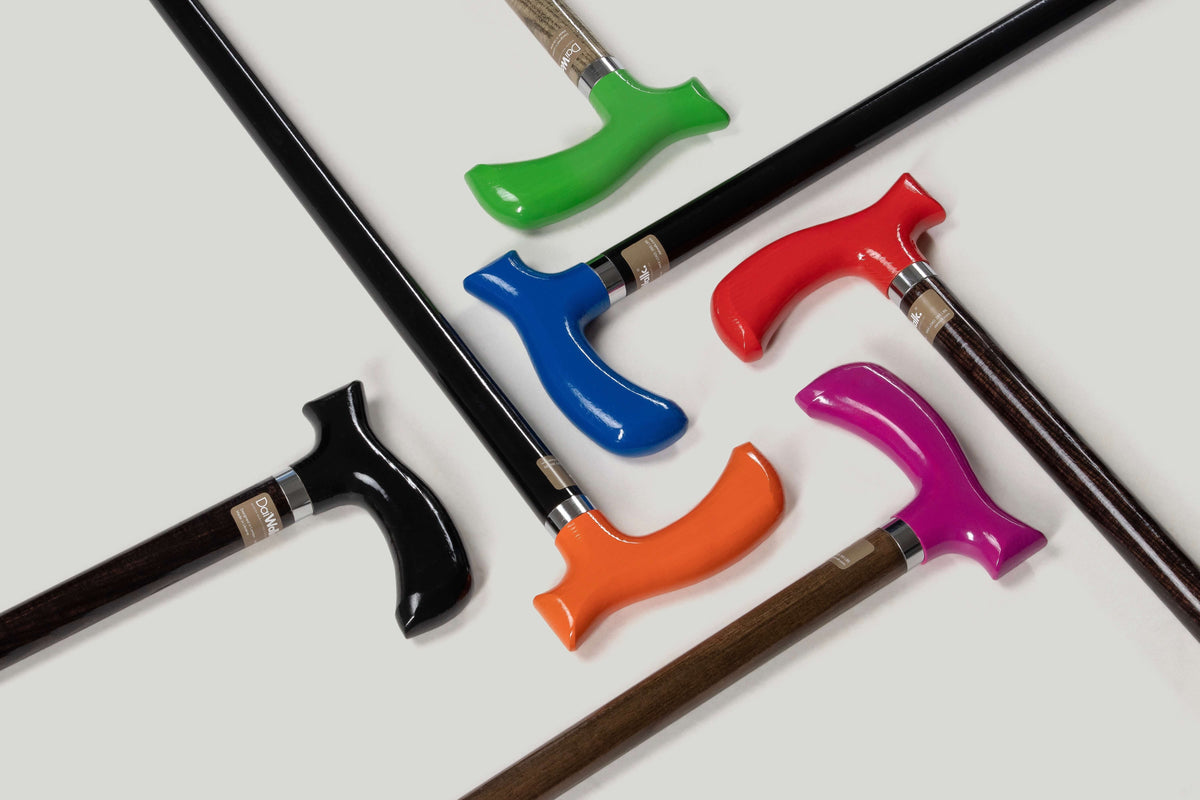
DaiWalk canes are available in oak, wenge, and ash. Each species has a distinct combination of mechanical properties, appearance, and grip characteristics. The choice between them is not purely aesthetic -- the species affects shaft stiffness, vibration damping, grip texture, and wet-surface performance.
Oak
European oak (Quercus robur) is the reference wood species for DaiWalk Original shafts. It is a ring-porous hardwood with a pronounced open grain structure -- the wood shows visible grain lines, medullary rays (pale flecks in quartersawn sections), and natural variation in colour from pale cream to light brown.
Mechanical properties relevant to cane use:
- Density: 720-770 kg/m3 (moderate-high for a hardwood)
- Flexural stiffness: High -- oak resists bending under lateral load, which is the load pattern during cane use
- COF (DaiWalk test data): Dry 0.68, wet 0.57, cold 0.54
- Vibration damping: Good -- wood damps vibration 25-60x more effectively than aluminium, with oak at the mid-to-lower end of wood damping performance
- Grain appearance: Open, pronounced, visually warm -- natural brown tones that work in both casual and formal settings
Wenge
Wenge (Millettia laurentii) is a central African hardwood with exceptional density and a distinctive near-black appearance with fine, lighter-coloured grain lines. It is among the densest timbers used in DaiWalk production.
Mechanical properties:
- Density: 880-920 kg/m3 (substantially denser than oak)
- Flexural stiffness: Very high -- wenge resists bending more than oak at equivalent shaft diameter
- COF (DaiWalk test data): Dry 0.71, wet 0.59, cold 0.56
- Vibration damping: The higher density of wenge provides marginally better vibration damping than oak at equivalent shaft dimensions
- Grain appearance: Near-black with fine brown grain -- visually striking, reads as a premium material in formal and professional settings
Ash
Ash (Fraxinus excelsior) is a diffuse-porous hardwood with high flexibility and impact resistance -- historically the species of choice for sports equipment (cricket stumps, oars, tool handles) due to its energy-absorption characteristics.
Mechanical properties:
- Density: 670-720 kg/m3 (slightly lighter than oak)
- Flexibility: More flexible than oak or wenge -- provides slightly more give under lateral load
- Vibration damping: The flexibility of ash gives it better shock-absorption characteristics than stiffer woods, which some users find more comfortable on hard surfaces
- Grain appearance: Pale cream to light olive-brown, straight grain -- the most understated of the three species, which some users prefer for its low visual weight
Side-by-Side Comparison
| Property | Oak | Wenge | Ash |
|---|---|---|---|
| Density (kg/m3) | 720-770 | 880-920 | 670-720 |
| Shaft stiffness | High | Very high | Moderate |
| COF dry | 0.68 | 0.71 | Not individually tested |
| COF wet | 0.57 | 0.59 | Not individually tested |
| Colour | Pale to mid brown | Near-black | Pale cream to olive |
| Grain character | Open, pronounced | Fine, dramatic contrast | Straight, subtle |
| Vibration damping | Good | Very good | Best (most flexible) |
| Formal setting | Very suitable | Excellent | Suitable |
Which to Choose
- Oak: The general-purpose choice. Excellent grip, good stiffness, attractive natural appearance. The most versatile species for daily use across all settings
- Wenge: Best grip performance, highest stiffness, most visually distinctive. Preferred by users who want the most formal or sophisticated appearance and the highest wet-grip performance. Heavier than oak by approximately 15%
- Ash: Best for users who want maximum shock absorption (hard floors, long walking distances) and prefer a lighter, more understated appearance
Browse the oak cane range, view the full DaiWalk collection, or use the 3D configurator to select your shaft species.
Related reading: Carbon Fibre vs. Wood vs. Aluminium | Walking Cane Vibration Damping


