


Corticosteroids are among the most widely prescribed medications in the world -- used for inflammatory arthritis, asthma, inflammatory bowel disease, dermatological conditions, and post-transplant immunosuppression. What is less discussed with patients is the specific impact steroids have on fall risk and on the bone quality that makes a fall genuinely dangerous.
How Steroids Increase Fall Risk
Corticosteroids affect balance and mobility through several parallel mechanisms:
- Proximal myopathy: Steroids cause selective atrophy of type II fast-twitch muscle fibres, particularly in the proximal muscles of the thigh and hip. This manifests as difficulty rising from a chair, climbing stairs, and making rapid postural corrections.
- Fluid retention and weight gain: Central adiposity and fluid accumulation alter the body centre of mass and can affect gait mechanics
- Tendon weakening: Glucocorticoids reduce collagen synthesis and tendon tensile strength, increasing the risk of tendon rupture under load
- Vestibular and visual effects: Higher-dose corticosteroids can cause dizziness, visual disturbance (cataracts with long-term use), and occasionally elevated intracranial pressure
Osteoporosis: Why a Fall Becomes Dangerous
The compounding problem with steroids is osteoporosis. Glucocorticoid-induced osteoporosis (GIOP) is the most common cause of secondary osteoporosis globally. Even short courses of oral prednisone at 5mg/day or above accelerate bone loss, with the greatest bone mineral density decline occurring in the first 3-6 months of treatment.
A patient on long-term steroids who falls has significantly higher fracture risk because GIOP also impairs bone microarchitecture and trabecular connectivity beyond what DEXA scans fully capture.
Dose and Duration Considerations
| Steroid Dose | Duration | Fall Risk Impact | GIOP Risk |
|---|---|---|---|
| High dose (over 30mg/day prednisolone) | Acute (under 2 weeks) | Dizziness, mood effects | Low |
| Moderate dose (7.5-30mg/day) | 4-12 weeks | Moderate myopathy onset | Moderate |
| Low dose (under 7.5mg/day) | Long-term (months-years) | Proximal muscle weakness | High |
| Any dose | Repeated courses | Cumulative myopathy | Cumulative risk |
When to Consider a Walking Cane
A cane should be considered when:
- Steroid-induced myopathy causes perceptible hip or thigh weakness affecting stair use or rising from chairs
- The patient is on long-term steroid therapy with documented GIOP (T-score below -1.5)
- Episodes of dizziness or visual disturbance accompany steroid doses
- The combination of steroid use plus other fall risk factors (age over 65, prior fall, polypharmacy) creates a composite high-risk profile
For patients in this category, the cane performs two functions: it provides direct mechanical balance support during ambulation, and it reduces the loading demands on the proximal muscles that steroids have weakened.
Handle Selection for Steroid Patients
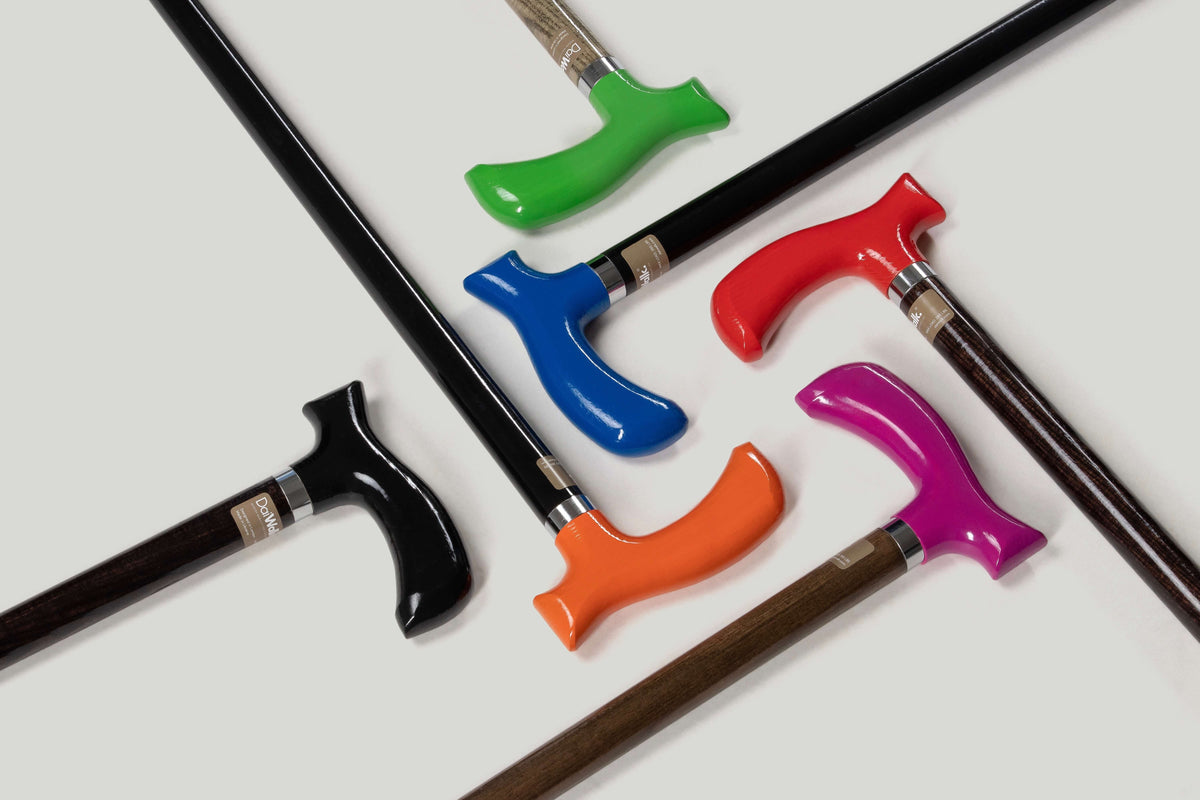
Proximal myopathy affects shoulder girdle and upper arm as well as legs. The DaiWalk Anatomic Grip distributes load across the full palm at 1.9 N/cm2 compared to 4.2 N/cm2 at a T-bar handle -- reducing fatigue in patients whose upper limb muscles are also affected by steroid-induced weakness. View the full DaiWalk range or use the 3D configurator to select handle type.
Exercise as a Parallel Intervention
Resistance training specifically targeting the proximal muscles (hip abductors, quadriceps, hip extensors) partially counteracts steroid-induced myopathy. Exercise programmes should begin as early as possible during steroid therapy and continue during taper. The cane is not a substitute for this exercise -- it is a safety net that makes exercise safer by reducing fall risk during the period when muscles are weakened.
Related reading: Walking Cane for Osteoporosis | Walking Cane for Rheumatoid Arthritis


