


Cerebral palsy (CP) covers a group of permanent movement disorders from non-progressive brain injury occurring in the developing brain, typically before or around birth. The separate article on spastic cerebral palsy covers the most common CP subtype; this article addresses ataxic cerebral palsy specifically, which involves cerebellar dysfunction rather than the motor cortex or pyramidal pathway damage of spastic CP.
Ataxic CP: How It Differs from Spastic CP
Ataxic CP represents approximately 5-10% of cerebral palsy cases. Its characteristics:
- Cerebellar dysfunction: Rather than spasticity or dystonia, ataxic CP is characterised by hypotonia (low muscle tone), intention tremor (tremor that increases as the limb approaches its target), and incoordination
- Wide-based gait: The characteristic wide stance gait of cerebellar dysfunction is the primary gait feature -- similar to Friedreich ataxia but with a congenital rather than progressive aetiology
- Balance impairment: Sitting and standing balance are often more severely affected than walking in ataxic CP -- the patient can walk with difficulty but has poor balance at rest
- Intention tremor: This tremor affects the arms during directed movements, which impairs cane placement precision
Walking Cane in Ataxic CP: Adults
This article focuses on adult ataxic CP users. In childhood, mobility aid decisions are made within a multidisciplinary paediatric CP team; as adults, many ataxic CP patients manage their own mobility aid decisions with or without ongoing physiotherapy input.
A walking cane in ataxic CP provides:
- An additional ground contact point that reduces the consequences of the balance perturbations from cerebellar hypotonia and incoordination
- A proprioceptive anchor -- the contact signal through the shaft is a stable sensory reference in a nervous system where sensorimotor integration is impaired
- Rhythm assistance -- some ataxic CP users find that the physical rhythm of cane contact helps moderate gait irregularity
The Intention Tremor Challenge
Intention tremor in the arm affects the precision with which the cane can be placed. Unlike essential tremor (which is a postural/action tremor that can be partially managed with weight and grip), intention tremor (which increases as the limb approaches its target) is harder to address. Cane placement in the ataxic patient may be imprecise, meaning the cane tip lands in a slightly different position each step.
The Steady Tip (28mm contact patch) provides more tolerance for imprecise placement than a small ferrule -- there is more surface area to provide grip even if the tip is not placed exactly where intended. This is a specific advantage of a larger-contact tip for ataxic placement patterns.
Ataxic CP vs. Spastic CP: Cane Use Comparison
| Feature | Spastic CP | Ataxic CP |
|---|---|---|
| Muscle tone | High (spasticity) | Low (hypotonia) |
| Gait pattern | Scissoring, stiff | Wide-based, unsteady |
| Primary cane function | Stability, compensate for stiffness | Balance anchor, proprioceptive supplement |
| Arm function for cane | Variable, spasticity may limit | Intention tremor limits precision |
| Tip consideration | Standard Steady Tip | Larger contact (more tolerance for imprecise placement) |
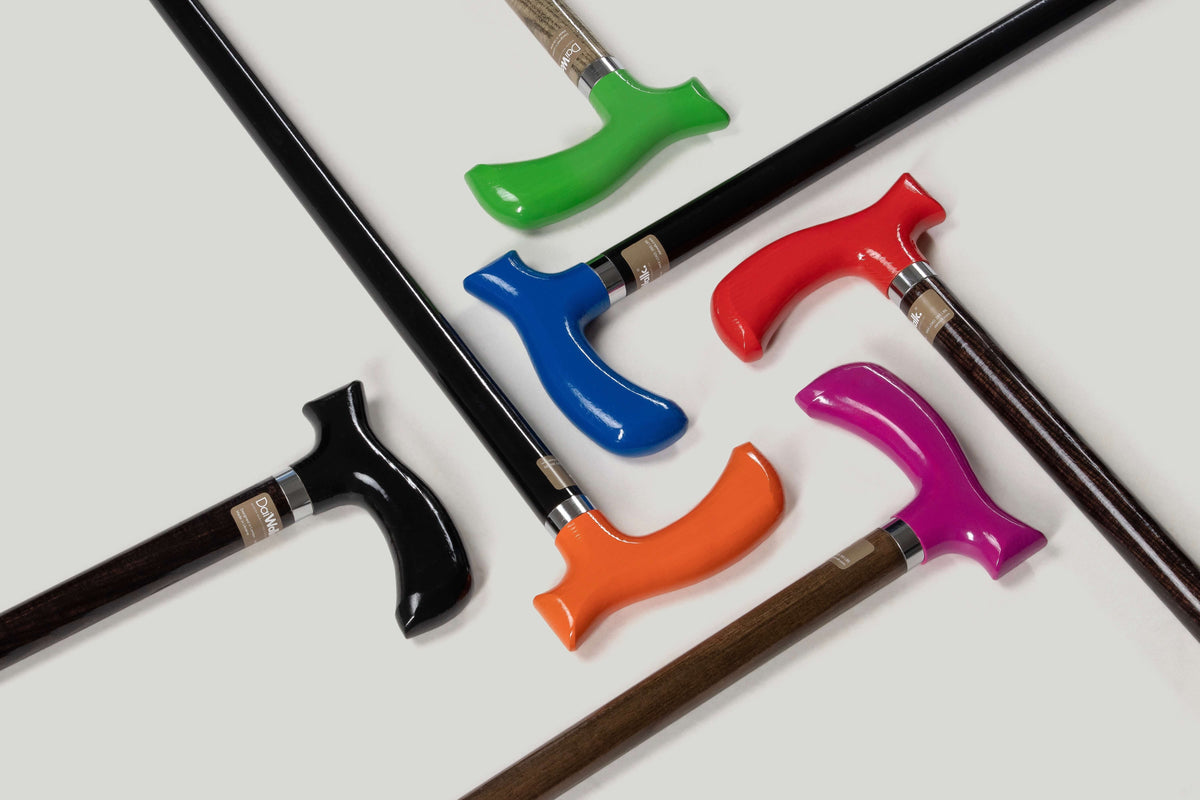
View the full DaiWalk cane range. Related: Walking Cane for Spastic Cerebral Palsy | Walking Cane for Friedreich Ataxia


