


Dermatomyositis (DM) and polymyositis (PM) are rare inflammatory myopathies -- autoimmune conditions that attack muscle tissue directly, producing proximal muscle weakness. Unlike peripheral neuropathies or joint diseases, the weakness in DM/PM is myopathic: the muscles themselves are inflamed and damaged, not the nerves supplying them or the joints connecting them.
The Proximal Weakness Pattern in DM and PM
Proximal muscle weakness means the muscles closest to the body core are most affected:
- Hip flexors and extensors -- difficulty rising from a chair, climbing stairs, stepping up to a kerb
- Shoulder girdle -- difficulty lifting arms overhead, carrying bags
- Neck flexors -- difficulty lifting the head from a pillow
- Distal muscles (hands, feet) are usually preserved or only mildly affected
This pattern has important implications for walking cane use: the handle grip and wrist function are preserved, making a cane mechanically feasible. But the hip and leg weakness means walking itself is the primary challenge.
How a Walking Cane Helps in DM/PM
A walking cane in DM/PM provides:
- Hip extensor support: The cane offloads some of the push-off work from the weakened glutes and hamstrings
- Stair ascent and descent: The cane provides an upper limb push that compensates for reduced lower limb strength on stairs
- Rising from chairs: A cane as a push-off point assists the weakened hip extensors in chair-to-stand transitions
- Balance: Proximal leg weakness impairs balance even when distal foot control is intact
Handle Choice in DM/PM
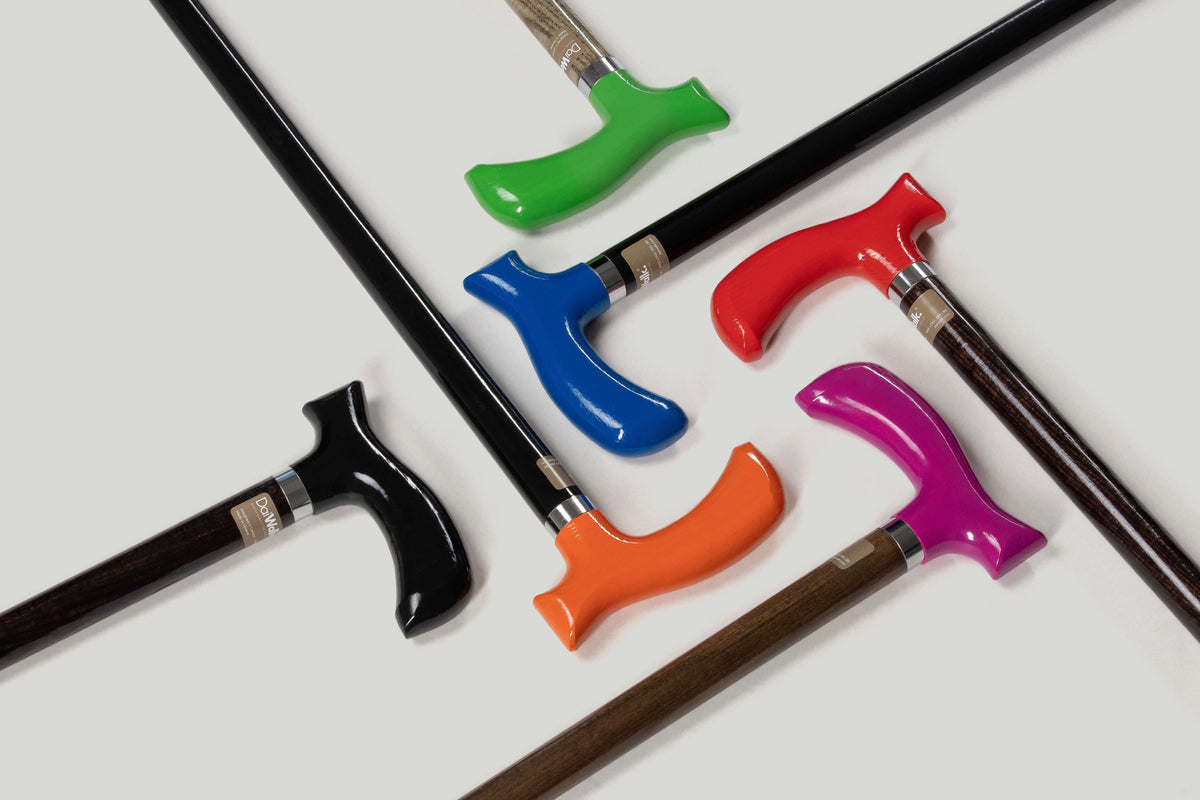
In DM/PM, the grip itself is rarely affected. However, shoulder girdle weakness means heavy canes or canes requiring high arm elevation are tiring. A cane that is lightweight and ergonomic at a natural hand height reduces shoulder fatigue. The DaiWalk Original 1.0 weighs 295-340g depending on configuration -- one of the lightest options in premium canes.
DM/PM Activity and Cane Strategy
| Activity Challenge | Weakness Source | Cane Strategy |
|---|---|---|
| Stairs | Hip extensors and quadriceps | Lead with stronger leg going up; cane on step below going down |
| Chair rise | Hip extensors, quadriceps | Push down on cane handle while rising; high chair preferred |
| Walking on flat | Hip flexors; balance deficit | Standard ipsilateral or contralateral cane placement |
| Uneven ground | Hip and core stability | Cane for lateral stability on terrain; slow pace |
Explore DaiWalk walking canes and related: Walking Cane for Lupus (Inflammatory Autoimmune).


