


Ehlers-Danlos syndrome (EDS) presents a paradox in mobility aid selection: the very tissue laxity that makes joints unstable also makes grip handles uncomfortable and wrist loading potentially dangerous. Most EDS patients who use a walking cane have hypermobile EDS (hEDS) or hypermobility spectrum disorder (HSD) -- conditions where joint proprioception is impaired, joints sublux or dislocate during ordinary activity, and fatigue is profound despite the person looking outwardly healthy.
Why EDS Mobility Needs Differ from Other Conditions
Standard cane advice (use contralateral to the affected leg, bear weight through the wrist) applies poorly to hEDS because:
- The wrist itself may sublux under load, making conventional weight-bearing through a cane painful or unsafe
- Grip handles concentrate force on a small area -- EDS skin and connective tissue may bruise or be painful under point pressure
- Proprioception loss means the person may not feel a subluxation developing until after it has happened
- POTS (postural orthostatic tachycardia syndrome) co-occurs in a large proportion of hEDS patients, meaning sudden position changes (standing from seated, transitioning from bent to upright) provoke tachycardia, pre-syncope, and near-falls
Cane Benefits Specific to hEDS/HSD
- Proprioceptive input: Ground contact through the cane tip provides an additional sensory signal that supplements impaired joint position sense. Many hEDS users report that cane contact reduces the sense of instability even when weight-bearing load through the cane is minimal
- POTS management: A cane allows partial forward lean during prolonged standing (reduces venous pooling in lower limbs) and provides immediate support during pre-syncopal episodes
- Subluxation prevention: The cane acts as an external stabiliser during the high-risk moments of gait -- weight transfer and single-leg stance phases
- Fatigue pacing: In EDS, fatigue is a primary disability factor. A cane reduces the postural muscular work required, extending walking tolerance before fatigue-induced instability develops
Handle and Grip Considerations in EDS
Conventional T-bar handles may cause problems in EDS:
- T-bar requires wrist ulnar deviation under load -- a common subluxation direction in hEDS wrists
- Small handle diameter concentrates pressure on finger joints that may already be painful
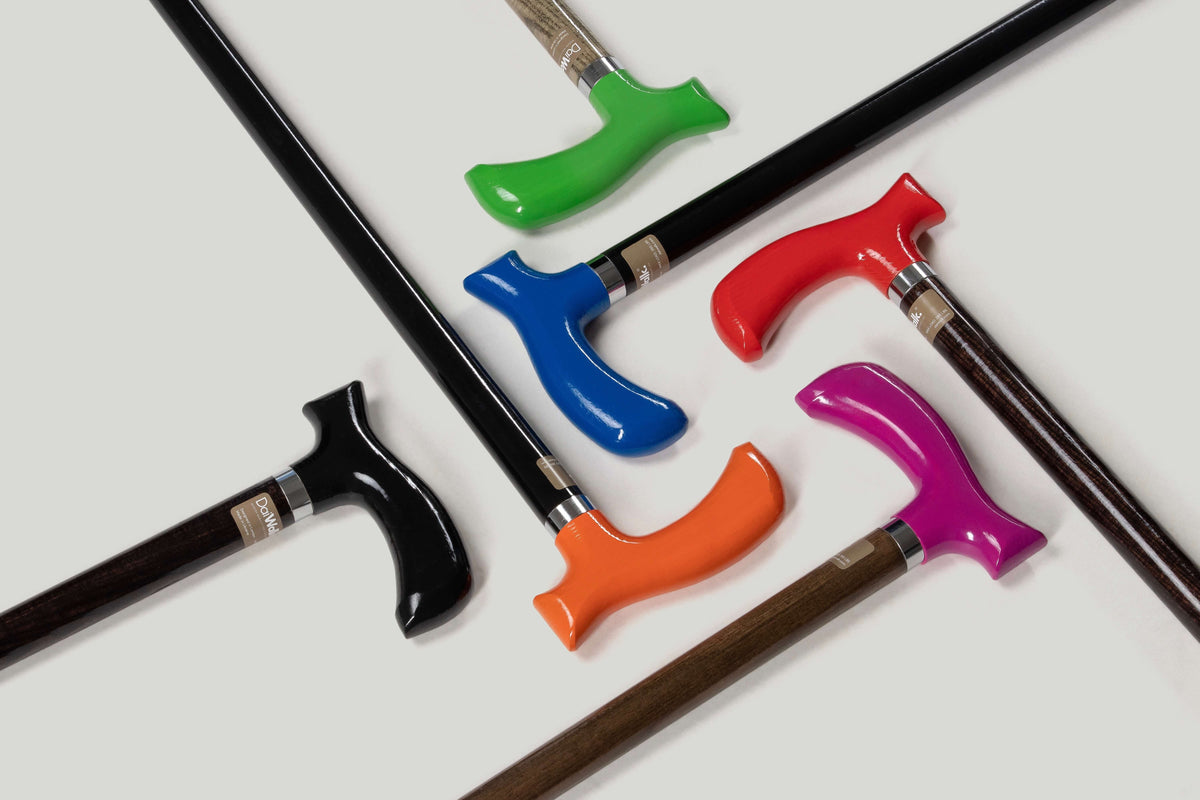
- The DaiWalk Anatomic Grip is designed with a pressure-distributing ergonomic profile: 1.9 N/cm² peak pressure compared to 4.2 N/cm² for a standard T-bar handle. This reduced peak pressure is directly relevant to EDS patients where point-loading on hypermobile finger and wrist joints causes pain and increases subluxation risk
Explore grip options at DaiWalk walking canes.
EDS and Cane Use: Functional Guide
| EDS Feature | Cane Function | Key Consideration |
|---|---|---|
| Joint proprioception deficit | Supplementary ground contact input | Even light cane contact improves stability |
| POTS / orthostatic intolerance | Support during positional transitions and prolonged standing | Partial lean reduces venous pooling |
| Joint subluxation risk | External stabiliser during single-leg stance | Avoid full weight-bearing through unstable wrist |
| EDS fatigue (postexertional) | Reduces postural muscular demand, extends walking distance before fatigue | Plan rest periods before fatigue threshold |
| Skin and tissue fragility | Handle padding reduces bruising risk | Anatomic grip reduces peak pressure |
Related: Walking Cane for Hypermobility Spectrum Disorder | Handle Pressure Science


