


Hip replacement revision surgery (also called revision total hip arthroplasty, or revision THA) is performed when a primary hip replacement fails -- through component loosening, wear, fracture around the implant (periprosthetic fracture), infection, or dislocation. Revision surgery is technically more complex than primary THA, typically longer, involves more bone loss, and produces a more prolonged and difficult recovery. Walking aid use, including walking canes, must be managed more carefully than after primary hip replacement.
Why Revision THA Recovery Differs from Primary THA
- Bone loss: Removal of the failed implant removes bone. Bone grafting or augmented implants add complexity and may require extended non-weight-bearing
- Muscle damage: Revision surgery involves more extensive soft tissue dissection; hip abductor weakness is more pronounced and more persistent
- Dislocation risk: Revision THA has higher dislocation rates than primary THA (up to 10-15% vs. 1-3%); hip precautions may be stricter and longer
- Recovery timeline: Full recovery may take 12-18 months vs. 6-12 months for primary THA
Walking Aid Progression After Revision THA
| Phase | Typical Duration | Weight-Bearing Status | Walking Aid |
|---|---|---|---|
| Acute post-op | 0-6 weeks | Partial or non-weight-bearing (surgeon-dependent; bone graft sites may require NWB) | Frame or crutches; cane insufficient |
| Early rehabilitation | 6-12 weeks | Progressive weight-bearing to full | Crutches then single cane contralateral to operated hip |
| Intermediate rehabilitation | 3-6 months | Full weight-bearing; rebuilding hip abductor strength | Cane contralateral; may be needed longer than after primary THA |
| Late rehabilitation | 6-18 months | Full; sport and high-demand activity return | Cane as needed for fatigue or demanding terrain |
Hip Abductor Weakness After Revision: The Trendelenburg Problem
Trendelenburg gait (pelvis drops to the unaffected side during the stance phase on the operated leg) is more pronounced and more persistent after revision THA than after primary THA. A cane held contralateral to the operated hip reduces the hip abductor force required during stance, correcting the Trendelenburg pattern. In severe or persistent hip abductor weakness, a cane may be needed for a year or longer.
Hip Precautions and Cane Use After Revision THA
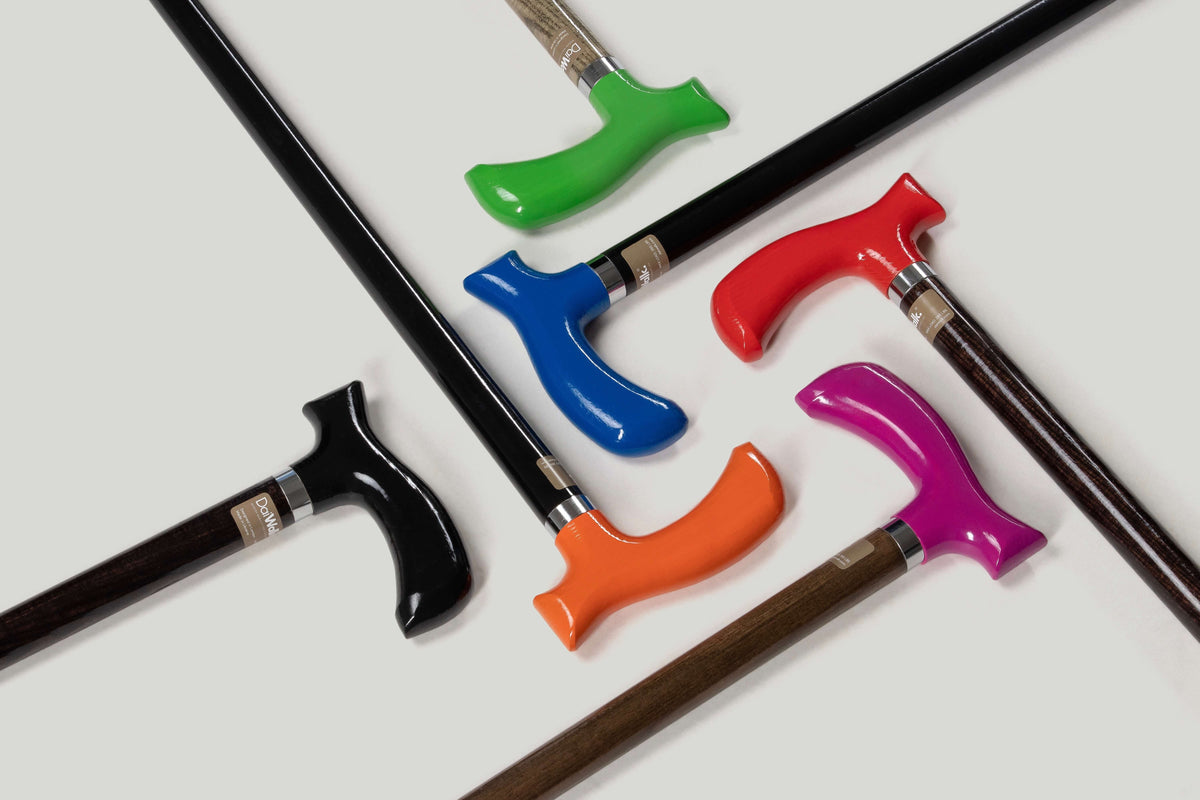
Hip precautions (avoid hip flexion beyond 90 degrees, avoid internal rotation) may be stricter after revision THA due to higher dislocation risk. Using a cane correctly -- without bending forward to the ground to pick it up, using a reacher for dropped items -- is part of hip precaution compliance. The DaiWalk ergonomic grip and correct shaft length minimise the need to bend at the hip when using the cane.
Explore DaiWalk walking canes. Related: Walking Cane for Hip Replacement Recovery | Walking Cane for Periprosthetic Fracture.


