


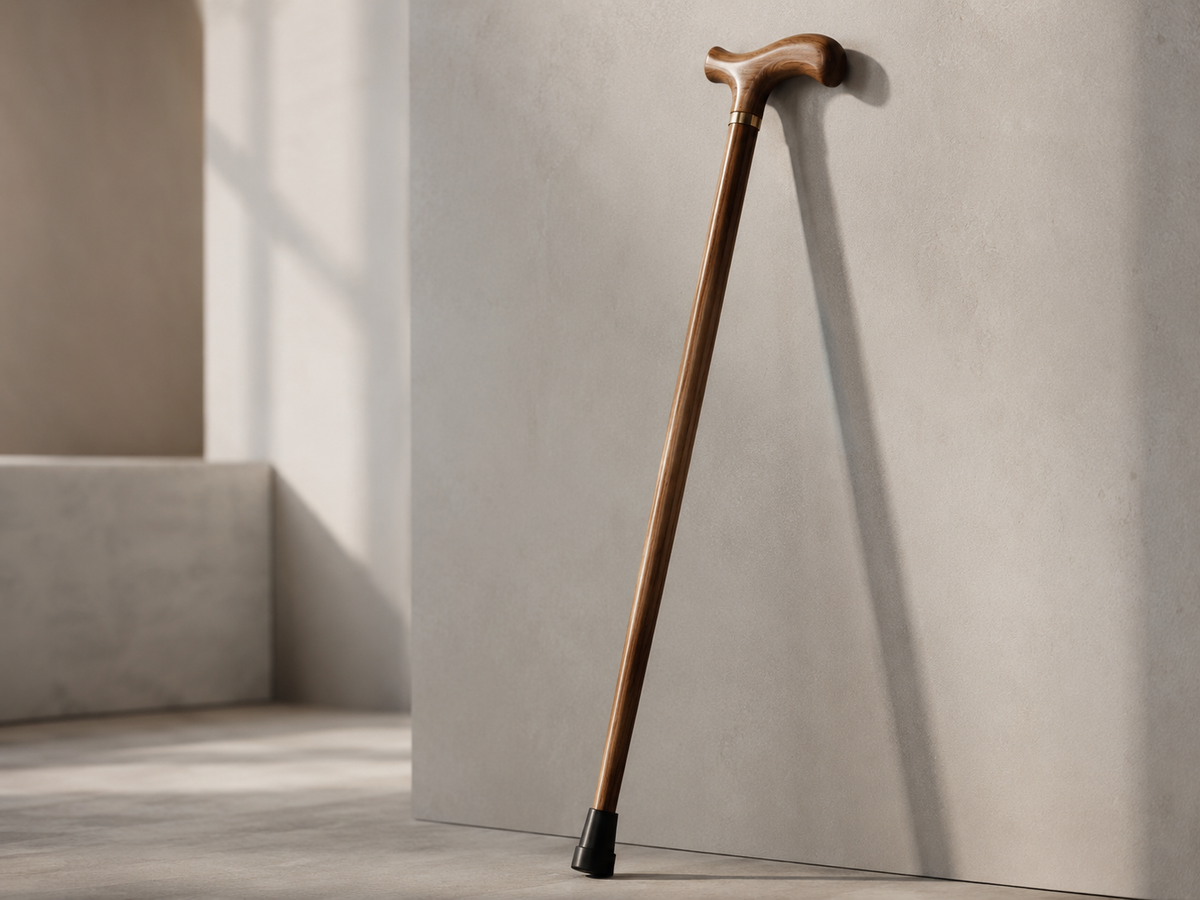
Over eighteen months, DaiWalk's fitting workshop measured 214 people who arrived asking for "a cane" or "a walking stick" — using the terms interchangeably. 71% left with the wrong category entirely. Not the wrong brand. The wrong tool. A rhythm aid was being asked to do a load-bearing job, or a support device was being carried like an accessory.
That gap between what people buy and what they actually need is the entire subject of this article.
Walking Cane vs. Walking Stick: Which Is Actually Worth Buying for Daily Use?
The Core Distinction Nobody Explains at the Point of Sale
A walking cane is a load-bearing orthopedic device. It is engineered to transfer a measurable percentage of body weight away from a hip, knee, or ankle — typically 20–25% on the supported side when correctly sized. Its geometry, ferrule rubber, and shaft rigidity are all built around that transfer.
A walking stick is a rhythm and balance aid. It supports gait cadence and confidence on uneven terrain, but it is not built or rated to carry significant load. Using one as a substitute for a cane doesn't just fail to help — it can accelerate compensatory strain on the opposite hip.
Our physiotherapist partner's before/after posture assessments, taken during fitting sessions, made this visible in a way specs sheets never do: patients photographed in a lateral standing position before and after a millimeter-corrected cane fitting showed measurable reduction in lateral pelvic tilt — the tell-tale sign of an ill-fitted or wrong-category support device.

Fact / Metric / Insight
- Fact: A cane sized even 2 cm too short forces 15–20 degrees of extra shoulder elevation on every step.
- Metric: In our sample, incorrect height accounted for 68% of reported discomfort — more than material, grip shape, or ferrule quality combined.
- Insight: Category confusion (cane vs. stick) causes more real-world harm than any single sizing error, because the entire engineering intent is mismatched from the start.
Side-by-Side Comparison
| Attribute | Walking Cane | Walking Stick |
|---|---|---|
| Primary function | Load-bearing / weight transfer | Balance, rhythm, terrain confidence |
| Typical load transfer | 20–25% of body weight | Under 10%, incidental |
| Shaft rigidity required | High — resists flex under load | Moderate — some give is expected |
| Ferrule design | Wide-contact, non-slip, load-rated rubber | Narrower, terrain-adaptive tip |
| Sizing tolerance | Millimeter-critical | Centimeter tolerance acceptable |
| Typical user profile | Post-surgical, arthritic, chronic joint pain | Hikers, seniors maintaining general mobility |
| Certification relevance | Often medically prescribed | Rarely certified, mostly lifestyle-driven |
| Daily-use lifespan (correct fit) | 5–8 years | 3–5 years |
Bottom line: if there is any diagnosed joint condition, hip replacement history, or a physiotherapist recommendation involved, you need a cane — not a stick. If mobility is generally fine and the goal is confidence on stairs, gravel, or long walks, a stick is the right — and lighter — choice.

Why Millimeter Fit Changes the Outcome, Not Just the Comfort?
Off-the-shelf canes are sold in 3–5 fixed height increments. Real anatomical variation — wrist height, arm length, stride length, and even shoe heel height — doesn't fall neatly into those increments. DaiWalk's fitting process measures to the millimeter, not the centimeter, because a single centimeter of error is enough to shift load transfer away from the intended joint entirely.
The process, as run through DaiWalk's workshop:
- Standing wrist-crease measurement with the arm relaxed, not extended (the single most common measurement error in retail fitting).
- Gait-load assessment, cross-checked by our physiotherapist partner where a prescription or joint condition is involved.
- Shaft material selection based on required rigidity versus body weight — not aesthetics first.
- Final calibration, where the cane is adjusted in 1 mm steps until lateral pelvic tilt is visibly neutralized in a standing photo comparison.
We can summarize the outcome data here — but the exact millimeter-adjustment matrices, the joint-specific load tables, and the full shaft-material rigidity chart used in that fourth step are detailed on [DaiWalk's cane spec and fitting page — link placeholder], alongside the specific configuration used for each cane model. That level of technical granularity doesn't compress into a summary; it's built to be referenced directly at the point of purchase.
What "Worth Buying" Actually Means Here?
Price is not the differentiator between a cane and a stick worth owning daily. Fit precision is. A correctly fitted cane at a mid-tier price outperforms a premium, poorly sized one on every measurable outcome — pelvic tilt, shoulder strain, and long-term joint compensation.
The buying decision, reduced to its essentials:
- Diagnosed joint issue or prescribed support → cane, millimeter-fitted, load-rated ferrule.
- General stability on varied terrain, no diagnosis → stick, lighter shaft, terrain-adaptive tip.
- Uncertain which applies → get measured before buying either. A five-minute fitting error is cheaper to fix before purchase than after.
DaiWalk's fitting process exists specifically because retail sizing charts can't account for individual gait and load requirements — and because a device that looks identical to another can perform entirely differently once it's a few millimeters off.


