


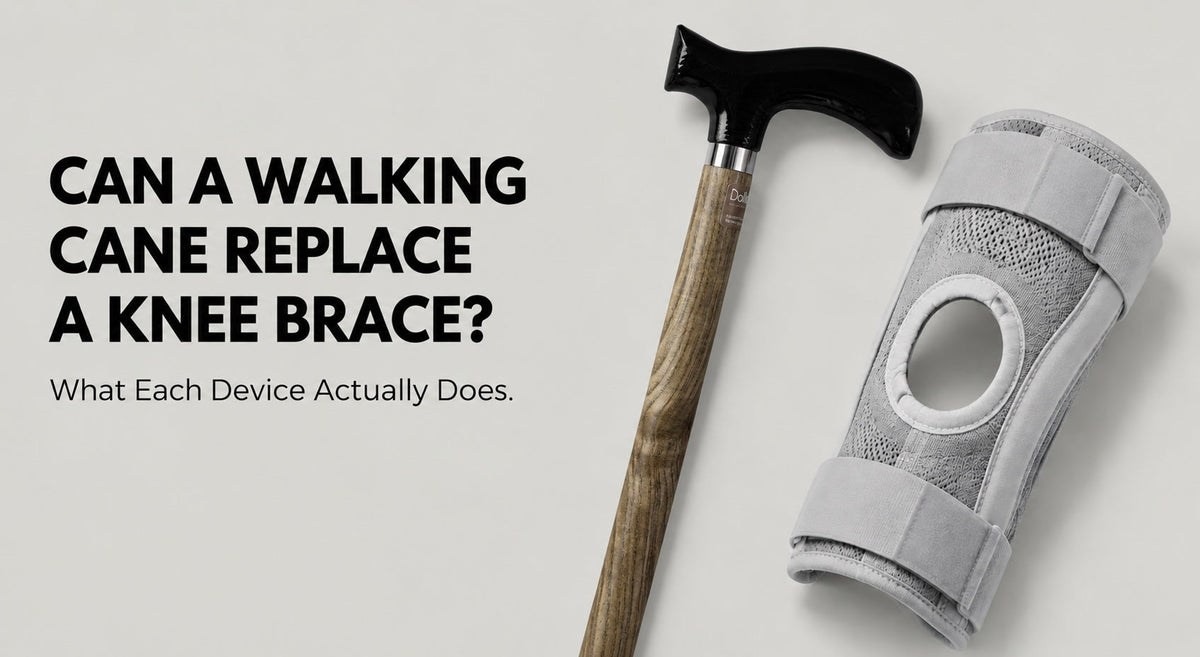
Walking canes and knee braces are both prescribed for knee conditions — often to the same patient for the same knee. They are sometimes presented as alternatives; more accurately, they address different aspects of knee load and work synergistically in many cases. Choosing between them without understanding what each does produces suboptimal outcomes for both.
What a Knee Brace Does
Knee braces (specifically valgus unloader braces for medial compartment OA) apply a lateral force to the knee, shifting load from the medial compartment to the lateral compartment. They work at the joint level — mechanically altering where within the knee the load falls.
Measured load reduction: valgus unloader braces reduce medial compartment load by approximately 13% in peer-reviewed biomechanical studies. They also provide proprioceptive feedback through the brace structure and reduce instability perception.
Limitation: they do not reduce the total load on the joint — they redistribute it. For a knee that cannot tolerate load in any compartment, a brace alone is insufficient.
What a Walking Cane Does
A walking cane reduces the total load through the knee during stance phase, by transferring a portion of body weight to the ground via the upper limb. The mechanism is different from the brace: instead of redistributing within the knee, it reduces the total input to the knee.
Measured reduction in knee adduction moment (the primary driver of medial compartment load) with contralateral cane use: approximately 11–14%. The reduction in total knee compressive force: approximately 10–20% depending on how heavily the user loads the cane.
The Comparison
| Mechanism | Knee Brace (Valgus Unloader) | Walking Cane (Contralateral) |
|---|---|---|
| Primary action | Redistributes load within the knee (medial to lateral) | Reduces total load entering the knee |
| Load reduction | ~13% medial compartment load reduction | ~11–14% adduction moment reduction; ~10–20% total load |
| Applies to | Medial compartment OA specifically | Any condition benefiting from joint offloading |
| Requirement | Correctly fitted, worn correctly, appropriate indication | Correct height, correct side, correct technique |
| Wearable all day | Some discomfort with extended wear; compliance issues at high activity | Yes — held, not worn |
| Portability | Worn on the body — always available | Carried — requires a hand |
| Combined use | Can be used simultaneously with a cane | Can be used simultaneously with a brace |
When to Use Both
For medial compartment OA specifically, using both a valgus brace and a contralateral cane produces additive benefit — the brace redistributes load within the knee, and the cane reduces the total load entering the knee. The mechanisms are complementary, not redundant.
Many orthopaedic surgeons prescribe both for moderate-to-severe medial OA before surgery consideration. The combined intervention can delay surgical intervention significantly — of particular relevance in younger patients for whom longevity of a joint replacement is a concern.
When a Cane Alone Is Sufficient
- Bilateral knee involvement (valgus unloader brace targets one compartment of one knee)
- General balance and load reduction without specific compartment targeting
- Post-surgical load management (brace compliance during post-surgical recovery varies)
- Users who cannot tolerate brace fit (skin conditions, peripheral neuropathy reducing sensation)
When a Brace Alone May Be Sufficient
- Mild medial compartment OA where hand use is inconvenient (two-handed work, sport)
- Patients with upper limb conditions that limit cane use
- Users where the cane's balance benefit is not required — only the load redistribution
View the DaiWalk walking cane options at the product collection. For knee-specific condition detail, see Walking Cane for Knee Pain.
Related Reading
- Walking Cane for Knee Pain
- Walking Cane After Knee Surgery
- Walking Cane for Arthritis
- Walking Cane vs. Forearm Crutch
Knee brace load reduction data from peer-reviewed biomechanical studies (valgus unloader brace). Cane adduction moment reduction from peer-reviewed gait analysis literature. Combined intervention data from published OA management guidelines.


