


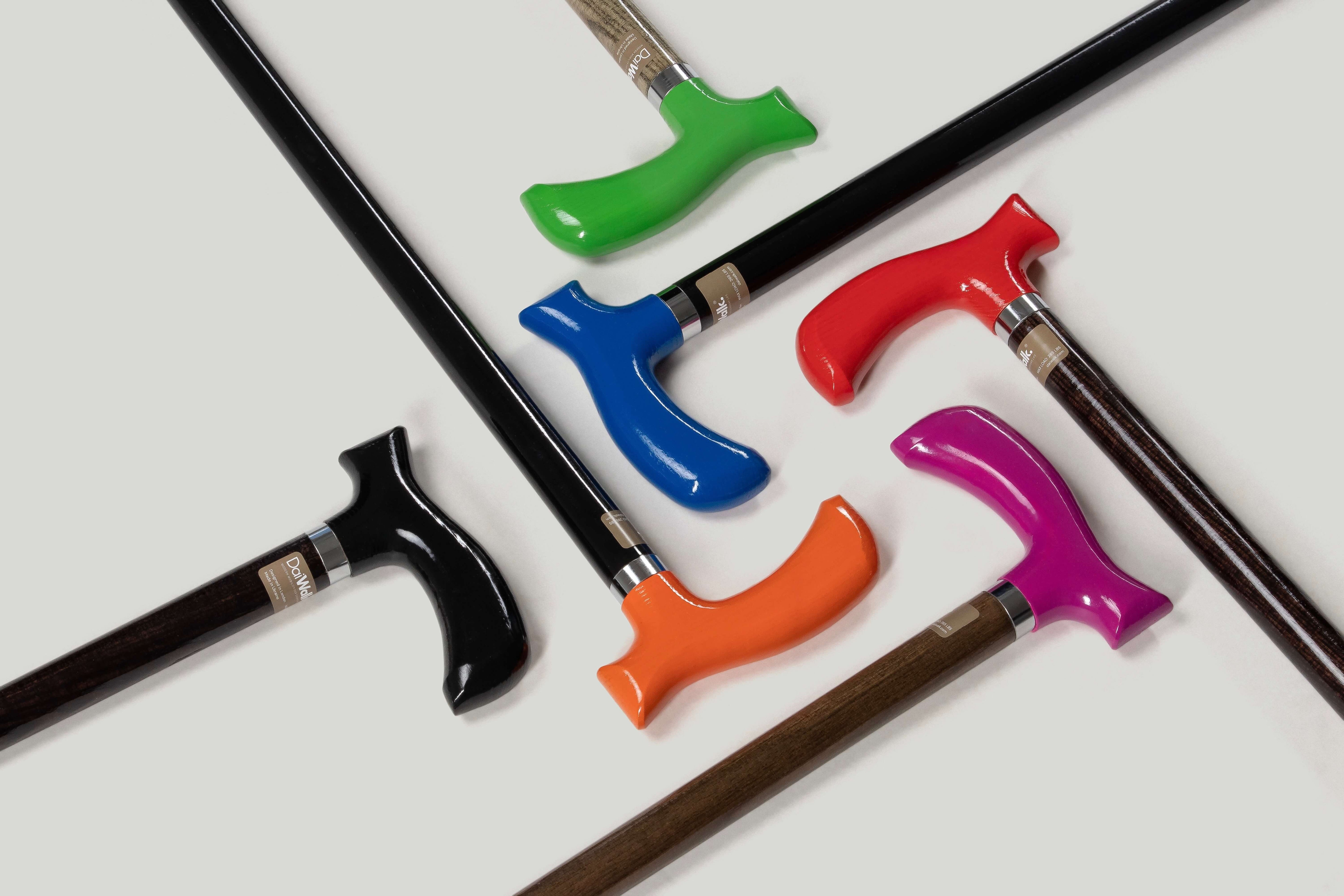
A walking cane and a forearm crutch both provide upper-limb support during walking. The structural difference is the load capacity: a walking cane transfers approximately 15–25% of body weight through the handle to the ground; a forearm crutch transfers 40–80% of body weight through the forearm cuff and handle combined. For users who need more than 25% offloading, the walking cane is biomechanically insufficient.
The transition point — when a cane is no longer enough — is more specific than most guides acknowledge.
The Load Capacity Difference
A walking cane handle is loaded in the wrist and hand. The hand-to-floor distance is approximately 900–1000mm, and the load path is through the metacarpals and wrist joint. Maximum comfortable continuous load through a single walking cane: approximately 15–20kg (25% of a 70kg user's body weight).
A forearm crutch distributes load across the forearm cuff (proximal loading) and the handle (distal loading). The forearm engagement allows significantly higher load transfer without equivalent wrist stress. Typical continuous load capacity: 25–45kg per crutch.
Users who need to offload more than 20–25% of body weight from the lower limbs — due to non-weight-bearing surgical status, severe joint damage, or significant lower limb weakness — cannot achieve the required offloading from a single walking cane.
When to Consider Upgrading from Cane to Forearm Crutch
| Indicator | Implication |
|---|---|
| Surgeon has prescribed partial to non-weight-bearing status | Cane is insufficient for the required offloading |
| Leaning heavily on cane causes wrist pain | Load exceeds comfortable cane capacity — forearm cuff needed |
| The cane prevents falls but the user feels close to falling regularly | More support points (bilateral canes or forearm crutch) required |
| User reports cane arm fatigue within 10–15 minutes of walking | Load exceeds the cane's efficient transfer capacity |
| Visible trunk lean over the cane at every step | Compensatory posture — load is too high for single cane |
The Two-Cane Option
Between single cane and forearm crutch, bilateral cane use is an intermediate option. Two standard walking canes, used simultaneously, provide:
- Doubled upper limb load transfer capacity
- Bilateral support points — wider effective base
- Better management of bilateral lower limb conditions (OA in both knees, bilateral hip involvement)
Bilateral cane use requires coordination and is typically PT-supervised initially. It is appropriate for users who need more support than a single cane but whose conditions do not warrant the clinical prescription of forearm crutches.
The Bilateral Cane vs. Forearm Crutch Decision
| Bilateral Canes | Forearm Crutches |
|---|---|
| Better for bilateral orthopaedic conditions | Better for high offloading requirement (post-surgical non-weight-bearing) |
| Easier to use on stairs with handrails | Better for upper stairs, ramps, significant inclines |
| More portable — each cane usable independently | Less portable — must use as a pair |
| Lower load capacity per limb | Higher load capacity — forearm cuff engagement |
| Lower social visibility | More visible — clearly medical-grade equipment |
When to Return From Crutch to Cane
The transition from forearm crutch back to a walking cane is often underspecified in rehabilitation protocols. The milestone that makes a single cane appropriate again:
- Weight-bearing status progresses to partial or full weight bearing on the affected limb
- The user can walk for 10–15 minutes on the crutches without trunk compensation or fatigue
- The PT confirms gait pattern is symmetric enough for single-cane support to be effective
The transition cane — the cane used immediately after crutch dependence — should be the same quality as the post-recovery long-term cane. The user's load and distance will increase rapidly during this period; a low-quality mechanism will degrade noticeably.
See the DaiWalk walking cane collection for options suited to post-crutch rehabilitation use.
Related Reading
- Walking Cane After Hip Replacement
- Walking Cane for Temporary Use
- What Makes a Walking Cane Ergonomic?
- Walking Cane Handle Types Compared
Load capacity data from biomechanical literature and DaiWalk internal testing. Rehabilitation transition milestones from physiotherapy protocol literature.


