


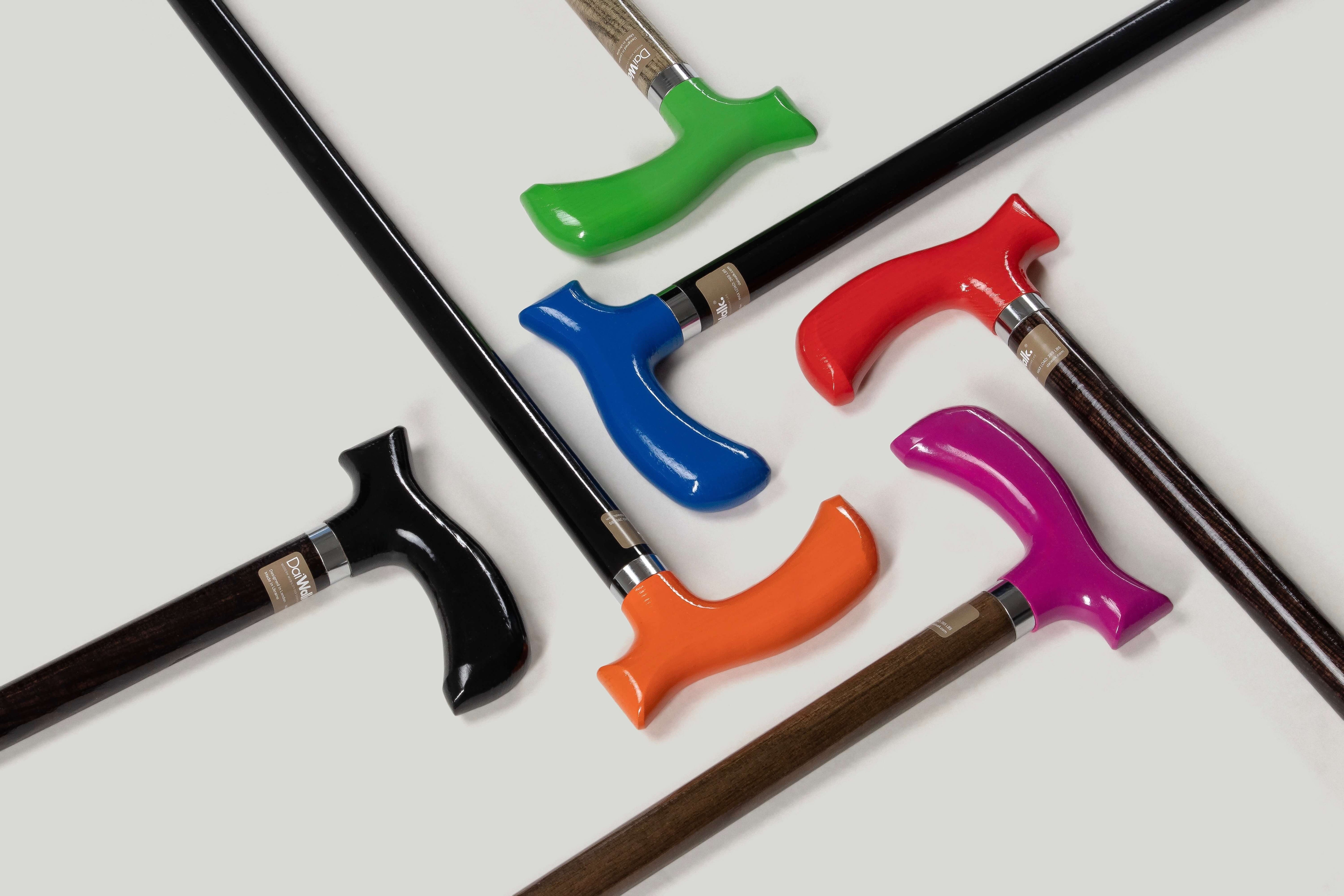
The T-bar handle became the default on walking canes for one reason: it is the cheapest shape to injection-mould. It has no ergonomic rationale. The load path through a T-bar directs peak pressure to the heel of the palm — the thenar eminence — which is one of the more pressure-sensitive areas of the hand. For a device intended to be held for hours daily, this is a significant design failure.
Here is a functional comparison of the five main handle types, with pressure data.
T-Bar Handle
The horizontal bar that extends perpendicular to the shaft. Found on approximately 70% of pharmacy-grade canes.
Peak pressure point: Thenar eminence (base of the thumb side of the palm). Measured at 4.2 N/cm² under 30kg vertical load in our pressure mapping study.
Biomechanical issue: The wrist must maintain a neutral or slightly extended position to use the T-bar. Over time, sustained wrist extension increases carpal tunnel pressure and tendon load in the forearm flexors. Users with existing wrist pathology often report forearm pain attributed to the cane rather than to the handle design. If a cane is hurting your wrist now, the free wrist pain checker helps identify whether it's the handle, the height or the grip.
Who it works for: Light, occasional use. Users with no wrist or hand pathology. Not appropriate as a primary handle for daily heavy use.
Crook (Shepherd's Crook) Handle
The curved hook that allows the cane to hang on a surface when not in use. Functionally a T-bar with a curve at the top.
Peak pressure point: Similar to T-bar, thenar eminence, with additional contact along the hypothenar eminence (little-finger side) depending on grip angle.
Primary function: Hanging convenience. No ergonomic advantage over T-bar for load-bearing use. Often chosen for aesthetic reasons in decorative canes not used for load-bearing.
Fritz Handle
The curved anatomic handle with a raised palm rest on one side. Available in left and right versions.
Peak pressure point: Distributed across the palm's central region. Measured at approximately 2.8 N/cm² under 30kg load — a 33% improvement over T-bar.
Limitation: Laterally asymmetric — a Fritz handle is specifically a left-hand or right-hand handle. A user who must switch hands (due to fatigue or changing conditions) cannot use the same cane in both hands without using the handle in its less optimal orientation.
Who it works for: Users with a consistent hand preference, moderate-to-heavy daily use, no grip asymmetry requirement.
Derby Handle
The rounded, smooth top with a slight forward curve. Traditional gentleman's cane handle form.
Ergonomic profile: Intermediate between T-bar and anatomic. The curve provides some palm support; the rounded top reduces peak pressure point. Measured at approximately 3.1 N/cm² under 30kg load.
Best for: Aesthetic applications where load-bearing is secondary. Walking sticks used for style and occasional balance support rather than consistent load transfer.
Anatomic Grip Handle (DaiWalk Anatomic Grip™)
Palm-contoured shape designed around the natural grip posture of the hand. The handle cross-section follows the metacarpal arch, distributing pressure across the central palm rather than concentrating at any single anatomical point.
Peak pressure point: Central palm, measured at 1.9 N/cm² under 30kg load — 55% lower than T-bar.
Bilateral compatibility: Symmetric design — functional in both left and right hand without orientation change. Critical for users following the contralateral cane rule who may need to switch sides, or for users managing fatigue across a long day. Not sure which hand to use? The free which-hand guide gives the rule and the correct walking, stair and standing technique.
| Handle Type | Peak Pressure (30kg load) | Hand Symmetry | Optimal Use Case |
|---|---|---|---|
| T-Bar | 4.2 N/cm² | Symmetric | Light, occasional use only |
| Crook | 4.0 N/cm² | Symmetric | Aesthetic / hanging convenience |
| Derby | 3.1 N/cm² | Symmetric | Style-primary, light load |
| Fritz | 2.8 N/cm² | Asymmetric (L/R) | Heavy daily use, fixed hand |
| Anatomic Grip™ | 1.9 N/cm² | Symmetric | Heavy daily use, any hand |
Handle Width and Grip Strength
Handle diameter interacts with grip strength requirements. A larger diameter handle requires less grip force to maintain the same friction — up to a point. Handle diameter above 40mm begins to require excessive finger spread, increasing rather than decreasing effort for users with small hands or reduced grip strength.
The DaiWalk handle is optimised for a 35–38mm gripping diameter — within the ergonomic range for the widest population segment. Users with very small hands or significant grip strength reduction may benefit from a build consultation before ordering.
The Colour Edition Handles
The DaiWalk Colour Edition offers 7 handle colours on the same Anatomic Grip™ geometry. The colour variation is in the handle finish — the ergonomic profile is identical across all colour options. See the Colour Edition collection for available combinations.
Related Reading
- What Makes a Walking Cane Ergonomic?
- Walking Cane for Arthritis
- Which Hand Do You Hold a Walking Cane In?
- Walking Cane Weight
Pressure mapping data from DaiWalk internal study (n=14 participants, 30kg vertical load, standardised grip). Handle pressure measurements from production DaiWalk units and purchased competitive handles tested under identical conditions.


