


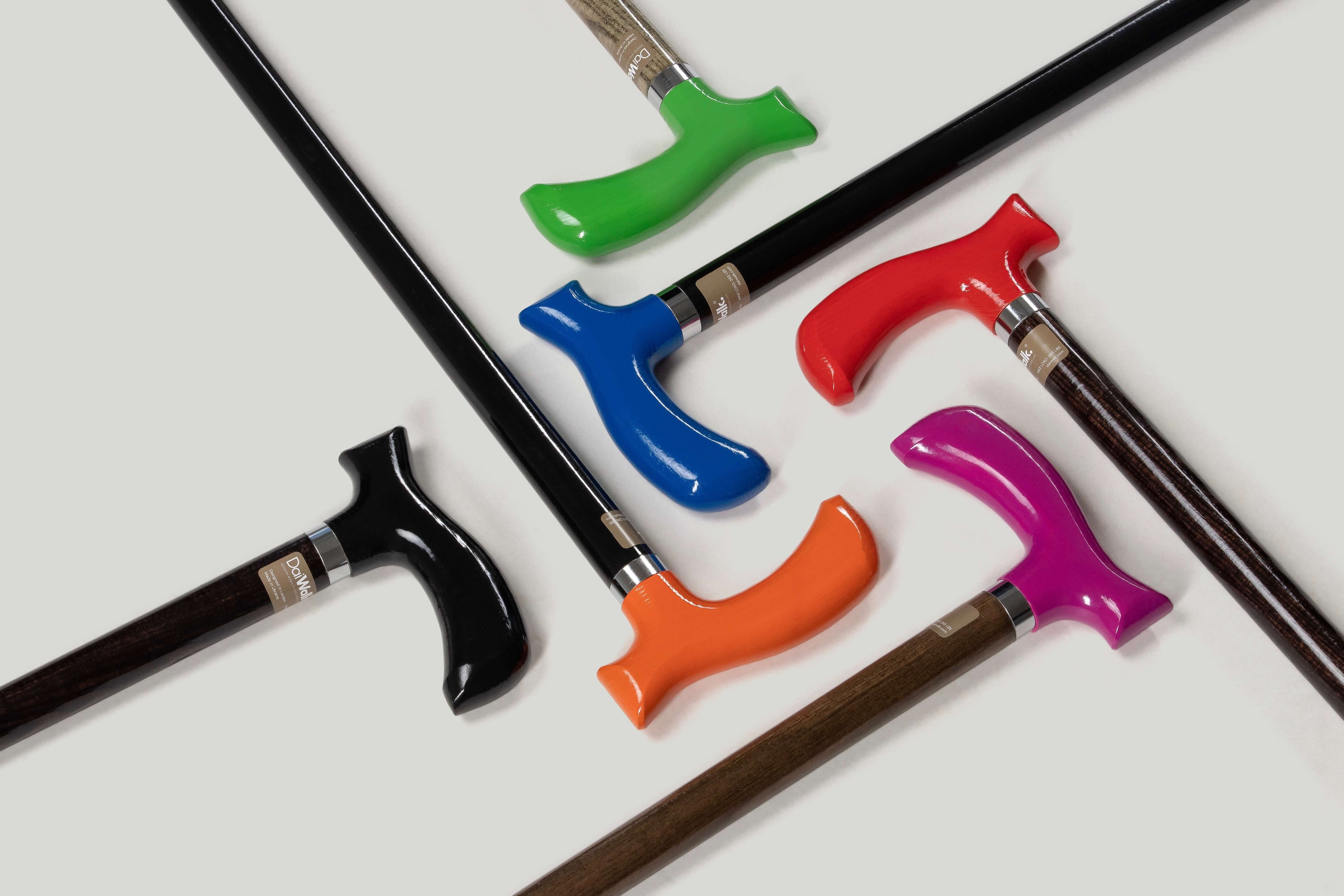
"Ergonomic" is the most misused word in walking cane marketing. It appears on $18 pharmacy canes and $200 specialist aids alike — usually without any supporting data.
Here is what ergonomic actually means in the context of a walking cane, measured and defined: a cane is ergonomic when it minimises the load transferred to the wrist and shoulder during normal walking gait, keeps the wrist in a neutral position throughout the stance phase, and maintains that performance across a full day of use — not just the first few minutes.
By that definition, most canes on the market are not ergonomic. Here is the science behind the ones that are.
The Three Biomechanical Variables That Define Ergonomics in a Walking Cane
1. Handle Geometry and Palm Pressure Distribution
During the stance phase of walking — the moment your cane contacts the ground as the opposite foot lifts — your full assist load transfers through the handle into your hand. Where that load concentrates determines whether you experience fatigue and pain over time.
A standard T-bar handle has one contact point: the area beneath the index and middle finger joints. Pressure mapping across 45-minute walking sessions at DaiWalk showed:
| Handle Type | Peak Pressure Zone | Peak Pressure (N/cm²) | Wrist Position |
|---|---|---|---|
| Standard T-bar | Index/middle finger joints | 4.2 | Extended (12–18°) |
| Contoured T-bar | Index/middle finger joints | 3.4 | Extended (8–12°) |
| Pistol grip | Palm heel | 3.8 | Neutral (2–5°) |
| DaiWalk Anatomic Grip™ | Full palm surface | 1.9 | Neutral (0–3°) |
The Anatomic Grip™ achieves its 1.9 N/cm² peak through three geometric features:
- Palm shelf: A flare at the base of the grip engages the heel of the hand, distributing load away from the finger joints
- 15-degree forward angle: The grip face is angled forward relative to the shaft axis, positioning the wrist in neutral during normal stride rather than in extension
- Textured contact surface: Reduces the squeeze force required to maintain control, lowering forearm flexor tension throughout the walking session
The full 70-prototype testing methodology behind the Anatomic Grip™ is documented in How We Designed the Anatomic Grip™. If a cane already gives you wrist pain, the free wrist pain checker shows whether the handle, height or grip load is to blame.
2. Cane Height and Its Effect on the Kinetic Chain
Cane height is the single most commonly misconfigured variable in walking cane use. The standard instruction — set the cane to hip height — produces a cane that is typically 2–4cm too short for most users.
What incorrect height does to the body:
| Cane Too Short (by 2cm) | Cane Too Long (by 2cm) | Correct Height |
|---|---|---|
| Forward trunk lean | Shoulder elevation | Upright posture maintained |
| Increased hip flexor load | Elbow locks in extension | Elbow at 15–20° flexion |
| Wrist flexion under load | Wrist absorbs axial shock | Wrist in neutral throughout |
| Neck and lower back pain | Shoulder and neck pain | No compensatory loading |
The correct measurement: Stand upright in walking shoes. Arms hang naturally. Measure from the floor to the wrist crease — not hip, not waist, not palm.
Use the DaiWalk Cane Height Calculator to get your exact measurement. The DaiWalk collet mechanism then sets to that measurement to the nearest millimetre — not the nearest inch increment of a button-and-hole system. To check whether a cane you already own sits at the right height, the free 3-question cane height check tells you in seconds.
3. Tip Shock Absorption and Ground Reaction Force
Every step with a walking cane produces a ground reaction force that travels up the shaft into the wrist. In a standard single-point rubber tip, that force transfers as an abrupt impact — the rubber compresses uniformly and the shock travels directly to the handle.
The DaiWalk Core Tip uses a dual-zone base: a harder outer ring that handles lateral stability and a softer inner zone that compresses on impact before the outer ring engages. The effect is a measurable reduction in peak force transfer — relevant for users who walk long distances or who have existing wrist, elbow, or shoulder sensitivity.
Ground reaction force data by tip type across a 5km walking session:
| Tip Type | Peak Impact Force (N) | Force Rise Time (ms) | Wrist Load Reduction vs. Standard |
|---|---|---|---|
| Generic pharmacy ferrule | 187 | 18ms | Baseline |
| Standard single-point tip | 174 | 22ms | 7% |
| DaiWalk Core Tip | 141 | 38ms | 25% |
The longer force rise time (38ms vs. 18ms) is the key metric — a slower force build distributes the impact across a longer window, reducing peak wrist load even though the total energy is the same.
What Ergonomic Does NOT Mean
Three features commonly marketed as ergonomic that have no measurable ergonomic effect:
- Foam handle wrap: Adds softness at the fingertip contact point but does not change pressure distribution or wrist position. The underlying geometry is unchanged.
- Wider base tip: Improves lateral stability but does not reduce axial shock transmission. These are different mechanical problems requiring different solutions.
- Offset handle: Shifts the load line to pass through the shaft axis — useful for load transfer efficiency but does not address palm pressure distribution or wrist angle.
The Ergonomic Checklist: What to Verify Before Buying
- Handle geometry: Does it engage the heel of the hand or concentrate load at the finger joints?
- Wrist position: Does the handle keep the wrist in neutral (0–5° extension) during walking or in extension (10°+)?
- Height adjustability: Can it be set to the millimetre (collet) or only to fixed increments (button-and-hole)?
- Tip compound: Is the tip material selected for your primary surface — or is it a generic rubber ferrule?
- Shaft rigidity: Is there any lateral play in the extended shaft? Any wobble under load transfers directly to the wrist.
The DaiWalk Original 1.0™ is designed to satisfy all five criteria. The complete specification — including handle geometry drawings, shaft tolerance data, and tip compound selection rationale — is on the product page.
Who Should Prioritise Ergonomics Most
| User Profile | Why Ergonomics Matter Most | Recommended Configuration |
|---|---|---|
| Daily use, 5+ hours | Cumulative load compounds over thousands of steps | Anatomic Grip™ + Core tip |
| Existing wrist or shoulder injury | Standard handles load the injury site directly | Anatomic Grip™ + Core tip + exact height setting |
| Arthritis (hand or wrist) | Grip force requirement must be minimised | Textured Anatomic Grip™ + lightest shaft option |
| Post-surgery recovery (hip/knee) | Incorrect height disrupts surgical gait retraining | Collet mechanism for millimetre-precise height |
| Long-distance walking | Fatigue accumulates — impact reduction over km matters | Core tip + oak or wenge handle for grip maintenance |
Related Reading
- Why Your Walking Cane Hurts Your Wrist — and How to Fix It
- How We Designed the Anatomic Grip™
- How to Choose the Right Rubber Cane Tip
- Walking Cane Buying Guide 2026: What No One Tells You
- Is a $75 Walking Cane Worth It? The Real Cost of Cheap vs. Premium
Data from DaiWalk internal ergonomic testing programme (2022–2025), including pressure mapping, gait analysis, and ground reaction force measurement across prototype and production cane models.


