


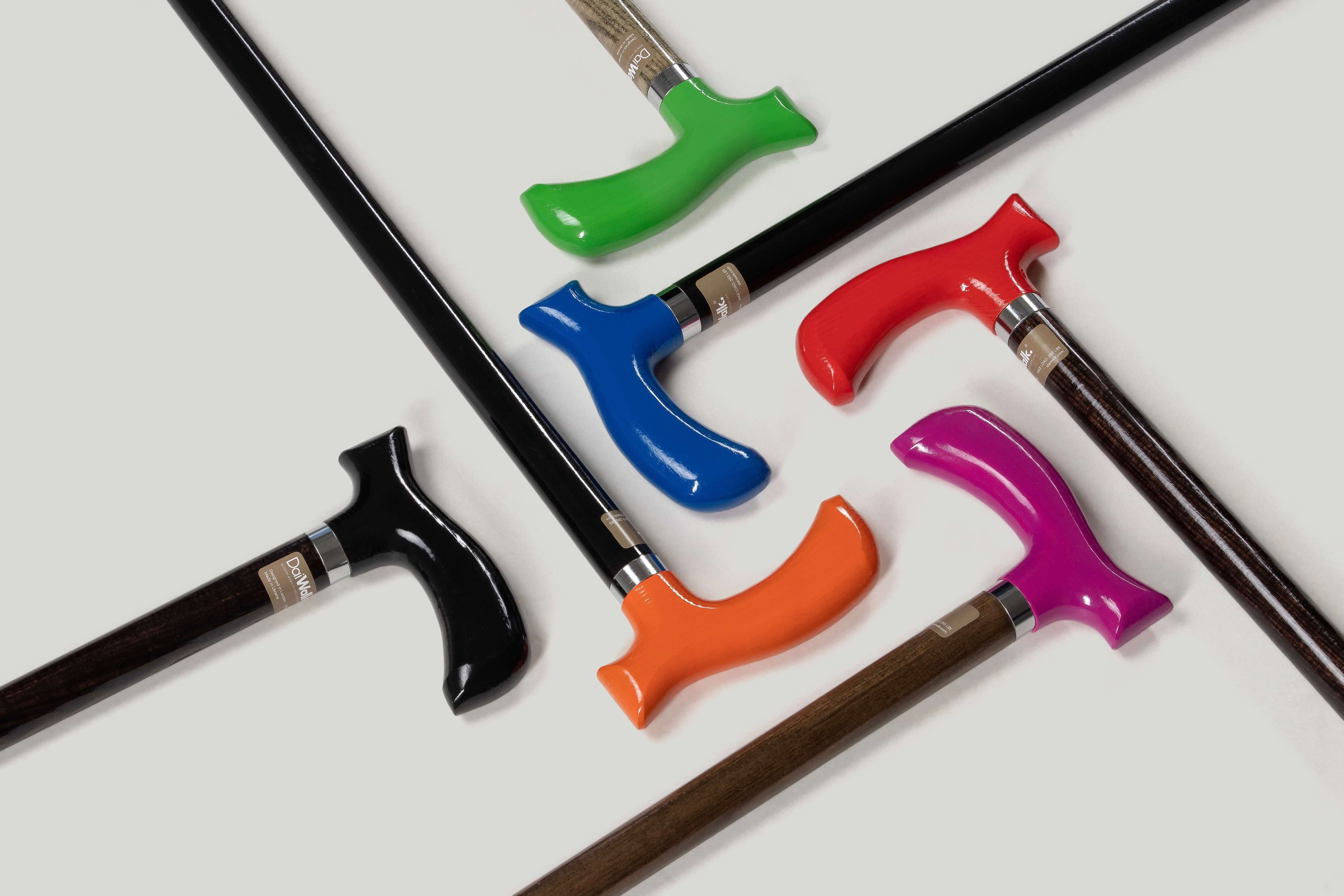
Most walking cane handles are a T-bar. A horizontal cylinder, welded or moulded onto a vertical shaft. It works, in the sense that it holds the cane upright and gives you something to grip. But it wasn't designed for hands — it was designed for manufacturing simplicity.
We wanted to do something different. Here's what that actually involved.
Starting with the problem
The T-bar concentrates load at one point: the area just below the index and middle fingers. Hold a standard T-bar for ten minutes and press your palm — you'll feel exactly where the pressure has been sitting.
This matters for people who use a cane every day, for full days. Not because the pain is always acute, but because cumulative load across thousands of steps causes fatigue, and fatigue changes gait. When your wrist hurts, you walk differently. You start compensating. If you're experiencing this already, see Why your walking cane hurts your wrist — and how to fix it, or run the free wrist pain checker to pinpoint whether it's height, handle or grip.

What we measured
Before designing anything, we looked at where load actually distributes during a walking stride. The cane contacts the ground during the stance phase — roughly the same moment the opposite foot lifts. At that point, the full assist load transfers through the handle into the hand.
We mapped pressure distribution across the palm using four handle prototypes with different geometry: standard T-bar, contoured T-bar, pistol grip, and a custom palm-following profile. We tested across different hand sizes (measured as grip circumference from 170mm to 230mm) and across different walking durations (15 minutes, 45 minutes, 90 minutes).
The results weren't surprising, but they were useful: the more the handle followed the natural curve of the palm, the more evenly load distributed, and the less wrist extension was required to maintain grip.
The geometry we landed on
The Anatomic Grip™ has three specific features that came from this process:
- A palm shelf — a subtle flare at the base of the grip that supports the heel of the hand, not just the fingers. This moves some load out of the finger joints and into the more tolerant heel pad.
- A forward-angled contact surface — the grip face is angled approximately 15 degrees forward relative to the shaft axis. This means your wrist sits closer to neutral during normal walking stride, rather than extending back.
- A textured finish on the contact zones — not decorative. Grip texture means you can maintain control with less squeeze force. Less squeeze force means less tension in the forearm flexors.
What we kept from the T-bar
Familiarity. The Anatomic Grip™ is still a horizontal handle — it mounts perpendicular to the shaft, and you hold it the same way you'd hold any cane. We didn't want people to have to learn a new grip pattern. The improvements are underneath the familiarity. If you're not sure which hand to hold it in, the free which-hand guide covers the rule and the technique.
Material
The grip itself is available in natural oak, wenge, and black alloy. The wood options aren't decorative — wood has better grip coefficient than powder-coated metal in wet conditions (rain, sweat), and it's warmer to the touch in cold weather. The alloy finish is harder-wearing and preferred for heavier daily use.
What we'd do differently
The current Anatomic Grip™ is sized for a median hand. We know from feedback that people with smaller hands (grip circumference below 175mm) and larger hands (above 215mm) get less benefit from the palm shelf geometry, because the shelf lands in a slightly different place relative to their palm heel. Future versions will address this with two size options.
See the Original 1.0™ — every cane includes the Anatomic Grip™ as standard.
Related articles
- Why your walking cane hurts your wrist — and how to fix it
- DaiWalk vs a standard walking cane: 6 differences that actually matter — how the Anatomic Grip™ compares to a standard T-bar in practice
- How to choose the right rubber cane tip — the other component that affects comfort


