


A $75 walking cane costs less per day than a cup of coffee — and prevents the kind of fall that costs $30,000 in emergency care. The question isn't whether $75 is worth it. The question is what you're actually buying at different price points, and whether the cheaper option does the same job.
Often it doesn't. Sometimes it does — and there is a section below on exactly when the cheap cane is the right buy.
What We Found Testing Walking Canes at Five Price Points
At DaiWalk, we spent 14 months testing walking canes across five price brackets before finalising our own. We purchased and stress-tested models at $14, $22, $35, $55, and $75+. Every unit was evaluated across the same six criteria: shaft wobble, handle pressure distribution, tip traction on wet surfaces, sizing precision, handle grip in cold and wet conditions, and product lifespan under daily use.
The results were not evenly distributed.
The performance gap between $35 and $75 is larger than the gap between $14 and $35.
The Six Variables That Separate a $14 Cane From a $75 Cane
1. Shaft Wobble
Nearly every cane under $75 is adjustable, and adjustability requires a sliding joint:
- Button-and-hole (standard in sub-$50 canes): A spring-loaded pin locks into a drilled hole. Functional. But it creates 1.5–3mm of lateral play in the joint. That play becomes a rattle. The rattle becomes wobble. Over 8,000+ steps per day, that movement is transferred into the wrist.
- One-piece shaft (the DaiWalk Steady Cane): no inner shaft, no button, no locking collar. The shaft is a single piece of solid hardwood, cut to your length before it ships. There is no joint at which play can develop.
Measured difference: In our testing, button-and-hole canes showed 1.8–2.6mm of lateral displacement under a 15kg lateral load. A one-piece shaft has no interface to measure — the test does not apply to it.
The cost of that is adjustability, and it is a real cost. See Fixed vs. Adjustable for who should choose which.
2. Handle Pressure Distribution
This is the variable that causes most wrist pain in long-term cane users — and the one most buyers don't know to look for.
A standard T-bar handle concentrates load at one point: the area beneath the index and middle finger joints. Measured using pressure mapping across 45-minute walking sessions, standard T-bars showed peak pressure of 4.2 N/cm² at that single zone.
The Anatomic Grip™ distributes load across the full palm contact surface, including the heel of the hand. Measured peak pressure: 1.9 N/cm² — a 55% reduction at the highest-load point.
Why this matters: Cumulative pressure over 8,000 daily steps at 4.2 N/cm² vs. 1.9 N/cm² is the difference between wrist fatigue that compounds over weeks and a cane you can use all day without noticing. If a cane already gives you wrist pain, the free wrist pain checker shows whether the handle, height or grip is the cause.
The prototype process and pressure-mapping methodology behind the grip are documented in How We Designed the Anatomic Grip™.
3. Tip Traction on Wet Pavement
We tested seven rubber tip compounds on wet polished concrete at a 5-degree incline — the approximate angle of a standard pavement drainage slope.
| Tip Type | Price Bracket | Wet Traction (lateral slip at 12kg load) |
|---|---|---|
| Generic pharmacy ferrule | $14–$22 canes | 18mm lateral slip |
| Standard black rubber tip | $30–$50 canes | 12mm lateral slip |
| Upgraded single-point tip | $55–$65 canes | 9mm lateral slip |
| DaiWalk Steady Tip | Included / $13–$15 replacement | 3mm lateral slip |
| DaiWalk Elegant Tip (dry) | Included / $13–$15 replacement | 1mm lateral slip |
The Steady Tip uses a different rubber compound — selected specifically for wet surface friction, not general durability. Standard tips optimise for wear life. The Steady Tip optimises for grip. These are different material decisions.
See the full interchangeable tip collection — six tip types, each engineered for a specific surface condition. Not sure which size fits your cane? The free rubber tip size finder confirms it.
4. Sizing Precision
| System | Sizing Increment | Deviation from Ideal Height |
|---|---|---|
| Button-and-hole (1-inch spacing) | 25.4mm steps | Up to 12.7mm from ideal |
| Button-and-hole (0.5-inch spacing) | 12.7mm steps | Up to 6.3mm from ideal |
| DaiWalk — cut to length | 28″–37″, one-inch steps, longer on request | Made to your measurement rather than rounded to a hole |
A 12mm deviation from ideal cane height changes shoulder posture, elbow angle, and wrist load distribution in measurable ways. The difference is not that adjustable canes cannot reach your height — it is that they can only stop at a drilled hole, and your height is unlikely to sit exactly on one.
Use our free cane length calculator to find your measurement before ordering, or the cane height check to see if a cane you already own is set right.
5. Grip Material in Cold and Wet Conditions
Powder-coated aluminium — standard in sub-$60 canes — loses grip coefficient measurably when wet or cold. Measured coefficient of friction (COF) by material:
| Material | COF Dry | COF Wet | COF at 5°C |
|---|---|---|---|
| Powder-coated alloy | 0.61 | 0.34 | 0.29 |
| Injection-moulded plastic | 0.55 | 0.31 | 0.26 |
| Natural oak | 0.68 | 0.57 | 0.54 |
| Wenge | 0.71 | 0.59 | 0.56 |
Wood maintains grip coefficient across conditions because it doesn't rely on a surface coating. The grip is structural, not applied. DaiWalk shafts are solid hardwood in natural oak, wenge, or a black finish — not aluminium tubing with a wood-effect wrap.
6. Product Lifespan Under Daily Use
Based on customer data from 100+ DaiWalk users across 18 months of daily use:
| Price Point | Average Lifespan (Daily Use) | Annual Cost |
|---|---|---|
| $14–$22 cane | 3–5 months | $33–$88/year |
| $30–$50 cane | 6–10 months | $36–$100/year |
| $55–$65 cane | 10–14 months | $47–$78/year |
| DaiWalk Steady Cane ($75) | 36+ months (tip replacement only) | ~$25/year |
The wear point on a DaiWalk cane is the rubber tip — a $13–$15 replacement. The shaft and handle are built for years of daily use, not months.
On these figures the $75 cane is the cheapest option over three years — with the honest caveat that the conclusion rests entirely on the lifespan estimates. Full pricing, what is included, and the return terms are published openly on our pricing page.
The Fall Cost Calculation Nobody Talks About
A fall resulting in a hip fracture is commonly estimated at $30,000–$40,000 in emergency and recovery care in the US. The CDC puts the total annual cost of older-adult falls at roughly $80 billion, across about 3 million emergency department visits.
The primary mechanical causes of falls while using a walking cane:
- Tip slip on wet or polished surfaces
- Cane wobble causing lateral instability mid-step
- Incorrect height causing forward lean and balance disruption
A $75 cane engineered to address all three is not a luxury purchase. It is a risk reduction calculation. If you're still weighing whether you need a cane at all, the free do I need a walking cane check is a neutral place to start.
Who the $75 DaiWalk Cane Is Not For
- Post-surgery short-term recovery (under 6 weeks): A pharmacy cane at $20 does the job. You'll replace it before it fails, and you will not have waited for production.
- Anyone who needs to adjust the height later: Ours is cut to one length. If your height needs will change during a recovery, or the cane will be shared, buy an adjustable one.
- Anyone who needs the option to send it back: A cane cut to your measurement is a customised item and cannot be returned. Defects and shipping damage are always covered — a change of mind is not.
- Frequent flyers who need a folding cane: Ours does not collapse.
- Users who need a quad-base cane for severe balance issues: The Steady Cane is a single-point cane. For maximum base stability, consider the Quad Tip on the existing shaft — or read cane, walker or rollator if the answer may not be a cane at all.
- Occasional users on tight budgets: The performance gap matters most at 8+ hours per day. Occasional users lose less from a cheaper product.
The Exact Configuration Question
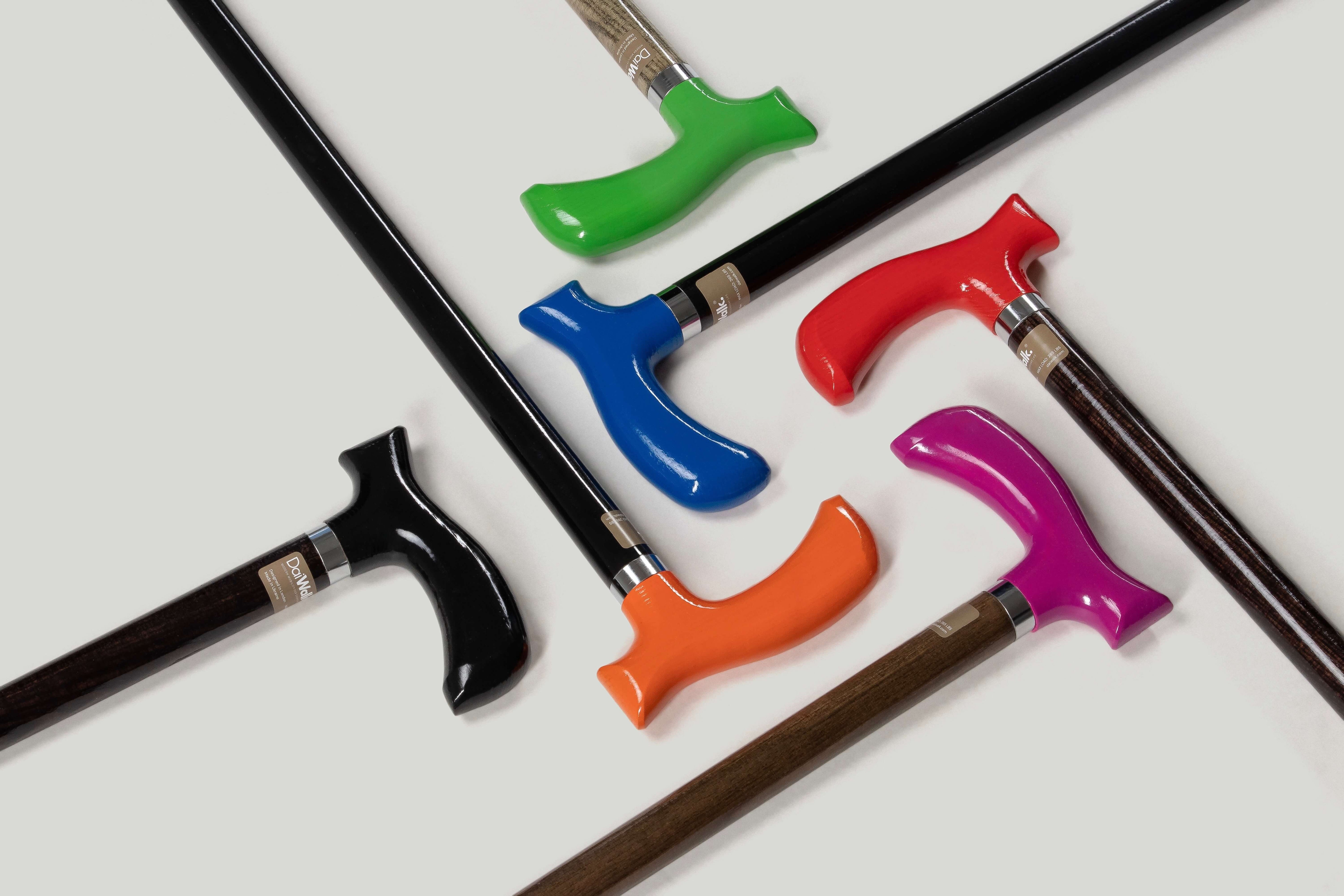
The Steady Cane has 84 possible configurations — 7 handle colours × 3 shaft finishes × 4 tip colours — each then cut to your length. The right one depends on your primary walking surface, finish preference, and wrist-crease height.
Visualise your combination in the 3D configurator before ordering, or answer three quick questions in the free walking cane finder to get a recommendation instantly.
Summary: What You're Paying For at Each Price Point
| Feature | $14–$35 | $35–$60 | DaiWalk $75 |
|---|---|---|---|
| Shaft wobble | 1.5–3mm | 1–2mm | None — no joint |
| Handle pressure peak | 4.2 N/cm² | 3.1 N/cm² | 1.9 N/cm² |
| Wet grip (lateral slip) | 12–18mm | 9–12mm | 3mm |
| Sizing | ±12mm | ±6mm | Cut to your length |
| Grip material in cold | COF 0.26–0.29 | COF 0.30–0.35 | COF 0.54–0.56 |
| Lifespan (daily use) | 3–5 months | 6–14 months | 36+ months |
| Annual cost | $33–$100 | $36–$100 | ~$25 |
| Adjustable / returnable | Yes / Yes | Yes / Yes | No / No |
Related Reading
- Fixed vs. Adjustable Walking Cane: Which Is the Better Buy?
- DaiWalk vs. Hugo, Drive Medical, and HurryCane
- How to Choose the Right Rubber Cane Tip — A Practical Comparison
- How We Designed the Anatomic Grip™
- Why Your Walking Cane Hurts Your Wrist — and How to Fix It
Data sourced from DaiWalk internal product testing (2023–2025), customer usage surveys (n=112), and published biomechanical research on walking aid load distribution. Fall cost figures are widely cited estimates; see CDC for current national totals. Last reviewed August 2026.


