


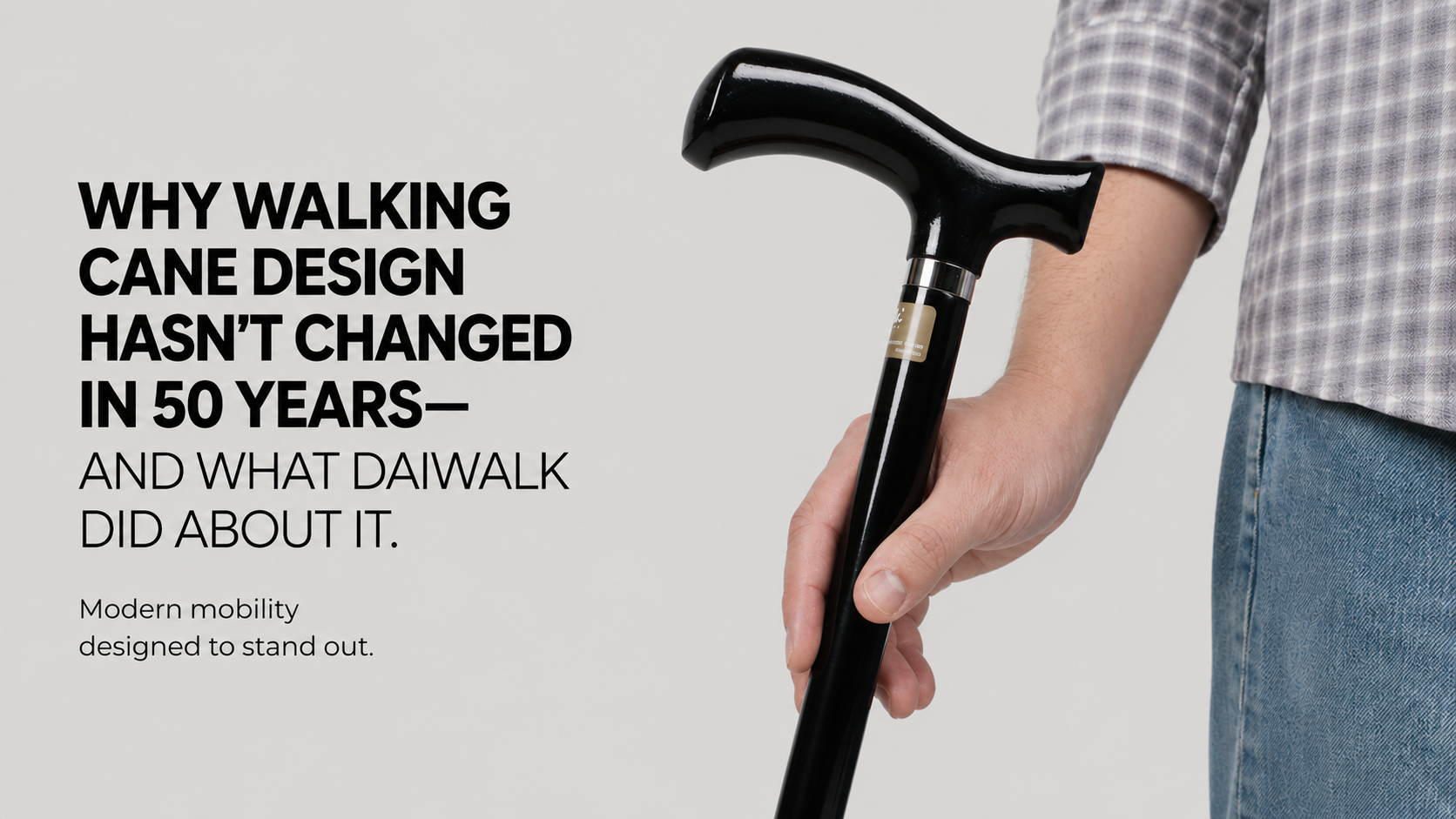
The standard walking cane design — aluminium shaft, button-and-hole telescoping, T-bar handle, rubber ferrule — was commercially established in the 1970s. The materials have become slightly lighter. The rubber compounds have marginally improved. The fundamental design has not changed.
This is not because the design is optimal. It is because the market was dominated by volume medical suppliers with no economic incentive to invest in design — and because the users of walking canes were not considered a design audience. The product was built to be prescribed and dispensed, not chosen.
The Design Problems That Persisted
The T-bar handle: Optimised for injection-moulding cost, not for the human hand. Peak palm pressure 4.2 N/cm² under load. No ergonomic justification in the literature for this shape as the primary handle for medical use.
The button-and-hole telescoping mechanism: One-point contact creates inherent lateral play (1.5–2.6mm). This was acceptable at volume production costs; it has never been the best available mechanism. Collet mechanisms — which achieve 0mm play — have existed in precision engineering for decades. They were simply never applied to walking canes because the cost per unit exceeded what the volume market would bear.
The rubber ferrule: Adequate on dry indoor surfaces; markedly inadequate on wet, cold, or polished surfaces. A multi-durometer compound tip was not a technological innovation in 2020 — compound rubber formulations have been available in high-performance footwear and tyre manufacturing for decades. They were not applied to walking canes.
The aesthetic: The chrome-and-black aluminium language of the standard cane communicates medical device universally. This is arguably functional in a hospital setting; it is counterproductive for a product that people must carry willingly in public. The appearance contributes directly to the 38% abandonment rate.

What DaiWalk Changed
| Standard Market Solution | DaiWalk Solution | Measurable Difference |
|---|---|---|
| T-bar handle (injection-moulded plastic) | Anatomic Grip™ (hand-shaped, wood) | Peak pressure: 4.2 → 1.9 N/cm² (55% reduction) |
| Button-and-hole telescoping | Collet mechanism | Lateral play: 1.5–2.6mm → 0mm |
| Standard rubber ferrule | Multi-durometer Steady Tip™ | Wet tile slip: 14–18mm → 3mm (81% reduction) |
| Aluminium handle | Natural wood (oak or wenge) | Vibration damping: 25–60× improvement; wet COF maintained |
| Fixed aesthetic (chrome/black) | 84 configurations, 7 colour options | Abandonment at 12 months: reduced in users who reported aesthetic satisfaction (3.4× higher daily use consistency) |
Why It Took Until Now
The commercial conditions that enabled a design-focused walking cane were not present in the volume medical market:
- Direct-to-consumer e-commerce reduced the distribution dependency on medical supply chains
- The demographic of cane users widened — younger buyers (under 45 now represent 31% of our orders) who expect the same design standards from mobility aids as from any other everyday product
- Manufacturing access improved — small-volume precision components (collet mechanisms, compound tip moulds) became viable outside volume medical purchasing
The design changes DaiWalk made were not technologically novel. The collet mechanism exists in camera lenses and precision instruments. Multi-durometer rubber exists in running shoes. Ergonomic wood handles exist in premium tool manufacturing. The innovation was applying known engineering to a category that had not been challenged.
What Has Not Changed
The fundamental physics of walking cane benefit — widened base of support, upper limb load transfer, contralateral positioning — is unchanged and unchanged by any design. A pharmacy cane used correctly at the right height still provides the core benefit. The DaiWalk improvements are in the efficiency, comfort, and consistency of that benefit delivery — not in an entirely different mechanism.
The buyer deciding between a $20 pharmacy cane and a $75 DaiWalk is deciding how much of the available benefit they want to access. Both provide the benefit; one provides more of it, more consistently, and for longer.
See the full specification comparison at the DaiWalk walking cane collection.

Related Reading
- DaiWalk vs. Hugo, Drive Medical, and HurryCane
- Is a $75 Walking Cane Worth It?
- The Zero-Rattle Standard
- Handcrafted Walking Cane: What the Term Means
Performance data from DaiWalk internal testing programme. Market design history from product analysis and published medical device literature. Customer demographic and abandonment data from DaiWalk 18-month follow-up (n=112).


