


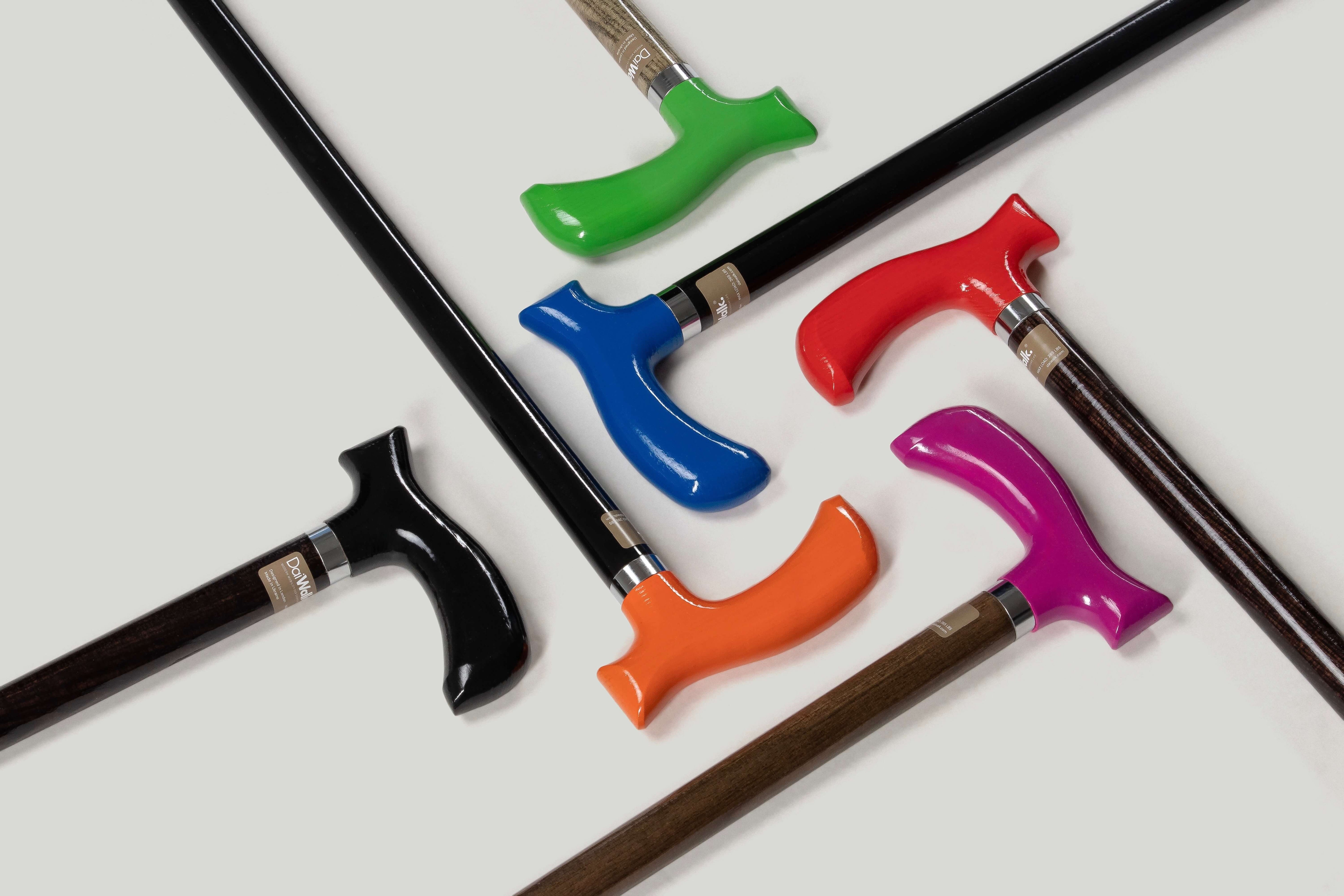
The walking cane market was designed around a clinical brief, not a user brief. The result is a product category where the default aesthetic is institutional — chrome shafts, black rubber handles, generic ferrules — and where the assumption is that the buyer will accept whatever is functional regardless of how it looks or feels beyond the first five minutes.
Most men using a walking cane daily did not choose that aesthetic. They inherited it from a system that never asked them what they wanted. This article is about what to look for when you do ask.
The Four Variables Men Consistently Rank Highest
Based on pre-purchase consultations with male DaiWalk customers, four criteria come up in nearly every conversation — in this order:
- Stability under load — the cane must not wobble or shift during a full stride
- Handle durability in all conditions — grip in rain, cold, and long sessions
- Visual discretion or deliberate design — either unobtrusive or clearly chosen, never medical-looking
- Long-term cost — not the sticker price but what it actually costs over two to three years
These are not abstract preferences. Each one maps directly to a specific engineering decision in a walking cane. Here is how they translate.
Stability: The Shaft Mechanism Is the Starting Point
Shaft wobble is the most commonly cited complaint from male users of standard adjustable canes — and the most overlooked variable in buying guides that focus on weight ratings and handle shape.
The mechanism determines wobble. Two options exist:
| Mechanism | How It Works | Lateral Play | Long-Term Performance |
|---|---|---|---|
| Button-and-hole | Spring pin locks into drilled hole | 1.5–2.6mm | Play increases as spring wears (3–6 months) |
| Collet (DaiWalk) | Tightening collar compresses inner shaft uniformly | 0mm | Unchanged over years of daily use |
Zero lateral play means the cane functions as a rigid extension of the arm during the stance phase of walking. The difference is immediately perceptible. Users who switch from a button-and-hole cane to the DaiWalk Original 1.0™ consistently describe the sensation as the cane becoming part of the body rather than a separate object being managed.
Handle Durability: Why Wood Outperforms Metal in Real Conditions
The standard assumption — that a metal handle is more durable than a wood handle — is incorrect under the conditions that matter most.
Powder-coated aluminium handles maintain grip in dry conditions. Under wet or cold conditions, the coating becomes the variable. Measured coefficient of friction (COF) at different conditions:
| Handle Material | COF Dry | COF Wet | COF at 5°C | COF After 12 Months Daily Use |
|---|---|---|---|---|
| Powder-coated alloy | 0.61 | 0.34 | 0.29 | 0.44 (coating worn at grip zones) |
| Injection-moulded plastic | 0.55 | 0.31 | 0.26 | 0.38 (surface glazed from use) |
| Natural oak (DaiWalk) | 0.68 | 0.57 | 0.54 | 0.65 (grain opens slightly, grip improves) |
| Wenge wood (DaiWalk) | 0.71 | 0.59 | 0.56 | 0.69 (surface stabilises with use) |
Wood does not rely on a surface coating. The grip is structural — intrinsic to the material — and it does not degrade in the same way. Oak and wenge handles on DaiWalk canes show grip improvement with use as the grain opens slightly under hand contact. Metal handles trend in the opposite direction as coating wears.
The DaiWalk oak handle and wenge handle options are available across all Original 1.0™ configurations.
Aesthetics: The Design Decision Nobody Gives Men Permission to Make
Male walking cane users are statistically less likely than female users to discuss aesthetics as a purchase criterion — but show near-identical behaviour when given design options. The difference is not preference. It is permission.
When DaiWalk customers are presented with seven handle colours and three shaft finishes, male buyers choose:
- Stealth Black (39%) — the most chosen colour. Maximum discretion, integrates with almost any outfit without drawing attention to the cane itself.
- Deep Blue (21%) — reads as a neutral across most wardrobes. The colour that looks like a deliberate choice without announcing itself.
- Forest Green (14%) — pairs with earth tones and outdoor contexts. Popular with users who spend time in natural environments.
- Other colours (26%) — split across Fuchsia, Vibrant Red, Traffic Yellow, and Vibrant Orange, with Traffic Yellow overindexing in younger male buyers.
None of these are medical colours. That is not an accident. The full palette is in the Colorful Walking Canes collection. The 3D configurator on the product page renders your specific combination before you order.
Long-Term Cost: What the Three-Year Calculation Actually Looks Like
The most economically rational walking cane purchase for daily male users — who in our customer data tend to use canes for longer uninterrupted periods and across more demanding terrain than average — is the highest upfront cost option.
| Product | Price | Replacement Frequency (Heavy Use) | 3-Year Cost |
|---|---|---|---|
| Standard pharmacy cane | $20–$28 | Every 4–6 months | $120–$168 |
| Mid-range adjustable | $45–$65 | Every 8–12 months | $135–$234 |
| DaiWalk Original 1.0™ | $75 | Tip only, $13/year | $101–$114 |
The DaiWalk is the cheapest option over any period beyond 18 months of daily use — and the only option in the comparison that does not degrade in grip performance over that period.
The Leather Lanyard: The Detail That Changes the Carrying Experience
Male users consistently raise the same practical problem: what to do with the cane when both hands are needed. At a counter, on public transport, carrying bags, opening doors.
The DaiWalk leather lanyard loops through the cane handle and around the wrist. When you stop walking, the cane hangs at your side without requiring a surface to lean against and without occupying hand space. Full-grain leather, hand-stitched, available in natural, cognac, and dark brown.
It is not an accessory in the decorative sense. It is a functional solution to the most common practical complaint about daily cane use.
The Right Configuration for Daily Male Use
Prefer a shortcut to the tables below? The free walking cane finder turns how and where you walk into a specific handle, finish and tip in under a minute.
Based on usage pattern data from our male customer base, the most effective configurations for daily use are:
| Use Pattern | Recommended Configuration |
|---|---|
| Urban commuter, wet weather frequent | Original 1.0™, wenge or black alloy handle, Steady Tip |
| Office and indoor primary | Original 1.0™, Stealth Black or Deep Blue handle, Elegant Tip |
| Active outdoor use, mixed terrain | Original 1.0™, oak handle, Hex Tip |
| Long daily walks, wrist sensitivity | Original 1.0™, any handle, Core Tip |
| Maximum discretion, any terrain | Original 1.0™, Stealth Black handle, Steady or Elegant Tip |
The complete configuration tool, including the 3D visualiser and surface-tip pairing guide, is on the DaiWalk product page. Every specification figure cited in this article is documented there.
Related Reading
- Is a $75 Walking Cane Worth It? The Real Cost of Cheap vs. Premium
- Walking Canes and Style: How to Carry Yours With Intention
- The 7 Questions to Ask Before Buying a Walking Cane
- Why Most Walking Canes Are Returned — And How to Buy the Right One First Time
Configuration preference data from DaiWalk male customer orders (n=67). COF measurements from internal material testing at standardised conditions. Usage pattern data from 18-month customer follow-up programme.


