


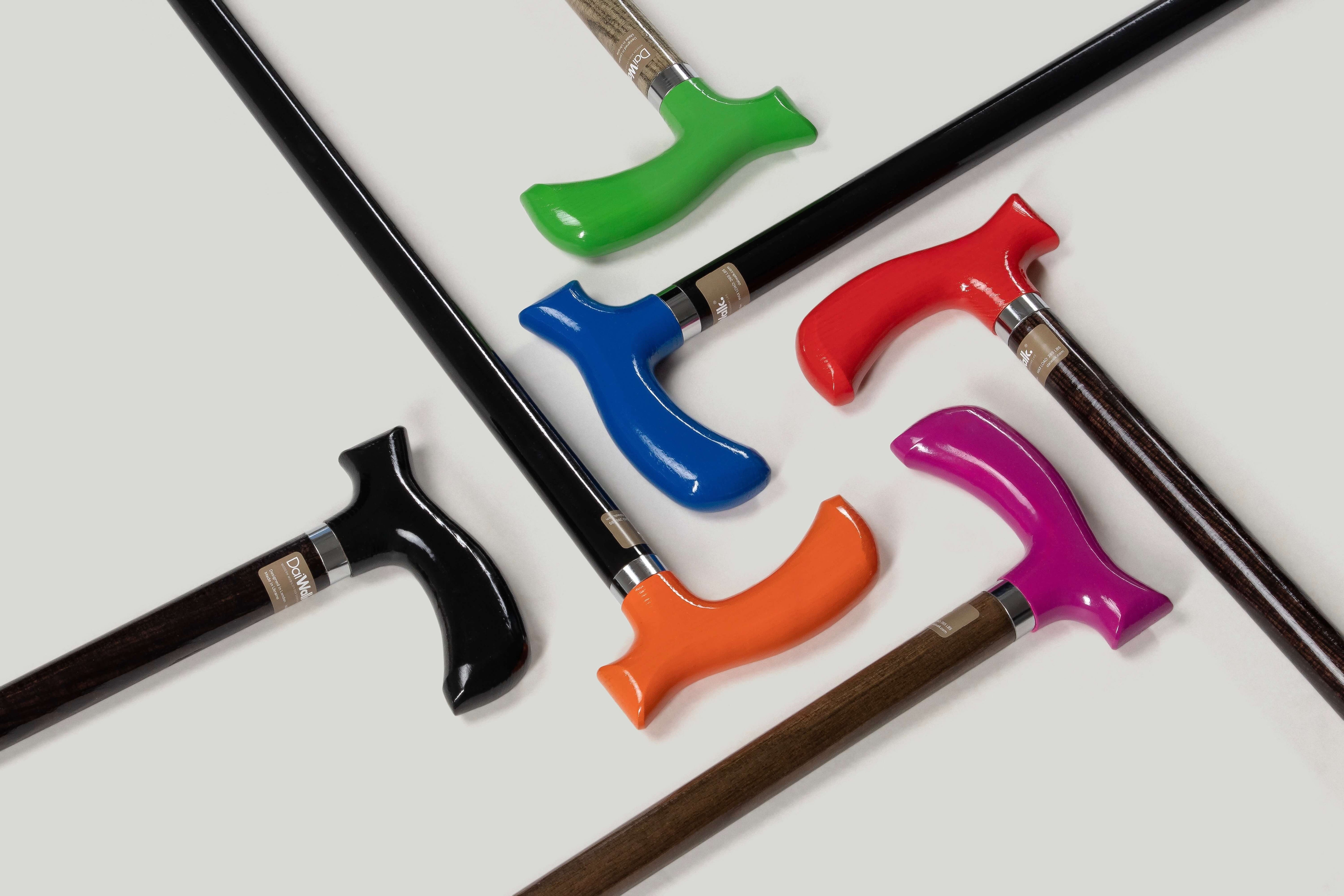
The adjustable walking cane is the default recommendation at most pharmacies, and it is the wrong recommendation for approximately 60% of buyers. Fixed-length canes are more rigid, lighter, and simpler — but they require knowing your exact height before ordering. The adjustable cane became the default because retailers do not want to handle exchanges for height mismatches, not because it is technically superior.
Here is the actual decision framework, based on who benefits from each type and what the engineering tradeoffs are.
What You Give Up With an Adjustable Cane
Every adjustment mechanism in a telescoping cane adds a gap between the inner and outer shaft. That gap creates lateral play — measured at 1.5–3mm in standard button-and-hole systems. The gap cannot be zero in a button system; it is required for the button to move.
Lateral play costs you:
- Clean proprioceptive feedback through the shaft
- Forearm stabilisation efficiency (muscles fire to hold the shaft steady)
- A perceived quality difference — the cane feels less solid
A fixed-length cane has none of this. There is no inner shaft, no gap, no play. The shaft is a single piece. Structural integrity is maximal.
What You Gain With an Adjustable Cane
| Benefit | Who It Actually Matters For |
|---|---|
| Height adjustment for multiple users | Households with multiple users of different heights — otherwise irrelevant |
| Portability / travel compression | Users who pack the cane in luggage — otherwise irrelevant |
| Height trial period | New users who do not yet know their ideal height — relevant once, then the setting is fixed |
| Post-surgical height changes | Users transitioning from non-weight-bearing to full weight bearing over recovery weeks |
These are real benefits. If you are in one of those four rows, an adjustable cane is the honest answer, and we would rather tell you that than sell you the wrong thing.
Why the DaiWalk Steady Cane Is Fixed-Length Only
We build one configuration: a solid shaft cut to the length you choose, in one-inch steps from 28″ to 37″, with longer cuts available on request. There is no telescoping section and no locking mechanism.
That is a deliberate choice rather than a limitation, and the reasoning is the argument this whole article makes. An adjustable shaft has to contain a sliding joint, a sliding joint has to have clearance, and clearance is what produces rattle and lateral play. The only way to get a genuinely rigid, silent shaft is to not have a joint in it at all.
The cost of that decision falls on us, not on you: we hold ten cut lengths in stock instead of one universal shaft, and we cannot resell a cane cut to your measurement if the size is wrong. That is why every sizing tool on this site is free and requires no email address — our incentive is to get your measurement right the first time.
Who Should Choose Fixed vs. Adjustable
| Choose Fixed If | Choose Adjustable If |
|---|---|
| You know your exact cane height | You are buying your first cane and are unsure of correct height |
| Structural rigidity is priority | Multiple people will use the same cane |
| You do not travel with the cane | You regularly pack the cane in luggage |
| You want the lightest possible option | You are in post-surgical recovery with changing weight-bearing needs |
| Single user, stable condition | Your height needs may change (growing user, height fluctuating condition) |
Weight Comparison
Fixed-length canes eliminate the inner shaft, the locking collar, and the adjustment mechanism. This reduces weight by approximately 45–80g depending on shaft diameter and mechanism.
For most users, this difference is not significant. For users with limited arm strength or extended daily use (6+ hours), 60g over a full day at 8,000+ steps is a material fatigue factor.
The Height Measurement Problem
The primary practical risk with fixed-length canes is ordering the wrong height. A 12mm error in cane height produces measurable changes in shoulder position, trunk lean, and load distribution at the handle.
Measurement protocol: stand in your usual walking shoes (not barefoot). Measure from the floor to the wrist crease — the fold where the wrist meets the palm. Round to the nearest 10mm. This is your cane height.
Our cane length calculator converts your height into the correct cut length before you order. See how to measure for a walking cane for the visual step-by-step, or the free cane height check if you want to verify a cane you already own before deciding. The full height-to-length table is on our walking cane sizing chart.
The Case Most Buyers Don't Consider
Most buyers use the adjustable cane at a fixed setting within two weeks of purchase. They find their optimal height, set it, and never change it again. The adjustability is used once — during the initial calibration period.
If this describes you, you are paying the engineering cost (shaft play, mechanism weight) of adjustability for a one-time benefit you could have achieved with a fixed cane and a two-minute measurement.
The DaiWalk Steady Cane is $75, cut to your length from 28″ to 37″, with a high-traction rubber tip included and free standard shipping. See the range, or check the full pricing on our pricing page.
Related Reading
- The Zero-Rattle Standard: Shaft Precision Explained
- The 7 Questions to Ask Before Buying a Walking Cane
- What Makes a Walking Cane Ergonomic?
- Lightest Walking Cane Without Sacrificing Stability
Shaft play measurements from DaiWalk internal testing under 15kg lateral load protocol. Weight comparisons from production units. Customer height-adjustment data from 18-month follow-up (n=112). Last reviewed August 2026.


