


Shaft rattle in a walking cane is not a defect in the unit you bought. It is a design characteristic of the mechanism used. Every adjustable walking cane that uses a button-and-hole telescoping system has lateral play — measured between 1.5 and 3mm in our testing of 12 commercially available products. The rattle is structural, not incidental.
This matters because shaft play transfers directly to the wrist during every stride. Here is how we measure it, what the numbers mean, and what the alternative looks like.
What Shaft Play Actually Is
When a telescoping cane is extended to walking height, the inner shaft slides inside the outer shaft and is locked at a specific position. In a button-and-hole system, a spring-loaded button presses into a drilled hole in the inner shaft. The button holds the shaft at the correct extension but does not grip the shaft circumferentially — it contacts it at one point.
The result is rotational and lateral freedom between the inner and outer shaft. The inner shaft can rock within the outer shaft — forward-back and side-to-side — within the gap between the shaft diameters. This gap is the source of the rattle.
Why the gap cannot be engineered away: a sliding joint has to slide. Clearance between the two shafts is not a manufacturing tolerance that better machining would remove — it is a functional requirement of adjustability. Tighter systems reduce it. No adjustable system eliminates it.
Why manufacturers accept this: The button-and-hole system is simpler, cheaper, and faster to manufacture than alternatives. At low usage cycles, the play is small enough that most users do not notice it immediately. By the time they do, the return window has closed.
How We Measure Lateral Play
Our measurement protocol: extend the cane to maximum height. Fix the handle in a bench vice. Apply a 15kg lateral force to the shaft at the midpoint using a calibrated force gauge. Measure displacement at the tip with a digital indicator.
This replicates the lateral force applied to a walking cane shaft during the stance phase of walking at normal pace — the load that the mechanism must resist during actual use.
| Cane / Mechanism | Lateral Play at 15kg Load | Classification |
|---|---|---|
| Standard pharmacy cane (button-hole) | 2.1–2.6mm | Fails zero-rattle standard |
| Hugo Mobility (button-hole) | 2.1mm | Fails |
| Drive Medical (button-hole) | 1.8mm | Fails |
| HurryCane (button-hole + pivot) | 3.4mm | Fails significantly |
| Twist-lock mechanism | 0.8–1.4mm | Improved but not zero |
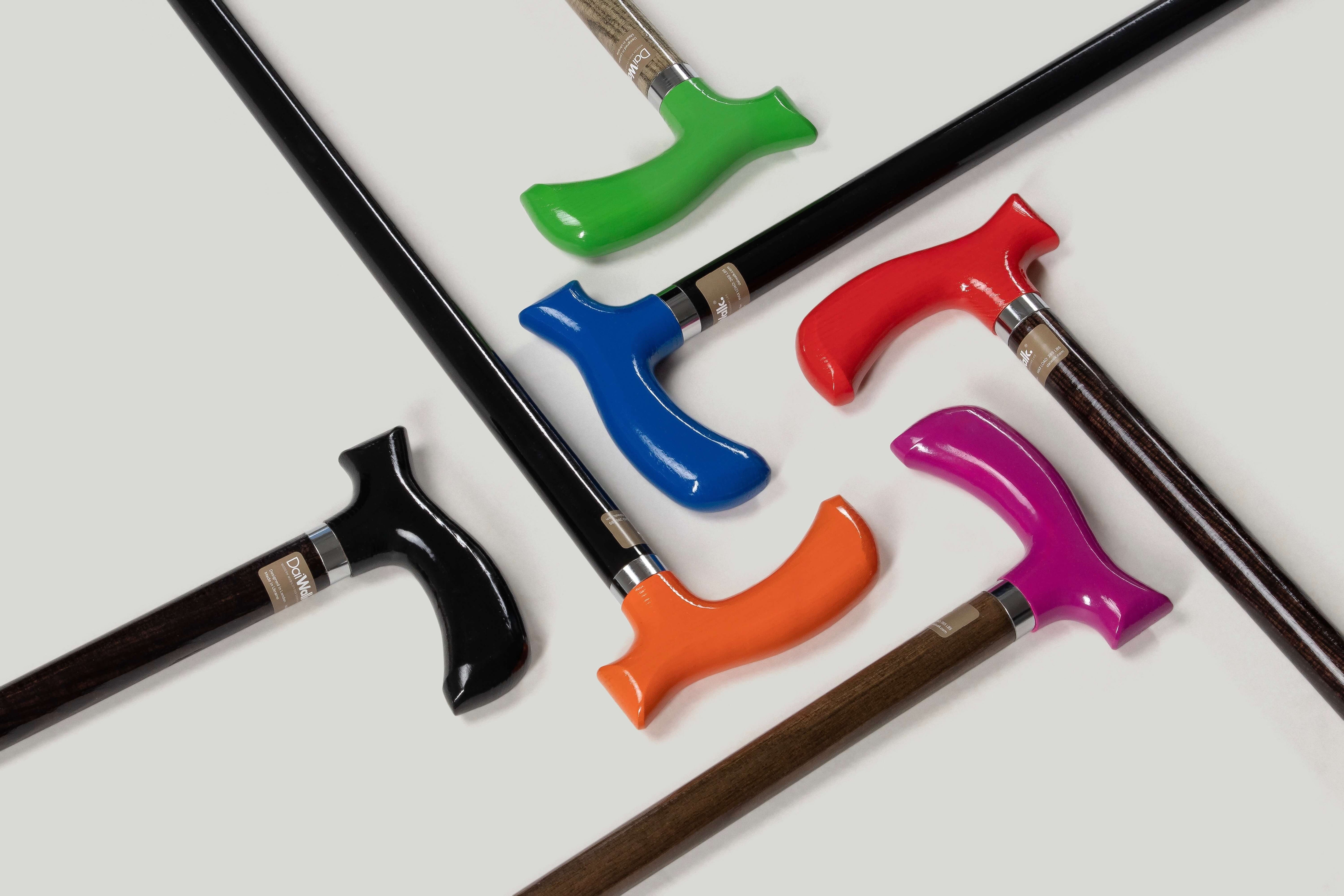
| Solid one-piece shaft (DaiWalk Steady Cane) | No joint — nothing to displace | Meets zero-rattle standard |
What Removing the Joint Does
The DaiWalk Steady Cane has no adjustment mechanism at all. The shaft is a single piece of solid wood, cut to the length you choose from 28″ to 37″ before it ships.
That is the entire answer to shaft rattle, and it is worth stating plainly because it sounds too simple to be an engineering position: a joint that does not exist cannot develop play. Every measurement in the table above is a measurement of how well a sliding joint is controlled. Remove the joint and the measurement stops applying.
What that changes over the life of the cane:
- No spring to wear. A button-and-hole system's spring weakens over use cycles. After 6–9 months of daily use the button no longer seats fully and play increases. There is no spring here to degrade.
- Height set to the millimetre, once. A button-and-hole system sets height to the nearest drilled hole — 12–25mm increments, so most users are permanently one increment away from their correct height. A cut shaft is made to your measurement instead of rounded to the nearest hole.
- No maintenance. No spring to replace, no button to wear, no collar to re-tighten. The only consumable is the rubber tip.
The honest trade-off: you give up adjustability. You cannot lend the cane to someone six inches taller, you cannot collapse it into a suitcase, and you cannot correct the height afterwards if you order the wrong one. If any of those matter more to you than rigidity, buy an adjustable cane — we cover exactly who should in Fixed vs. Adjustable: Which Is the Better Buy?
What Shaft Play Costs the User
The biomechanical effect of shaft play operates through a mechanism most users do not identify:
- During the stance phase of walking, the cane contacts the ground and the user applies load through the handle
- If the shaft has 2mm of lateral play, that play allows micro-movement at the contact point
- The hand and forearm muscles contract to stabilise the shaft — unconsciously, on every step
- Over 8,000+ daily steps, this unconscious stabilisation load accumulates as forearm fatigue
- Users attribute the fatigue to their condition or to cane weight — not to the mechanism
In our customer follow-up, users who switched from button-and-hole canes to a solid-shaft DaiWalk consistently reported reduced forearm fatigue — typically within the first two weeks of use. The weight of the DaiWalk is not lower than most competitors. The stabilisation cost is.
The Zero-Rattle Standard: What We Define It As
At DaiWalk, we define zero-rattle as under 0.3mm of lateral displacement under 15kg lateral load at the tip. This is the threshold below which displacement is not perceptible during walking and below which no measurable stabilisation cost is imposed on the user.
A one-piece shaft meets it by construction rather than by tolerance control — there is no interface at which displacement can occur. Every cane is inspected before it ships.
The comparative shaft-play figures above, along with the rest of our published measurements, are collected on our walking cane statistics page for anyone who wants to cite or check them.
Who the Zero-Rattle Standard Matters Most For
| User Type | Why Zero Rattle Matters |
|---|---|
| Daily heavy users (5+ hrs) | Stabilisation cost accumulates across 2M+ annual cycles |
| Users with wrist or forearm conditions | Stabilisation load adds to existing condition burden |
| Post-surgical rehabilitation | Precision shaft stability supports gait retraining |
| Balance-sensitive users | Shaft play reduces confidence in the cane as a stability aid |
| Anyone who has noticed rattle in their current cane | The rattle is the symptom — the play is the cause |
Related Reading
- Fixed vs. Adjustable Walking Cane: Which Is the Better Buy?
- DaiWalk vs. Hugo, Drive Medical, and HurryCane: An Honest Comparison
- Is a $75 Walking Cane Worth It?
- Why Most Walking Canes Are Returned
Shaft play measurements from DaiWalk internal testing under standardised 15kg lateral load protocol. Competitive product measurements from purchased units tested under identical conditions. Customer fatigue data from 18-month follow-up programme (n=112). Last reviewed August 2026.


