


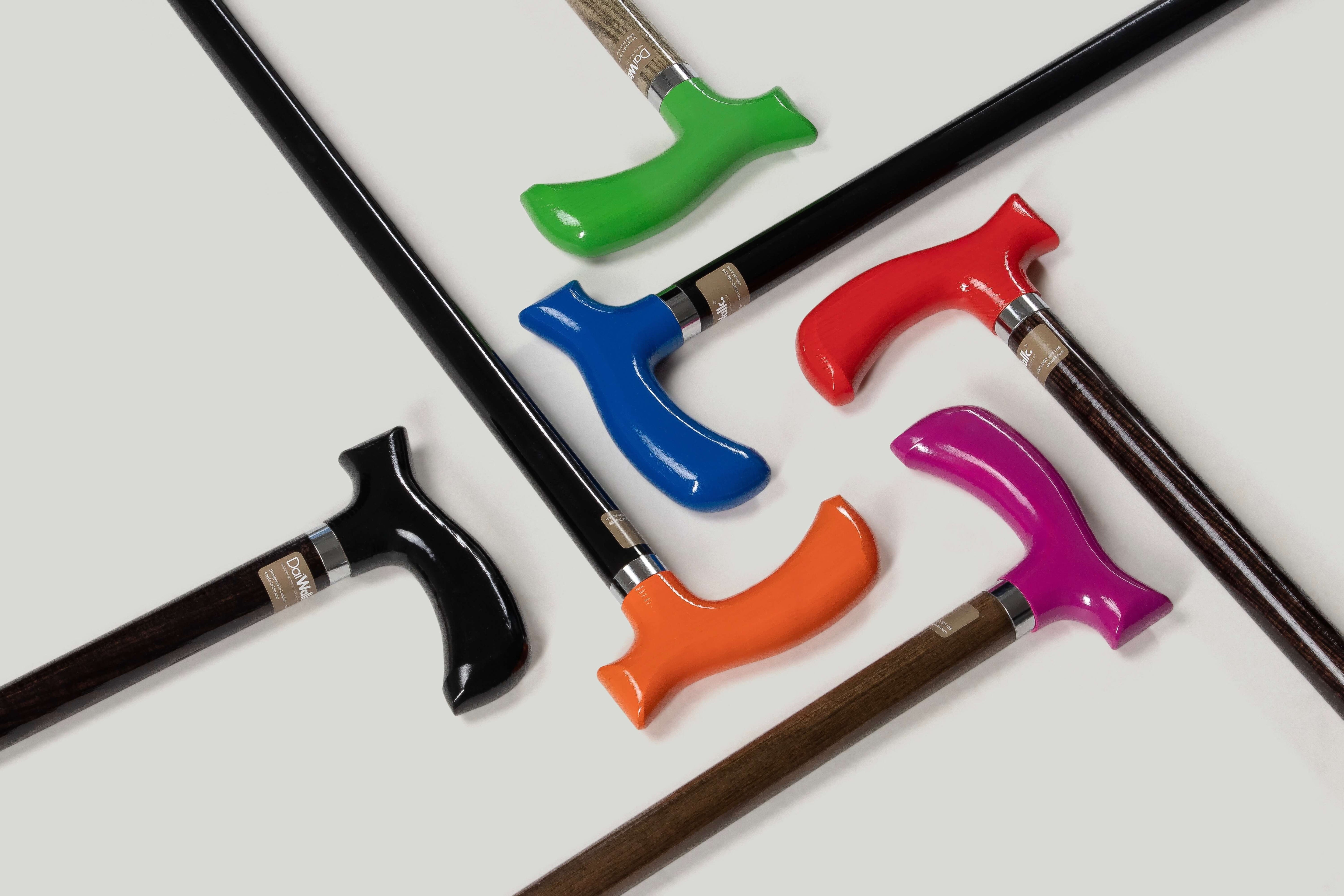
DaiWalk makes six rubber tip types for walking canes. They're not interchangeable in the sense that any will do — each one solves a specific problem. Here's how to decide which you need.
The quick version
| Tip | Best for | Avoid if |
|---|---|---|
| Elegant | Smooth indoor floors, everyday urban use | You walk a lot on wet pavement |
| Steady | Rain, wet pavements, uneven sidewalks | You need the cane to stand on its own |
| Core | Long daily walks, wrist or elbow impact fatigue | You need maximum lateral stability |
| Quad | Maximum stability, rehab, the cane needs to stand alone | Cobblestones or very uneven terrain |
| Hex | Gravel, cobblestones, outdoor terrain | Smooth indoor floors (overkill and louder) |
| Neon | Low-light environments, evening walks | You want the cane to be subtle |
The Elegant tip
Low-profile, non-marking, silent on hard floors. This is the default tip on most DaiWalk canes — it preserves the cane's clean lines and works well on the surfaces most people encounter most often: polished concrete, wood floors, tile, tarmac.
What it doesn't do well: grip on wet surfaces. The low-profile design that makes it quiet and clean also reduces traction in rain. If you walk outside in all weather, the Steady tip is a better choice.
The Steady tip
High-traction rubber compound, wider base, deeper tread. Built for wet pavements and rain. The grip difference on a slippery surface is significant — the rubber compound was selected specifically for wet traction rather than just durability.
Use the Steady tip if outdoor walking is your primary use and weather is unpredictable. Use the Elegant tip indoors and swap to Steady when you're heading outside in wet conditions.
The Core tip
The Core is a shock-absorbing tip with a dual-zone base — a harder outer ring that handles lateral stability and a softer inner zone that compresses slightly on impact. The effect is a small reduction in the force that travels up the shaft into your wrist on each step.
It's not dramatic — this isn't suspension technology — but for people who walk long distances or who notice impact fatigue in the wrist or elbow after extended use, the Core tip addresses something the other tips don't. For more on why impact travels up the cane to the wrist, see Why your walking cane hurts your wrist — or run the free wrist pain checker to pinpoint the cause.
The Quad tip
Four-point base. Self-standing. This tip is primarily for people who need maximum lateral stability — typically in post-surgery rehabilitation or for conditions that affect balance significantly. The four points spread load wider than a single-point tip, and the cane stands unsupported when you set it down.
Trade-off: the wider base means the tip is more visible at the bottom of the cane and slightly louder on hard floors. On very uneven terrain, the four points can rock rather than grip.
The Hex tip
Six-point base for maximum ground contact. The Hex is the right tip for outdoor terrain — gravel, cobblestones, grass edges, uneven paving. The six contact points mean the cane finds grip even when the surface is irregular.
Overkill for indoor use. If you're primarily indoors or on smooth pavement, the Elegant or Steady is the better choice.
The Neon tip
Transparent body, available in orange and black. The visibility function is the point: in low-light conditions, the transparent rubber catches and scatters light rather than absorbing it. It's the right choice if you walk in the evenings or in environments where being visible matters — car parks, roads, dusk.
Finding your tip size
Most DaiWalk canes use a 19mm (3/4 inch) shaft. To confirm your size, measure the inner diameter of your existing tip or check the shaft markings. Use our Tip Size Finder if you're unsure — it takes 30 seconds.
Struggling to get an old, stuck tip off before fitting a new one? The stubborn tip removal wizard walks through a safe heat method that won't damage the shaft.
Shop all DaiWalk tips from $13
Related articles
- 5 surfaces where your rubber cane tip makes the most difference — which tip for wet pavement, cobblestones, night walking
- Why your walking cane hurts your wrist — and how to fix it — the Core tip and wrist impact
- DaiWalk vs a standard walking cane: 6 differences — how our tip system compares to a generic ferrule


