


The walking cane industry has a design problem that it does not acknowledge: the standard adjustable cane was designed around a male clinical baseline — handle geometry, shaft length range, weight rating, and grip circumference all calibrated to an average that does not reflect the majority of daily cane users.
Women represent approximately 58% of walking cane users in Europe and North America. The canes designed for them are, in most cases, the same canes designed for men — available in pink.
This article addresses what the design gap actually consists of and what to look for instead.
What the Design Gap Consists Of
Handle Geometry
Standard T-bar handles are sized for a median male grip circumference of approximately 195–205mm. Female grip circumference averages 170–185mm. A handle designed for a larger hand places the contact zones in different positions relative to a smaller palm — shifting peak pressure away from the intended load zones and onto the finger joints.
In pressure mapping tests conducted across a range of hand sizes, the standard T-bar showed the largest pressure differential between male and female hand sizes — up to 0.8 N/cm² higher peak pressure for hands in the 170–180mm range compared to 195–205mm hands, using the same handle geometry.
The DaiWalk Anatomic Grip™ was designed around a broader hand size range. The palm shelf geometry engages the heel of the hand regardless of grip circumference — the contact point shifts slightly with hand size but the load distribution principle holds. Measured peak pressure for smaller hands (170–180mm): 2.1 N/cm². Standard T-bar for the same hands: 4.8 N/cm².
Shaft Minimum Height
Most adjustable walking canes have a minimum shaft height of 76–81cm (30–32 inches). The correct cane height for a woman of 155cm in flat shoes is approximately 73–75cm — below the minimum of most standard canes.
The practical result: a woman of average or below-average height cannot set a standard cane to her correct height. She uses it too long, which causes shoulder elevation, elbow lock, and wrist shock absorption on every step.
The DaiWalk Original 1.0™ has a minimum height of 71cm — covering users from approximately 148cm upward in flat shoes. Use the Cane Height Calculator to confirm your setting before ordering. If you already own a cane, the free 3-question cane height check tells you whether it is too long for you.
Grip Force Requirements
Average female grip strength is 30–40% lower than average male grip strength. A handle that requires high grip force to maintain control — because the surface is smooth, the geometry is wrong, or the weight distribution places too much load at the tip of the fingers — is more fatiguing for a user with lower grip baseline.
The textured contact surface on the DaiWalk Anatomic Grip™ reduces required grip force by increasing friction at the contact zones. Less squeeze force means less forearm flexor tension over a full walking session — relevant for users with arthritis, low grip strength, or conditions affecting hand function.
The Colour Question: Design vs. Condescension
The walking cane industry's response to the female market has largely been: make it pink. This is not design. It is a colour applied to a product that was not designed with the buyer in mind.
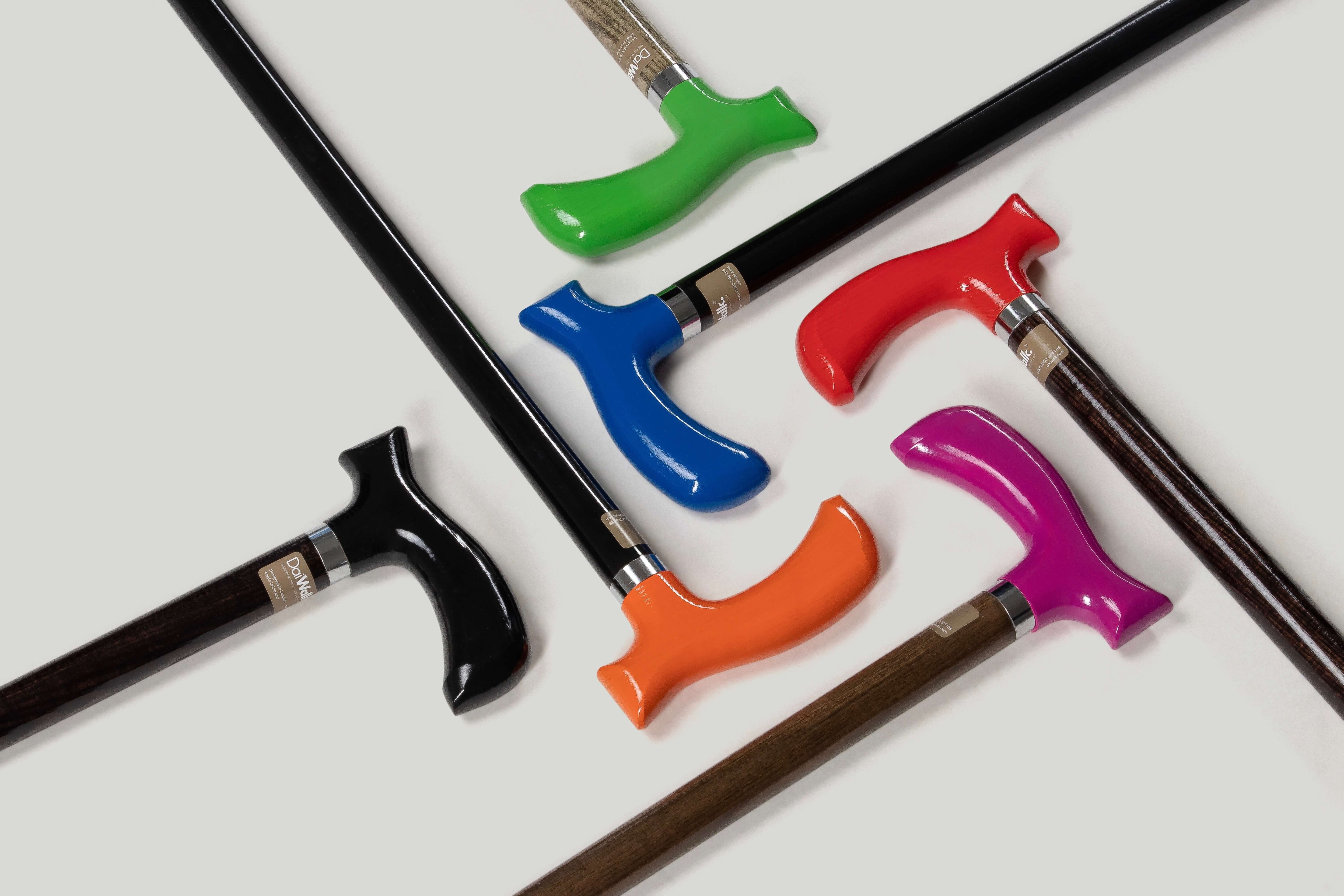
DaiWalk's approach is different. Seven handle colours — none of them gender-assigned — allow female buyers to choose based on their actual wardrobe and aesthetic preference, not a marketing assumption.
Colour choices from our female customer base:
| Handle Colour | % of Female Buyers | Primary Wardrobe Context Cited |
|---|---|---|
| Stealth Black | 28% | Versatility — works with everything |
| Fuchsia | 22% | Warm tones, neutrals, statement use |
| Vibrant Orange | 18% | Earth tones, contrast with neutrals |
| Deep Blue | 14% | Professional contexts, denim |
| Forest Green | 10% | Natural palette, outdoor contexts |
| Vibrant Red + Traffic Yellow | 8% | High-contrast, deliberate statement |
The full colour palette is in the Colorful Walking Canes collection. Every colour is available across all handle materials — oak, wenge, and alloy.
The Lanyard Question: Hands-Free Carrying
Female users in our customer data raise the carrying question more frequently than male users — specifically the problem of managing a cane while carrying a bag. The cane occupies one hand; the bag occupies the other. The combination requires constant management at doors, counters, and public transport.
The DaiWalk leather lanyard resolves this. It loops through the handle and around the wrist, allowing the cane to hang freely at the side when not in active use — hands free, cane accessible, no surface required to lean it against. Available in natural, cognac, and dark brown full-grain leather.
Specific Conditions: What Female Users Most Frequently Cite
The most common conditions cited by female DaiWalk buyers at point of purchase:
| Condition | Key Design Variable | DaiWalk Response |
|---|---|---|
| Rheumatoid arthritis | Grip force, handle pressure, weight | Anatomic Grip™, textured surface, lightweight alloy shaft |
| Hip replacement recovery | Height precision, shaft stability | Collet mechanism, 0mm play, millimetre-precise height |
| Fibromyalgia / CFS | Cane weight, handle fatigue | Ultralight alloy shaft, low grip-force handle |
| Hypermobility (EDS/HSD) | Wrist support, lateral stability | Anatomic Grip™ palm shelf, zero-rattle shaft |
| Osteoporosis (fall prevention) | Tip traction, shaft rigidity | Steady or Hex Tip, collet mechanism |
For wrist-specific conditions and how handle geometry interacts with them: Why Your Walking Cane Hurts Your Wrist — and How to Fix It. If a cane already hurts your hand, the free wrist pain checker helps pinpoint why.
The POP™ Series: When the Cane Is a Statement
For female buyers who want no ambiguity — where the cane is explicitly a design object rather than a medical tool carried reluctantly — the DaiWalk POP™ series exists.
Each POP™ cane is individually hand-painted. No two are identical. The design language is deliberate and visible — the opposite of institutional. Starting at $137.
The Right Configuration for Female Daily Use
| Use Pattern | Recommended Configuration |
|---|---|
| Under 155cm, indoor primary | Original 1.0™, oak or alloy handle, Elegant Tip, minimum height setting confirmed via calculator |
| Active lifestyle, outdoor and urban mixed | Original 1.0™, wenge handle, Steady Tip + Hex Tip |
| Arthritis or low grip strength | Original 1.0™, textured Anatomic Grip™, Core Tip, lanyard |
| Style priority, daily use | Original 1.0™, Fuchsia or Orange handle, Elegant Tip + leather lanyard |
| Maximum statement | POP™ series, individually painted, Steady or Elegant Tip |
Every DaiWalk configuration — including the full height range, handle material options, and tip selection — is on the product page. The 3D configurator renders your combination before you order. The Cane Height Calculator confirms your setting before you buy.
Not sure where to start? The free walking cane finder matches a configuration to how and where you walk in under a minute.
Related Reading
- Walking Cane for Men: What to Look For Beyond the Basics
- Walking Canes and Style: How to Carry Yours With Intention
- Why Your Walking Cane Hurts Your Wrist — and How to Fix It
- Walking Cane Buying Guide 2026: What No One Tells You
Handle pressure mapping data from DaiWalk internal testing across hand sizes 165–225mm grip circumference. Colour preference data from female DaiWalk customer orders. Condition data from pre-purchase customer consultations (n=58 female buyers).


