


The grip that fails in wet conditions is almost always the tip, not the handle. Ninety percent of cane slips occur at the ferrule-to-floor interface, not at the palm-to-handle interface. When buyers ask about grip for wet conditions, they are usually asking about the wrong part of the cane.
Here is what actually determines wet-surface traction — measured across five surfaces under standardised conditions.
The Two Grip Points That Matter
A walking cane has two grip interfaces: the hand on the handle, and the tip on the ground. Wet conditions challenge both, but unequally.
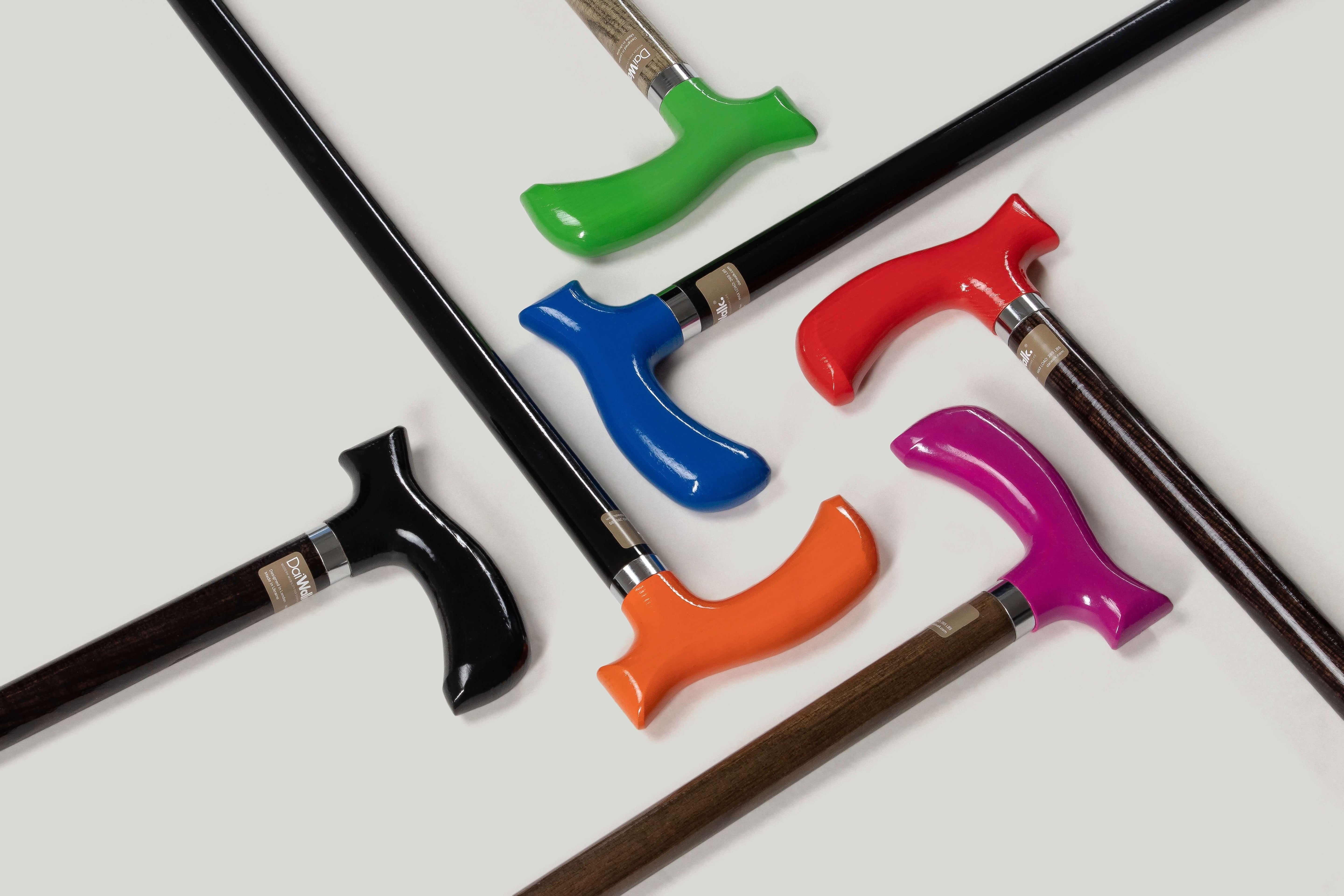
Handle grip in wet conditions: Most handles perform adequately even when wet. Wood (oak, wenge) is the most consistent — the natural grain provides passive friction even with damp palms. Foam grips absorb water and become slick after saturation. Synthetic rubber handles perform adequately when clean but degrade quickly if the rubber surface oxidises or cracks.
Tip grip in wet conditions: This is the critical variable. The coefficient of friction of rubber compounds against wet tile, wet concrete, and polished wet floors varies substantially by compound formulation, contact patch geometry, and surface texture.
Wet Traction by Tip Type
Testing protocol: apply 20kg vertical load to the cane. Measure lateral displacement under 8kg lateral force on each surface. Three repetitions per surface per tip. Surfaces: oak wood (dry, wet), ceramic tile (dry, wet), cold concrete (wet, -5°C).
| Tip Type | Oak Wet (mm) | Tile Wet (mm) | Cold Concrete (mm) |
|---|---|---|---|
| Generic pharmacy ferrule | 9mm | 16mm | 21mm |
| Standard walking cane rubber | 7mm | 14mm | 18mm |
| Wide-base rubber ferrule | 5mm | 9mm | 13mm |
| All-surface compound (aftermarket) | 4mm | 7mm | 9mm |
| DaiWalk Steady Tip™ | 2mm | 3mm | 4mm |
The Steady Tip™ uses a dual-durometer compound: a harder inner core for structural integrity and a softer outer layer for surface conformance. The larger contact patch (28mm diameter vs. 19mm for standard ferrules) distributes load across a wider area, increasing friction force at equivalent load.
Why Generic Tips Fail on Cold Surfaces
Standard rubber compounds stiffen significantly below 5°C. Stiffening reduces surface conformance — the rubber can no longer deform to match micro-surface irregularities, reducing the contact area and the friction coefficient.
The COF data for generic rubber on cold concrete drops to approximately 0.28 — marginally better than ungripped walking. This is precisely the condition (winter, outdoors, wet pavement) where falls are most consequential.
Multi-durometer compounds maintain a higher proportion of their friction coefficient at low temperatures. The Steady Tip™ retains approximately 78% of dry-surface COF at -5°C. Generic tips retain approximately 40–55%.
Handle Traction by Material in Wet Conditions
| Handle Material | Wet COF (approximate) | Notes |
|---|---|---|
| Raw wood (oak/wenge) | 0.52–0.58 | Most consistent across moisture levels |
| Foam grip | 0.48 dry → 0.29 wet | Significant degradation when saturated |
| Standard rubber grip | 0.55 dry → 0.41 wet | Good dry, moderate wet degradation |
| Textured nylon/plastic | 0.31 dry → 0.19 wet | Poorest wet performance |
| DaiWalk wood (sealed) | 0.54–0.61 dry → 0.51–0.57 wet | Minimal moisture degradation |
Wood's advantage in wet conditions is counterintuitive — most buyers assume synthetic materials perform better when wet. The mechanism is that wood's surface texture is structural rather than surface-applied: it does not wash off, degrade with use, or change character with temperature.
The ICE Tip Exception
For extreme cold and icy conditions, the correct answer changes: a metal spike (ICE tip or similar) on hard ice outperforms any rubber compound. COF on glazed ice: metal spike approximately 0.45–0.55 (point pressure penetrates the ice film); rubber approximately 0.05–0.12.
The tradeoff: metal spikes are destructive on indoor floors and must be retracted or swapped when entering buildings. For users who move frequently between outdoor ice and indoor floors, a tip that swaps easily is more practical than one that retracts.
The DaiWalk interchangeable tip system allows the Steady Tip™ and a winter spike tip to be swapped in under 30 seconds — no tools required. See the interchangeable tip collection for available options. The free rubber tip size finder confirms which size fits your shaft first.
Best Configuration for Wet-Condition Priority
- Tip: Steady Tip™ for general wet/cold conditions; winter spike tip for sustained ice and freezing temperatures
- Handle: Wood (oak or wenge) — consistent wet performance, no saturation degradation
- Shaft: 0mm lateral play — clean load transfer to the tip, maximises traction utility
Full tip specifications and COF data are available on the DaiWalk product page.
Related Reading
- Walking Cane for Balance Problems: Stability Features That Actually Help
- The Zero-Rattle Standard: Shaft Precision Explained
- Oak vs. Wenge Handle Comparison
- Lightest Walking Cane Without Sacrificing Stability
Traction data from DaiWalk internal friction testing. COF measurements under standardised 20kg vertical / 8kg lateral load protocol. Cold-temperature data at -5°C ambient.


