


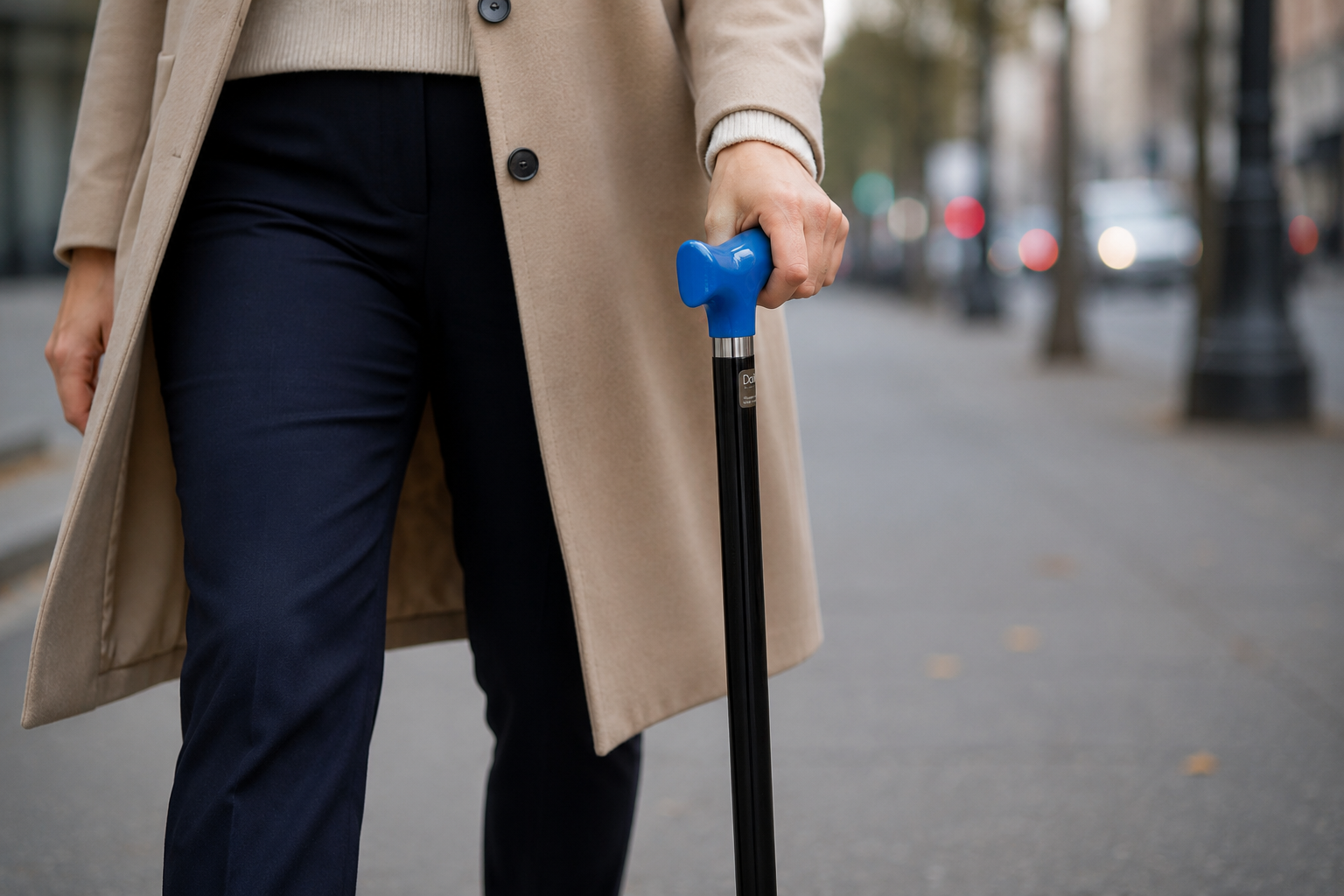
Most people wait too long. They notice the unsteadiness, the hesitation at the top of the stairs, the way they reach for walls in unfamiliar places — and they file it under "getting older" or "having a bad week." Then one fall changes everything.
A mobility aid — whether a walking cane, a rollator, or a forearm crutch — is not an admission of weakness. It is a precision tool. Used at the right time, it reduces joint load, prevents falls, and lets you keep doing the things that matter. Used too late, it becomes reactive care rather than preventive freedom.
This guide covers five specific, observable signs that indicate it is time to start using a mobility aid. Not vague feelings. Not age thresholds. Concrete signals — and what to do once you recognise them.
Older adults in the US experience approximately 36 million falls annually, according to the CDC.
A correctly fitted walking cane offloads up to half the pressure on an affected hip or knee during gait.
People who delay using a prescribed mobility aid have approximately three times the injury risk of those who use one consistently.

Sign 01
01You Are Having Frequent Near-Falls or Balance Episodes
A near-fall — also called a stumble, a lurch, or a "catch" — is when your body loses balance and you recover, usually by grabbing something, stepping wide, or lurching into a wall. Most people dismiss these as embarrassing but minor. They are not.
Near-falls are the strongest predictive indicator of a future serious fall. Research from the British Geriatrics Society consistently shows that people who report two or more near-falls in a six-month period are at dramatically elevated risk for a fall resulting in fracture or hospitalisation. The near-fall is the warning — not the event itself.
What counts as a near-fall? Reaching for a wall or furniture to stabilise. Stumbling on a flat surface. Having to widen your stance suddenly to avoid going down. Catching yourself on a door frame going up or down stairs. Any moment where you said — or thought — "that was close."
Near-falls happen for different reasons: inner-ear issues, reduced proprioception (the body's sense of its own position), muscle weakness, medication side-effects, or neurological conditions. A walking cane addresses the outcome regardless of the cause — it widens your base of support and gives your nervous system an additional contact point to reference.
If you have had more than one near-fall in recent months, this sign alone is sufficient reason to start using a cane. You do not need to wait for a diagnosis.
A well-fitted cane prevents falls in two ways: mechanically, by providing a third point of contact that stabilises your base; and neurologically, by giving your proprioceptive system an additional input signal — the ground feedback through the cane shaft — which actively improves balance performance even before you put weight on it.
Studies consistently show that cane users who have received gait instruction have significantly fewer fall events than non-users with equivalent balance deficits. The cane works. The key is correct fit and correct technique — both of which we cover in the DaiWalk guide to using a walking cane correctly.
Sign 02
02You Have Pain That Limits How Far or How Long You Walk
Chronic pain in the hip, knee, ankle, or lower back — particularly pain that intensifies during or after walking — is a direct indicator that your joints are under more load than they can currently manage comfortably. A mobility aid redistributes that load.
The mechanism is well-documented: a walking cane held in the opposite hand to the affected joint transfers a portion of body weight through the arm and shaft, reducing the force through that joint by a measurable margin. Clinical data suggests reductions of 30–50% in joint contact force during gait, depending on the individual's technique and anatomy.
Important distinction
Pain vs. Discomfort — Know the Difference
Mild muscle soreness after exercise is normal adaptation. The pain that signals a mobility aid may be needed is different in character.
- Pain that begins within the first few minutes of walking, not after prolonged effort
- Pain that persists after stopping, rather than resolving quickly with rest
- Pain that causes you to alter your gait — limping, favouring one side, taking shorter steps
- Pain that is consistent across days rather than only occurring after unusual exertion
- Pain accompanied by swelling, stiffness after rest, or grinding sensations
The important point here is that walking with altered gait to compensate for pain — limping, leaning, shortening your stride — creates secondary damage over time. You protect one joint by overloading another. A correctly used cane eliminates the need to compensate, which is why physiotherapists routinely recommend them alongside treatment rather than as a last resort.
Using your cane correctly is as important as having one. Incorrect technique — wrong hand, wrong height, wrong rhythm — can create new strain patterns rather than relieving them. Read our guide on how to use a walking cane correctly to avoid back pain before your first walk.
Read the technique guide →
Sign 03
03You Are Avoiding Activities Because of Fear or Uncertainty
This sign is the most psychologically significant — and the most commonly overlooked. It does not show up as pain or as a visible event. It shows up as a decision: not to go to that dinner, not to take that walk, not to visit that museum, because you are not confident you will manage the terrain.
This is avoidance behaviour, and it is one of the most reliable early indicators that your body is already compensating for reduced stability. The problem with avoidance is that it compounds. Reduced activity leads to muscle loss and reduced proprioception, which worsens balance, which increases avoidance. It is a compressing spiral — and it often goes unnoticed until the restriction has become serious.
Outdoor spaces
Avoiding cobblestones, uneven paving, slopes, or outdoor dining with step access.
Social events
Declining invitations that involve standing for long periods, unfamiliar venues, or significant walking.
Stairs & inclines
Opting for lifts exclusively, taking escalators over stairs, or planning routes specifically to avoid gradient.
Wet or dark surfaces
Not going out in rain, avoiding car parks, or feeling anxiety on polished floors.
Travel
Stopping short trips or holidays due to uncertainty about managing airports, stations, or unfamiliar ground.
Being alone
Only leaving the house with someone else present — just in case something happens.
A walking cane does not merely address the physical risk — it addresses the psychological restriction. People who begin using a cane consistently report that they return to activities they had abandoned, not because the cane makes them physically stronger overnight, but because it removes the uncertainty. Confidence in your next step changes what steps you are willing to take.
The stigma question. A significant number of people — particularly younger adults and those who do not identify as "disabled" — delay using a cane specifically because of how they believe it will look. This is a real concern, and it is one DaiWalk was founded to address. A cane can be a considered, well-designed object that reflects your identity rather than erasing it.
Read: Redefining the walking cane →Sign 04
04You Have Had Surgery, a New Diagnosis, or Are in Rehabilitation
This is the clearest clinical indicator — and yet it is often resisted. Hip replacement, knee replacement, ankle reconstruction, spinal surgery, stroke recovery, Parkinson's diagnosis, multiple sclerosis, and a wide range of neurological and musculoskeletal conditions all have mobility aid use as a standard component of the recommended care pathway.
If a surgeon or physiotherapist has recommended a walking aid and you are not using one, or have stopped using one earlier than advised, this sign applies directly.
| Condition / Event | Typical Aid | Duration | Common Reason for Delay |
|---|---|---|---|
| Hip or knee replacement | Crutches → cane | 6–12 weeks post-surgery | "I feel fine already" |
| Stroke recovery | Quad cane or standard cane | Ongoing, varies by severity | Denial or pride |
| Parkinson's disease | Walking cane or rollator | Ongoing, progresses | Stigma or identity resistance |
| Multiple sclerosis | Cane during flares or ongoing | Variable | Fluctuating symptoms create false security |
| Severe osteoarthritis | Walking cane | Chronic management | "It's not that bad yet" |
| Ankle fracture recovery | Crutches → cane | 6–16 weeks | Impatience to return to normal |
Post-surgery, the most common reason people abandon their cane too early is that they feel better than expected. This is a dangerous misread of the situation. Surgical healing occurs over months, not days. Bone integration after joint replacement takes up to a year. The absence of acute pain does not mean the structural work is complete — and falling during this period can undo the surgery entirely.
Follow your clinical team's guidance. When they clear you to stop using the aid, that is the right moment — not when you feel ready.

Sign 05
05Your Posture Has Changed, or You Fatigue Much Faster Than You Used To
This is the subtlest sign — and often the last to be consciously recognised, because it develops gradually. Postural change and disproportionate fatigue during walking are the downstream results of the body compensating over time for balance or pain deficits.
When walking becomes effortful — when it requires more muscular and cognitive attention than it should — the body makes adjustments. You lean forward slightly to shift weight off the affected joint. Your shoulders drop on one side. Your stride becomes asymmetrical. Your pace slows. Each adaptation adds load to structures not designed to carry it, accumulating damage across weeks and months.
People often don't notice their own gait changes because they are gradual. These are signs to look for — or ask someone else to observe:
- Uneven footwear wear — significantly more worn heel or sole on one shoe
- Asymmetric stride — shorter steps on one side, visible even in your shadow
- Forward lean — head and shoulders in front of the hip line when walking
- Arm swing change — one arm swinging less, or arms used for balance rather than natural rhythm
- Toe drag — one foot not clearing the ground cleanly on each step
- Back or hip pain after walking — emerging from secondary compensation rather than primary joint stress
Walking normally is largely automatic — it requires minimal conscious effort once the movement is established. When the body is managing an underlying instability or pain response, walking becomes a partially conscious task: the nervous system is actively monitoring balance, adjusting weight distribution, suppressing pain signals. This is cognitively and physically exhausting in a way that is hard to explain but immediately recognisable.
People describe it as: "I used to be able to walk for an hour without thinking about it. Now I'm tired after twenty minutes." A mobility aid, by addressing the underlying instability, returns some of that automaticity — and with it, the endurance to do more.
Posture and cane technique are connected. An incorrectly fitted cane can create new postural problems — specifically, the forward lean that comes from a cane that is too short, or the shoulder elevation caused by one that is too tall. Read our guide on why the right cane matters beyond function to understand how design and fit interact.
Guide: accessories that support correct posture →Section 07
Which Mobility Aid Is Right for Your Situation?
Not every mobility need calls for the same tool. Understanding the spectrum helps you make an informed choice — and helps you understand when a single walking cane is the appropriate starting point versus when a different aid is warranted.
| Aid Type | Best For | Support Level | Everyday Use |
|---|---|---|---|
| Single walking cane | Balance support, joint offloading, mild-moderate instability | Moderate | Excellent |
| Forearm / elbow crutch | Partial weight-bearing, higher instability, post-surgery | High | Situational |
| Axillary crutches (underarm) | Non-weight bearing, acute injury recovery | Very high | Short-term only |
| Rollator / wheeled walker | Significant balance deficit, prolonged standing, Parkinson's | Very high | Situational |
| Standard walker / zimmer frame | Post-surgery inpatient recovery, severe instability | Maximum | Clinical context |
For the majority of people reading this article — those noticing early signs of instability, managing chronic joint pain, or returning from surgery — a single walking cane is the appropriate first tool. It is the least restrictive, the most socially natural, and the easiest to integrate into daily life.
The question of aesthetics matters here more than many clinical resources acknowledge. A person who finds their cane stigmatising, ugly, or at odds with their identity will not use it consistently. And inconsistent use negates the benefits. The cane you will actually carry is the right cane. Read more about why design matters as much as function when choosing a walking cane.
DaiWalk Approach
A cane you will actually use.
DaiWalk canes are designed for the person who needs functional support but refuses to sacrifice how they move through the world. Ergonomically considered, aesthetically deliberate, built to last.
- Ergonomic handle geometry refined across 70+ tested designs
- Colour options curated to work alongside real wardrobes, not against them
- Interchangeable rubber tips — replace when worn, choose for surface and season
- Wrist strap included — prevents drops, supports correct technique
Section 08
Frequently Asked Questions
No. A walking cane is an over-the-counter mobility aid — you do not need a prescription or clinical referral to purchase or use one. You may want to consult a physiotherapist for guidance on technique and fitting, particularly if you have a specific diagnosis, but you can begin using a cane based on your own assessment of the signs described in this article.
In clinical terms, almost never. The risks of using a cane too early are essentially nil — you may not need it at all times, but using it when you don't strictly need it carries no health cost. The risks of using one too late are significant: falls, fractures, secondary joint damage, and the loss of confidence and independence that compounds over time.
If you are showing any of the five signs described in this article, you are not acting prematurely. You are acting appropriately.
This is the most common concern people raise — and it is based on a misunderstanding of how canes work. A walking cane is not a replacement for muscle function; it is a supplementary tool. People who use canes appropriately can and do stop needing them after recovery from surgery or a specific episode.
Avoiding a cane out of fear of dependency actually leads to the opposite outcome: reduced activity leads to muscle loss and worse balance over time, making you more dependent, not less. Staying active — even with a cane — preserves strength and function better than restricting movement to avoid using a tool.
Functionally, the terms overlap considerably. A walking cane typically refers to a mobility aid designed for daily support, balance, and joint offloading. A walking stick most often refers to outdoor trekking poles. DaiWalk products are designed for everyday urban use and serve both functions — a considered tool for the person who moves through the world, not just through fields.
Stand upright in your usual footwear with your arms relaxed at your sides. The top of the cane should reach the crease of your wrist. At this height, your elbow will form a natural 15–20° bend when you hold the cane — this is the biomechanically optimal angle for load transfer and posture. Find detailed guidance and a sizing reference in the DaiWalk guide to correct cane use.
Not at all. Sports injuries, hypermobility disorders, connective tissue conditions like EDS (Ehlers-Danlos Syndrome), early-onset arthritis, MS, neurological conditions, and post-surgical recovery affect people across all age groups. Among DaiWalk's customers, a significant portion are under 50 and using a cane for functional or preventive reasons.
The idea that canes are exclusively for older adults is a cultural assumption, not a clinical one. The tool is appropriate whenever the need is present — regardless of age.
Yes, for several reasons. A wrist strap prevents the cane from being dropped — particularly important in wet conditions, on stairs, or when the hand tires. It also encourages correct technique: when the strap is fitted properly, the cane hangs from the wrist when not in direct use, making it easier to use handrails or carry items without putting the cane down. Read the DaiWalk guide to choosing a walking cane strap for more detail.


