


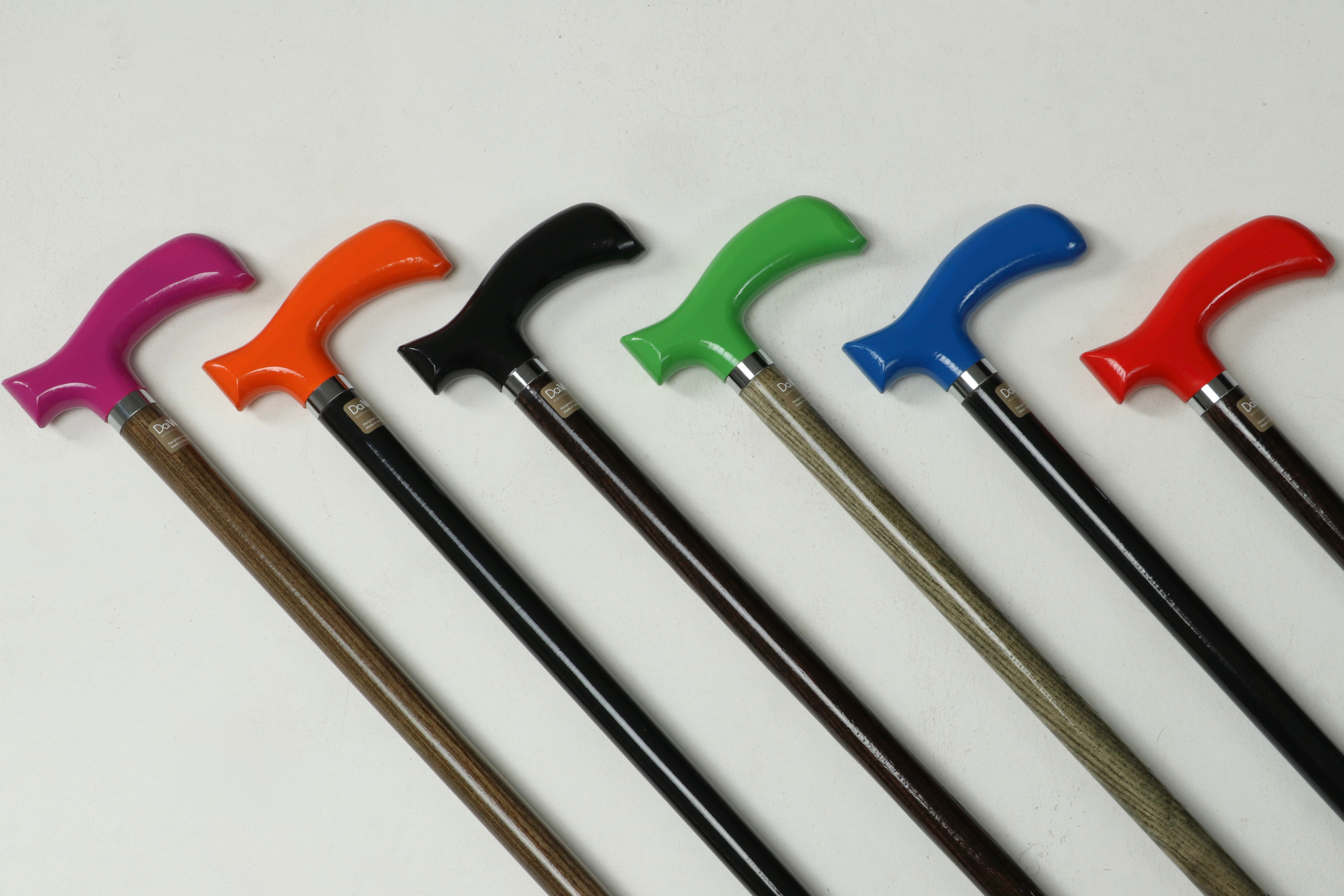
Why Handle Shape Matters More Than You Think
Most people choosing a walking cane focus on height, material, or colour. Rarely does anyone ask: what does the handle do to my wrist? Yet the handle is the single point of contact between your body and the device — every gram of weight you transfer, every step you steady, passes directly through that shape into your hand, wrist, and forearm.
Over the course of a day, a cane user may take thousands of steps. If the handle geometry forces your wrist into even a slight deviation from its neutral position, that repeated micro-stress accumulates. The result can range from mild fatigue to chronic conditions: carpal tunnel syndrome, tendonitis, ulnar nerve compression, or general wrist degeneration. These are not rare complaints — they are among the most frequently reported secondary injuries in long-term cane users.
The good news is that ergonomics research has produced a clear body of knowledge about what handle shapes do and do not do to the human wrist. This article summarises that science in plain terms, compares the main handle categories available today, and gives you a practical framework for choosing the handle that will keep your wrist healthy for years — not just comfortable for a day.
of long-term cane users report wrist or hand discomfort directly linked to handle design, according to occupational therapy surveys.
Beyond 30° of ulnar or radial deviation during grip, load on carpal tendons increases by up to 6× compared to a neutral wrist position.
An ergonomic handle distributes grip force across up to 3× more palm surface area than a standard crook, reducing peak pressure significantly.
Wrist Anatomy and How Load Actually Travels
To understand why handle shape matters, you first need a basic picture of how the wrist works under load. The wrist is not a simple hinge. It is a complex of eight carpal bones arranged in two rows, bridged by a network of ligaments and crossed by tendons that travel from the forearm muscles to the fingers. The carpal tunnel — a narrow channel on the palm side of the wrist — carries the median nerve alongside nine flexor tendons. Compression or repetitive stress here is what causes carpal tunnel syndrome.
When you grip a cane handle and bear weight through it, the load passes through your fingers, across the palm, through the carpal bones, and up the radius and ulna of the forearm. The critical variable is wrist position during load transfer. In a neutral wrist — roughly in line with the forearm, or with a slight 10–15° extension — the carpal bones are aligned so that load distributes broadly across the joint surfaces. The tendons run nearly straight, with minimal frictional stress.
Deviate from that neutral position and things change rapidly. Ulnar deviation (bending the wrist toward the little finger side) is the most common posture forced by traditional crook and T-handles. It narrows the carpal tunnel and creates a shearing force at the base of the wrist. Radial deviation (toward the thumb) is less common with cane handles but similarly damaging. Excessive extension or flexion also increases tendon excursion — the distance tendons must travel to produce finger movement — adding cumulative friction every step.
Key principle: The handle's job is to keep your wrist as close to neutral as possible while allowing you to bear meaningful weight. Any handle that forces consistent deviation is, biomechanically, working against your body.
There is also the question of pressure distribution. A narrow handle concentrates contact force onto a small region of the palm — typically the metacarpal heads at the base of the fingers. This localised pressure can damage superficial nerves (ulnar and median branches) and cause the characteristic numbness and tingling many cane users describe as normal. It is not normal; it is the palm telling you that the handle shape is wrong.
A well-designed ergonomic handle spreads contact across the full palm, including the thenar and hypothenar eminences (the muscular pads at the base of the thumb and little finger). This dramatically reduces peak pressure and fatigue, even when the same total force passes through the hand.

The Main Handle Shapes — and What Each Does to Your Wrist
Walking cane handles fall into five broad categories. Each has a distinct biomechanical profile — some supportive, some genuinely problematic for sustained use. Here is an honest comparison.
| Handle Type | Wrist Position | Pressure Distribution | Best For | Main Limitation |
|---|---|---|---|---|
| Crook (Shepherd's) | Forced ulnar deviation | Concentrated — fingertips & metacarpals | Occasional, light use | High wrist stress in sustained use |
| T-Handle (Derby) | Mild ulnar deviation | Moderate — palm heel & fingers | Moderate daily use | Limited palm surface contact |
| Pistol / Offset | Near-neutral; slight extension | Good — full palm contact | Regular to heavy daily use | Hand-specific (L/R); less decorative range |
| Ergonomic Contoured | Neutral; anatomically matched | Excellent — full palm + thenar pad | Daily use, chronic conditions | Hand-specific; higher cost |
| Ball / Globe | Variable — user-determined | Poor — single contact point | Decorative / occasional use only | No biomechanical benefit; fatigue risk |
Crook handles are the iconic curved shape most associated with walking canes. They are practical for hanging the cane and have a long aesthetic history, but biomechanically they are among the worst options for sustained use. The curve requires the wrist to rotate into ulnar deviation simply to produce forward leverage, and the contact area is narrow.
T-handles and Derby handles are a significant improvement. The horizontal bar provides more palm contact and requires less wrist deviation. For users who walk relatively short distances and carry moderate weight on the cane, a well-fitted T-handle is perfectly adequate. The limitation is that they are symmetric — they do not account for the anatomical asymmetry of the human palm.
Pistol and offset handles represent the first real ergonomic category. The characteristic angled or offset grip allows the weight column of the cane to pass closer to the centre of the palm, aligning load transfer more naturally with the wrist's neutral axis. Many occupational therapists recommend offset handles as the minimum standard for users who rely on a cane daily.
Ergonomic contoured handles take this further by sculpting the grip to match the specific anatomy of either a left or right hand — with a thumb rest, finger grooves, and a palm swell that engages the full hypothenar area. Research on these handle types consistently shows reduced EMG activity in forearm muscles during cane use (indicating less muscular effort to stabilise the grip), reduced peak palm pressure, and lower subjective discomfort scores.
Ball and globe handles are primarily decorative. They offer no consistent wrist positioning and concentrate load on a very small contact area. They are fine for a cane used occasionally as a fashion accessory, but should not be the primary choice for anyone who depends on their cane for stability.
Occupational therapist consensus: For daily cane users, an ergonomic or offset handle is the recommended minimum. The crook handle — despite its cultural dominance — is the option most consistently associated with secondary wrist injury in long-term users.
Read: How to Use a Cane Correctly to Avoid Back Pain →Handle Materials and Their Effect on Grip Comfort
Shape is the primary ergonomic variable, but material has a meaningful secondary effect — particularly in sustained use, temperature extremes, or for users with reduced hand strength or sensory issues.

- Bare hardwood or metal: Traditional and visually elegant, but hard surfaces maximise peak pressure against palm tissue. They also provide no grip friction when hands are wet or sweaty, creating a safety risk. Cold metal conductivity can cause discomfort in winter. Appropriate for occasional, light use.
- Rubber-coated or rubber-sleeved: A common upgrade that significantly improves grip security and provides modest pressure relief through compression. Rubber sleeves on a well-shaped handle are a cost-effective improvement. Degradation over time (stickiness, cracking) is the main drawback.
- Thermoplastic (PVC, ABS, nylon composites): The most common material for ergonomic moulded handles. Rigid enough to transmit force efficiently, but can be shaped into contours impossible to achieve in wood. Moderate thermal properties. Surface texture varies widely — look for matte or micro-textured finishes over smooth gloss, which becomes slippery under load.
- Memory foam or soft EVA padding: Excellent pressure distribution and tactile comfort, particularly for users with arthritis or reduced grip strength. The trade-off is that very soft foam compresses under load, which can subtly reduce proprioceptive feedback — the sensory information your hand uses to judge how much weight you are applying.
- Cork: A traditional material still used in quality Nordic walking poles and some rehabilitation canes. Cork moulds slightly to the hand shape over time, absorbs moisture, and has excellent thermal neutrality. Relatively durable but can crack if dried out.
- Silicone over-moulded: The premium option in many modern ergonomic handles. A rigid core provides structural integrity while a silicone layer offers both grip friction and pressure distribution. Generally the most comfortable material combination for sustained daily use.
Beyond raw material, handle diameter is a frequently overlooked variable. Research on power grip (the grip used when bearing weight on a cane) shows that grip force peaks and comfort is maximised when the handle diameter matches the span of the hand. A grip too thin creates excessive finger flexor tension; a grip too wide prevents the fingers from wrapping fully, reducing mechanical advantage. For most adults, a handle diameter of 32–38mm is optimal for sustained weight-bearing use. Handles outside this range — particularly the very thin shafts of fashion canes — are biomechanically compromised regardless of their material.
How to Choose the Right Handle for Your Wrist
Knowing the categories is useful; knowing which one is right for your specific situation is what matters. The following framework gives you a practical decision path based on your usage pattern and any existing conditions.
- Occasional use (under 1 hour/day, light weight-bearing): A quality T-handle or Derby in the correct diameter is adequate. Focus on fit and material — avoid thin metal or bare hardwood if comfort is a concern.
- Moderate daily use (1–4 hours/day, meaningful weight-bearing): An offset or pistol-grip handle is the recommended minimum. If you are buying one cane to use regularly, do not accept a crook handle as your primary option.
- Heavy daily use (4+ hours/day, significant weight-bearing): An ergonomic contoured handle designed for your dominant hand is the correct choice. The investment is meaningful — ergonomic handles typically cost more — but the alternative is progressive wrist damage that compounds over months and years.
- Existing wrist conditions (carpal tunnel, arthritis, tendonitis): Consult an occupational therapist before purchasing. The general recommendation is a large-diameter, soft-coated ergonomic handle, potentially with a wrist strap to reduce grip intensity. See our guide to choosing a cane strap for details on how strap support can modify wrist load.
- Reduced hand strength (post-stroke, neuromuscular conditions): A thicker-grip ergonomic handle with high-friction material is typically best. The goal is to minimise the grip force required to maintain control. Wrist straps become especially important to prevent drops.
- Style-conscious users who want both aesthetics and function: This is a genuinely underserved category. The assumption that ergonomic handles must look clinical is outdated — modern cane design has produced handles that are both biomechanically sound and visually refined. Do not accept the false choice between function and form.
A note on second opinions: If you have been using a cane for more than six months and experience wrist fatigue, numbness, or pain — even mild — this is not something to accept. These are signals from your body that the load path is not working. An occupational therapist can assess your grip pattern and recommend specific handle types in a single session. Most mobility aid users have never had this conversation.
Once you have identified your handle category, there are two final checks before buying. First, verify the handle-to-shaft connection is rigid — flex at this joint wastes energy and introduces lateral stress at the wrist. Second, confirm the handle can be fitted at the correct height: your elbow should be at approximately 15–20° of flexion when you hold the cane with your arm naturally extended at your side. An ergonomic handle on a cane set to the wrong height offers far less benefit than its design promises.
For more on setting cane height and walking technique, see our article on how to use a walking cane correctly to avoid back pain.
Accessories That Complete the Ergonomic System
The handle is the most important ergonomic variable, but it does not operate in isolation. Two accessories have a direct biomechanical effect on how load passes through your wrist: wrist straps and tip design.
Wrist straps are among the most underappreciated cane accessories. A properly fitted strap transfers a portion of the cane's weight and resistance to the wrist and forearm, reducing the grip force the fingers must generate to maintain control. This is significant: grip strength is often the limiting factor in sustained cane use, particularly for older adults or those with hand conditions. A strap can effectively extend comfortable use time and reduce cumulative finger and palm fatigue.
There is a secondary safety benefit: if you stumble or lose your grip, the strap prevents the cane from falling away. This is particularly relevant on stairs or uneven terrain — topics covered in our article on walking cane safety on stairs.

Tip design affects ergonomics indirectly but meaningfully. A worn, hard, or narrow tip increases the energy transmitted through the cane shaft on impact — particularly on hard floors. This vibration travels up the shaft to the handle, where it is absorbed by the hand and wrist. A high-quality rubber tip with appropriate hardness and contact area damps this transmission significantly. Users on hard flooring (offices, tile, stone) or who walk at pace will notice the difference between a quality tip and a cheap one.
Interchangeable tip systems — where the tip can be swapped for different surfaces or replaced when worn — ensure the cane's ground contact never degrades. A worn tip is not just a traction risk; it is an ergonomic one. Explore our range of interchangeable tips designed to maintain consistent ground contact across all surfaces.
Ergonomic thinking applies to the whole cane — not just the handle. A well-designed handle paired with a worn tip on a cane set to the wrong height is still a compromised system. The components work together; optimise all of them.
Explore DaiWalk Accessories →Frequently Asked Questions
For occasional or light use, a crook handle is not inherently dangerous. However, for sustained daily use — particularly if you are bearing meaningful body weight on the cane — the crook's geometry consistently forces the wrist into ulnar deviation, which increases carpal tunnel pressure and tendon stress. Over months and years, this produces measurable cumulative damage in a significant proportion of users. If you rely on a cane daily, a T-handle, offset, or ergonomic handle is strongly preferable from a joint health perspective.
An offset handle shifts the point of hand contact forward relative to the cane shaft, so that load passes more directly under the centre of the palm rather than the fingertips. This reduces wrist deviation and improves load distribution compared to a crook or standard T-handle. An ergonomic contoured handle does all of this and additionally sculpts the grip surface to match the anatomy of either a left or right hand — incorporating a thumb rest, finger grooves, and a full palm swell. Ergonomic handles are more expensive and hand-specific, but offer the greatest biomechanical benefit for heavy daily users.
Yes — when fitted correctly. A wrist strap allows the forearm to share a portion of the stabilising load with the fingers, reducing the grip force required. Research on trekking and Nordic walking poles (which use similar strap systems) shows that appropriate strap use can reduce grip force by 20–30%. For cane users, this translates to reduced finger flexor fatigue, lower peak palm pressure, and the ability to sustain comfortable use for longer periods. The key is correct strap adjustment: too loose provides no benefit; too tight creates its own compression issues at the wrist. Explore the range at DaiWalk accessories.
Prolonged use of a handle that forces sustained wrist deviation — particularly ulnar deviation — is a recognised risk factor for carpal tunnel syndrome and other repetitive strain conditions. The mechanism is the same as in occupational carpal tunnel: repeated or sustained compression of the median nerve within the carpal tunnel, caused by a non-neutral wrist position. It is unlikely that occasional cane use with a suboptimal handle will cause carpal tunnel in a previously healthy wrist. However, for someone already predisposed (women, those with diabetes, hypothyroidism, or a family history), or for heavy daily users, handle geometry is a clinically meaningful variable. If you have existing symptoms — numbness, tingling, weakness in the thumb or first two fingers — discuss handle selection with your GP or an occupational therapist.
The clearest signals are: wrist or hand fatigue that develops within the first hour of use; numbness or tingling in the palm or fingers during or after walking; pain at the base of the thumb or little finger; and a tendency to readjust your grip repeatedly during use (a sign that no grip position feels comfortable). Compare your symptoms with the pattern of use — if they appear consistently when using the cane and resolve with rest, the handle is almost certainly contributing. Photograph your grip while using the cane (or ask someone to): if your wrist is visibly deviated rather than approximately in line with your forearm, that is a concrete indicator that the handle geometry is not suited to your anatomy.
Yes. This is one of the more significant developments in cane design over the past decade. The assumption that ergonomic equals clinical or institutional is outdated. A number of modern cane makers — including DaiWalk — have developed handles that incorporate genuine ergonomic geometry within aesthetically considered forms. The key is looking beyond the traditional medical supply channel, where functional design has historically been prioritised over aesthetics, into the growing space of designer mobility aids. You should not have to choose between a handle that looks good and one that protects your wrist. Read more on this in our article on the difference between medical and designer canes.
The DaiWalk Original is engineered with handle geometry that keeps your wrist in a neutral load-bearing position — without compromising on design.


