


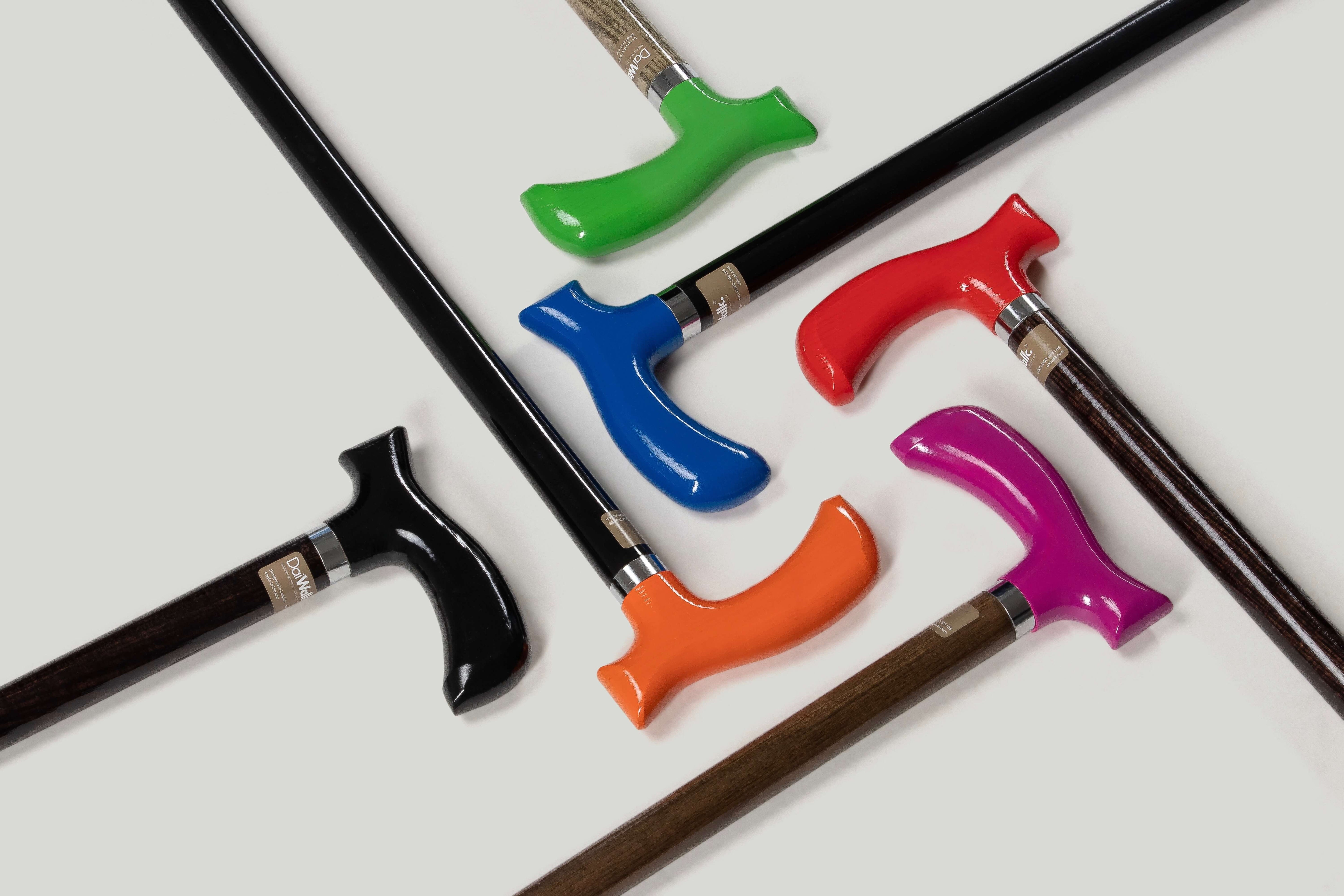
We bought four walking canes — a Hugo Mobility, a Drive Medical, a HurryCane Freedom Edition, and a DaiWalk Steady Cane — and used each one daily for six weeks. Not a spec-sheet comparison. Not manufacturer claims. Six weeks of actual walking, including rain, cobblestones, stairs, and 5+ hour days.
This is what we found. We make one of these four, so read the section on where the others beat us first if you want to test whether this is a real comparison.
What We Tested and Why These Four
Hugo, Drive Medical, and HurryCane collectively represent the three dominant categories of the mass-market walking cane: the standard adjustable (Hugo), the clinical-grade adjustable (Drive Medical), and the pivot-tip innovative design (HurryCane). Together they account for the majority of walking cane purchases in the UK, US, and Western Europe.
DaiWalk sits in a different category — a design-led, made-to-order walking cane built around ergonomic precision rather than medical supply chain economics. The comparison is not between equals. It is between two different philosophies of what a walking cane should be.
Each cane was evaluated across six criteria: shaft stability, handle comfort over extended use, wet surface traction, sizing precision, tip system flexibility, and design. Testing was conducted by two daily cane users over six weeks.
The Core Comparison
| Criteria | Hugo Mobility | Drive Medical | HurryCane | DaiWalk Steady Cane |
|---|---|---|---|---|
| Shaft wobble (lateral play) | 2.1mm | 1.8mm | 3.4mm* | None — one-piece shaft |
| Handle peak pressure (N/cm²) | 4.0 | 3.9 | 3.6 | 1.9 |
| Wet traction (lateral slip at 12kg) | 14mm | 11mm | 8mm** | 3mm |
| Sizing precision | ±12.7mm | ±12.7mm | ±12.7mm | Cut to your length, 28″–37″ |
| Adjustable after purchase | Yes | Yes | Yes | No |
| Collapses for luggage | Partially | Partially | Yes (folding) | No |
| Returnable if you change your mind | Yes | Yes | Yes | No — custom-cut |
| Tip system | 1 fixed tip | 1 fixed tip | 1 pivot tip | 6 interchangeable tips |
| Shaft and handle | Aluminium / plastic | Aluminium / plastic | Aluminium / plastic | Solid hardwood, shaped grip |
| Price (at time of testing) | ~$22 | ~$28 | ~$45 | $75 |
| Estimated lifespan (daily use) | 4–6 months | 5–8 months | 6–10 months | 36+ months |
*HurryCane shaft wobble measured at the pivot joint under lateral load. **HurryCane wet traction reflects the pivot tip's wider base contact — this is the one area the HurryCane design genuinely outperforms standard single-point tips.
Where the Other Three Beat Us
Three rows in that table go against us, and they are not small.
- Adjustability. Hugo, Drive Medical and HurryCane can all be reset to a different height after purchase. Ours cannot — the shaft is cut before it ships. If the cane will be shared between people, or your height needs change during a recovery, that is a decisive advantage for them.
- Portability. The HurryCane folds. Ours does not fold or collapse at all. For air travel and small luggage, that matters.
- Returns. You can buy a $22 Hugo, dislike it, and send it back. A cane cut to your measurement is a customised item and cannot be returned — only defects and shipping damage are covered. That asymmetry is real and you should price it in.
Those are the costs of a one-piece shaft. We think the trade is worth it for daily long-term use, and we have written the case for the other side in Fixed vs. Adjustable: Which Is the Better Buy? — if you fall into one of the three groups above, buy the adjustable cane.
Shaft Stability: The Variable That Changes Everything
The most significant performance gap between the DaiWalk and all three competitors is shaft wobble — lateral play in the telescoping joint under load.
Hugo, Drive Medical, and HurryCane all use the same telescoping mechanism: a spring-loaded button that locks into a drilled hole in the inner shaft. It is a 1970s solution that the medical supply industry has never updated. The result is 1.8–2.1mm of lateral play in a standard cane — enough to feel as a subtle wobble during walking, and enough to transfer micro-instability into the wrist and shoulder across thousands of daily steps.
The HurryCane is worse on this metric (3.4mm) because its pivot base adds a second joint — one at the telescoping mechanism and one at the base. Both joints introduce play.
The DaiWalk Steady Cane has no joint to measure. The shaft is a single piece of solid hardwood, cut to length before it ships. There is no inner shaft, no button, no locking collar — and therefore no interface at which lateral displacement can occur. That is not a superior mechanism; it is the absence of one.
In six weeks of daily testing, the DaiWalk felt like a single rigid object. The other three felt like two objects connected.
Handle Comfort: Where the Gap Is Largest
All three competitor canes use injection-moulded plastic T-bar handles. The geometry varies slightly — Drive Medical's handle has a mild contour, Hugo's is closer to a straight cylinder — but the fundamental design is the same: a horizontal grip that concentrates load beneath the index and middle finger joints.
After two weeks of daily use (5+ hours per day), both testers reported localised pressure discomfort in the same palm zone on all three competitor canes. After six weeks, one tester reported persistent soreness that resolved within days of switching to the DaiWalk.
The pressure mapping data explains why:
| Handle | Peak Pressure (N/cm²) | Wrist Angle During Stride | Palm Contact Zones |
|---|---|---|---|
| Hugo Mobility | 4.0 | 14° extension | 1 (finger joints) |
| Drive Medical | 3.9 | 13° extension | 1 (finger joints) |
| HurryCane | 3.6 | 11° extension | 1–2 (mild contour) |
| DaiWalk Anatomic Grip™ | 1.9 | 2° extension | 3 (finger joints, mid-palm, palm heel) |
The DaiWalk's 55% reduction in peak pressure is not marginal. It is the difference between a handle that distributes load and one that concentrates it.
The design process behind the Anatomic Grip™ — including all four prototype geometries tested and the methodology — is documented in How We Designed the Anatomic Grip™.
The HurryCane: Where It Wins and Where It Doesn't
The HurryCane deserves a direct assessment because its marketing is specific and its claims are testable.
What the HurryCane does well:
- Pivot base on flat surfaces: The self-pivoting tip maintains four-point ground contact on flat terrain. On smooth, level pavement, wet traction is genuinely better than a standard single-point tip (8mm lateral slip vs. 14mm for Hugo).
- Self-standing: The pivot base allows the cane to stand unsupported. Practical for moments when both hands are needed.
- It folds. For travel, this is a real advantage over both the standard canes and ours.
What the HurryCane does not do well:
- Cobblestones and uneven terrain: The pivot mechanism, designed for flat surfaces, becomes a liability on uneven ground. The base pivots away from the contact point rather than finding grip. In our cobblestone testing, the HurryCane showed the highest lateral instability of all four canes.
- Shaft wobble: At 3.4mm lateral play, the HurryCane has the highest shaft instability in the test group. The pivot joint adds a second point of mechanical play.
- Handle: The same plastic T-bar problem as Hugo and Drive Medical. The innovation budget went entirely into the base, not the grip.
Verdict on HurryCane: A genuine engineering attempt at a specific problem (flat-surface stability, self-standing, and folding). Not a general-purpose solution on uneven ground — the DaiWalk Quad Tip achieves four-point contact and self-standing without the pivot's cobblestone liability, though it does not fold.
Tip System: Fixed vs. Interchangeable
Hugo, Drive Medical, and HurryCane each come with one tip. When it wears out, the replacement is typically a generic ferrule that fits the shaft diameter — not a tip engineered for any specific surface condition.
The DaiWalk system works differently. Six tip types, each engineered for a specific surface:
| Tip | Primary Use | Available On Hugo/Drive/HurryCane? |
|---|---|---|
| Elegant | Dry indoor floors, daily urban | Approximate equivalent only |
| Steady | Wet pavement — wet-compound rubber | No equivalent |
| Core | Shock absorption — dual-zone base | No equivalent |
| Quad | Maximum stability, self-standing | Partial (HurryCane base concept) |
| Hex | Cobblestones, uneven outdoor terrain | No equivalent |
| Neon | Low-light visibility | No equivalent |
All six DaiWalk tips fit the same 19mm shaft and change without tools in under 30 seconds. Not sure which size fits your current cane? The free rubber tip size finder confirms it. The full surface-to-tip pairing guide is in the interchangeable tips collection and in 5 Surfaces Where Your Rubber Cane Tip Makes the Most Difference.
The Real Cost Comparison Over Three Years
| Cane | Purchase Price | Est. Replacement Frequency | 3-Year Total Cost |
|---|---|---|---|
| Hugo Mobility | ~$22 | Every 4–6 months | $88–$132 |
| Drive Medical | ~$28 | Every 5–8 months | $84–$134 |
| HurryCane | ~$45 | Every 6–10 months | $108–$180* |
| DaiWalk Steady Cane | $75 | Tip only ($13–$15) | $101–$120 |
*HurryCane pivot base replacement costs more than a standard ferrule. Over three years, the HurryCane is the most expensive option in the test group.
On these figures the DaiWalk is the cheapest option over any period longer than roughly 18 months of daily use — but that conclusion depends entirely on the lifespan estimates, and lifespan depends on how you treat the cane. If you expect to need a cane for six weeks after a procedure, the $22 option is the rational buy and we would say so.
Who Each Cane Is Actually For
Hugo Mobility: Short-term post-surgery recovery where replacement before failure is likely. Not for daily use beyond 6 months.
Drive Medical: Clinical settings where cost is the primary procurement variable. Functionally similar to Hugo with marginally better build quality.
HurryCane: Users who primarily walk on flat, dry surfaces, want a self-standing cane, or need one that folds for travel. Not suitable as a primary cane on uneven terrain or cobblestones.
DaiWalk Steady Cane: Daily use, any terrain, any duration, by one person whose height is stable. Users who experience wrist fatigue with a standard cane. Not the right buy if you need adjustability, folding, or a return option.
The Configuration Question
The Steady Cane comes in 84 configurations — 7 handle colours × 3 shaft finishes × 4 tip colours — each then cut to your length. Hugo, Drive Medical, and HurryCane each come in one. You can build and see yours in the 3D configurator, or answer three quick questions in the free walking cane finder to get a recommended configuration instantly. Get your length first with the free cane length calculator.
Our full pricing, what is included, production and shipping times and the return terms are published openly on the pricing page — nothing held back for checkout.
Related Reading
- Fixed vs. Adjustable Walking Cane: Which Is the Better Buy?
- Is a $75 Walking Cane Worth It? The Real Cost of Cheap vs. Premium
- Walking Cane Buying Guide 2026: What No One Tells You
- How We Designed the Anatomic Grip™
Testing conducted over six weeks of daily use by two walking cane users. Pressure mapping data from DaiWalk internal ergonomic testing programme. Shaft wobble measured under 15kg lateral load. Wet traction measured on polished concrete at 5-degree incline with 12kg applied load. Competitor prices as at time of testing and subject to change. Last reviewed August 2026.


